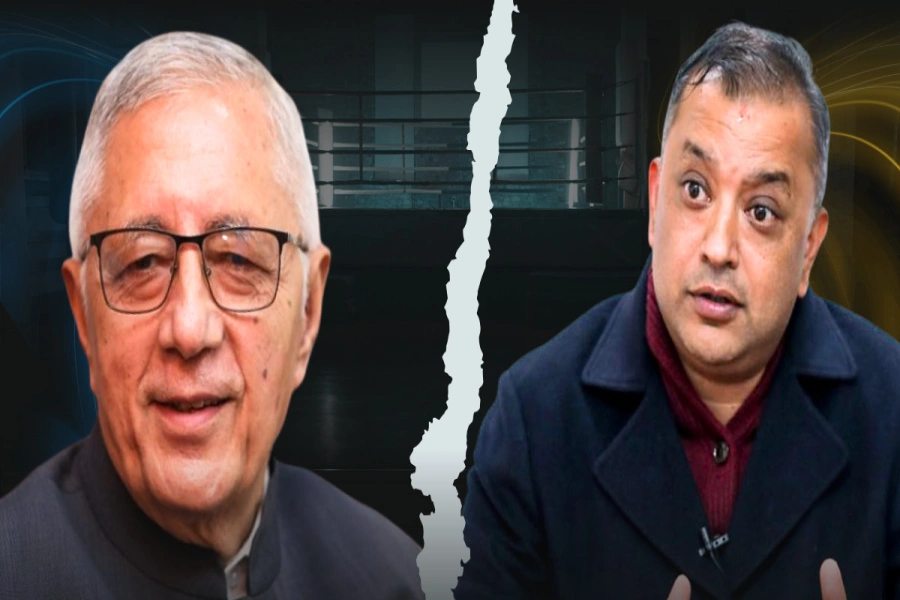
KATHMANDU, Sept. 15: The Nepali Congress (NC) appears headed for another major internal rupture, with party President Gagan Thapa’s establishment faction moving ahead with the 15th General Convention while the faction led by former president Sher Bahadur Deuba urges party leaders and cadres to stay away from the process.
The latest appeals from the two sides have underscored the widening divide in Nepal’s oldest democratic party, with both factions claiming legitimacy and invoking the party’s interests to justify their positions.
Thapa on Tuesday appealed to party leaders, cadres, members, supporters and well-wishers to participate enthusiastically in the convention process, beginning with ward conventions on September 19 and 20. The general convention is scheduled to be held in Kathmandu from October 2 to 5.
He urged party members not to be confused or hesitant, saying the convention was aimed at building a stronger NC.
“I sincerely appeal to all party committees at every level, office-bearers, members, supporters and well-wishers to participate enthusiastically and ensure that the 15th General Convention ... is conducted in a cordial and harmonious environment,” Thapa said.
Thapa also sought to reassure members about the legitimacy of the ongoing process, pointing out that the current Central Working Committee includes members elected by the 14th General Convention. Claiming that internal differences had been resolved, he urged party members to participate in the convention with “high morale.”
After split, NCP rival factions holding separate central commit...

But while Thapa’s faction is moving ahead with the convention process, the Deuba faction has challenged its legitimacy.
In a separate appeal issued Tuesday, Deuba urged party leaders and cadres not to participate in what he described as a convention being organized unilaterally by the faction advocating a special general convention.
Deuba accused the rival faction of proceeding in violation of the party statute, established procedures, traditions and decisions of the Central Working Committee.
“The general leaders, cadres and the Nepali people have yet to receive an answer as to why the ‘illegal special general convention’ was held,” he wrote.
The dispute has also reached the Supreme Court, which is considering the legitimacy of the special convention. Deuba argued that proceeding with the convention process before a final verdict would run counter to the party statute and established legal and constitutional principles.
He said the Supreme Court’s full bench had granted leave for a review, indicating that serious constitutional and legal questions remained unresolved.
Deuba maintained that, as the NC president elected by the 14th General Convention, it was his “legal, political and moral responsibility” to complete the 15th General Convention and hand over party leadership.
Rejecting the suggestion that he was seeking to retain power, Deuba said he had no personal desire for any position but would continue serving the party if his experience was considered necessary.
He also accused the special-convention faction of spreading misinformation that the party could not win elections under experienced leadership, arguing that subsequent election results had disproved such claims.
According to Deuba, holding a convention without the participation of a majority of party leaders and cadres would only weaken the NC when there was still room for consensus. He called on party members and well-wishers to help resolve the differences and prepare for the general convention scheduled for December 7–9.
The conflicting appeals have left the NC facing the prospect of parallel organizational processes. While Thapa’s faction is presenting its convention process as a legitimate exercise to renew the party, Deuba’s camp is challenging it and calling for a separate process.
The immediate test will come with the ward conventions. What was expected to be a routine first step toward organizational renewal could instead become another marker of the deepening divide.
With both sides claiming to represent the party’s institutional interests, the dispute risks turning the 15th General Convention into more than a leadership contest—it could determine whether the NC undergoes another formal split.
Throughout its history, the NC has split twice over internal leadership conflicts. The first split came in April 1953, when Prime Minister Matrika Prasad Koirala was expelled from the party and formed the Rastriya Praja Party. The two sides reunited in 1956. The second split occurred in May 2002, when Sher Bahadur Deuba broke away over the dissolution of parliament and formed the NC (Democratic), which reunited with the NC in 2007. The NC now risks another split if the two factions go ahead with their plans to hold separate general conventions.