

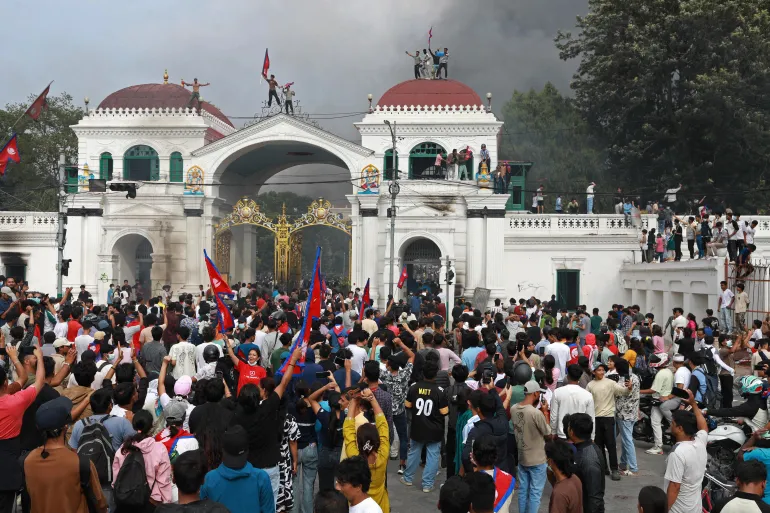
Every revolution begins as an idea before it becomes political fact. History shows that the energy of rebellion is born not from policy, but from philosophy. Nepal’s emerging generation embodies this same restlessness and moral conviction. Disillusioned by decades of political stagnation, corruption, and elite impunity, young Nepalis have ignited a new wave of dissent. Thousands flooded the streets demanding transparency, accountability, and systemic reform. Social media became the central engine of this revolt. It connected the youth across provinces, transforming online frustration into physical mobilization.
These demonstrations have been notably leaderless and nonpartisan, unified less by political affiliation than by a shared rejection of corruption and political decay. This inclusivity would be both their strength and weakness. Movements built on moral solidarity can move the streets but struggle to move the ballot box. Without a disciplined structure, moral energy often diffuses before it consolidates. History is replete with examples of revolts that inspired transformation but failed to institutionalize it, ceding power back to the experienced and entrenched. Nepal’s Gen-Z movement stands at this same precipice. Can a shared moral vision evolve into a coherent political machine?
Modi Magic on the Wane

A parliamentary majority requires 138 seats. Winning these constituencies, particularly the first-past-the-post ones, demands extensive local engagement and networks that reach into the country’s most remote areas. The Maoist insurgency of 1996–2006 shows that moral rebellion alone does not win political power. The Maoists succeeded because they embedded themselves in rural communities, built parallel institutions, and provided localized governance where the state was absent. Revolutions that endure are rarely spontaneous. They are cultivated patiently, village by village, institution by institution. Transforming moral grievance into structural organization took nearly a decade.
This raises a stark question. With elections just over a hundred days away, how could a Gen-Z movement realistically replicate that reach across seven provinces and 165 constituencies? The challenge is not energy or idealism; it is infrastructure, relationships, and the patient labor of building trust at the grassroots. This challenge is compounded by the fact that the movement is running against established parties such as the Nepali Congress, the Communist Party of Nepal, and the Maoist Centre, all of which possess decades-old machinery connecting local bureaucrats, party cadres, and community leaders to ordinary citizens. The difficulty is amplified by the realities of rural Nepal, where political loyalty is often less ideological and more transactional. Support for a party is frequently tied to the delivery of tangible goods—roads, irrigation, schools, health posts, and access to local employment, etc. In areas where malnutrition and poverty persist, abstract ideals like transparency or systemic reform have limited resonance compared to immediate survival needs.
The moral argument for change, while compelling in theory, loses traction in communities where party affiliation can determine whether a family secures essential resources. Coalition-building may be essential for any emerging party. In Nepal’s fragmented political landscape, alliances with sympathetic politicians or minor parties could help convert street legitimacy into parliamentary viability. Yet such coalitions demand negotiation, compromise, and the ability to appeal beyond urban networks. Even if a coalition forms, its capacity to maintain coherence under the pressures of electioneering remains untested. For a Gen-Z movement to transform moral energy into political power, it must navigate entrenched party networks, the material realities shaping voter behavior, and the complexities of coalition politics. Grassroots presence, sustained engagement, and the ability to address concrete needs are prerequisites. Without these, the promise of generational revolt risks remaining an aspirational narrative rather than a force capable of reshaping Nepal’s political landscape.
Yet the significance of Nepal’s Gen-Z movement should not be underestimated. The protests demonstrate the awakening of a generation willing to challenge structural corruption, demand accountability, and envision a political system responsive to citizens rather than entrenched elites. The ideas planted today can redefine discourse, shape future candidates, and create the conditions for lasting change. Early steps toward change are already visible: the formation of an interim government, the establishment of an organization to investigate corruption, and the dissolution of parliament. Yet these measures remain temporary, underscoring that real transformation will require sustained organization, strategic planning, and long-term engagement. Nepal’s Gen-Z movement is at a crossroads. Its energy, courage, and ideological clarity provide hope for a future where youth engagement shapes national governance. The coming months will reveal whether the movement can convert civic revolt into political reality, embedding itself into local communities, winning trust, and ultimately transforming Nepal’s electoral landscape. History teaches us that revolutions are rarely instantaneous. They require patience, strategic planning, and sustained engagement across both urban and rural spheres. Nepal’s Gen-Z has begun the moral awakening, but the hard test of political consolidation lies ahead.
The author earned a Bachelor's degree in Mathematics with minors in Computer Science and Finance from Washburn University, US.


-1784277548.webp)



