

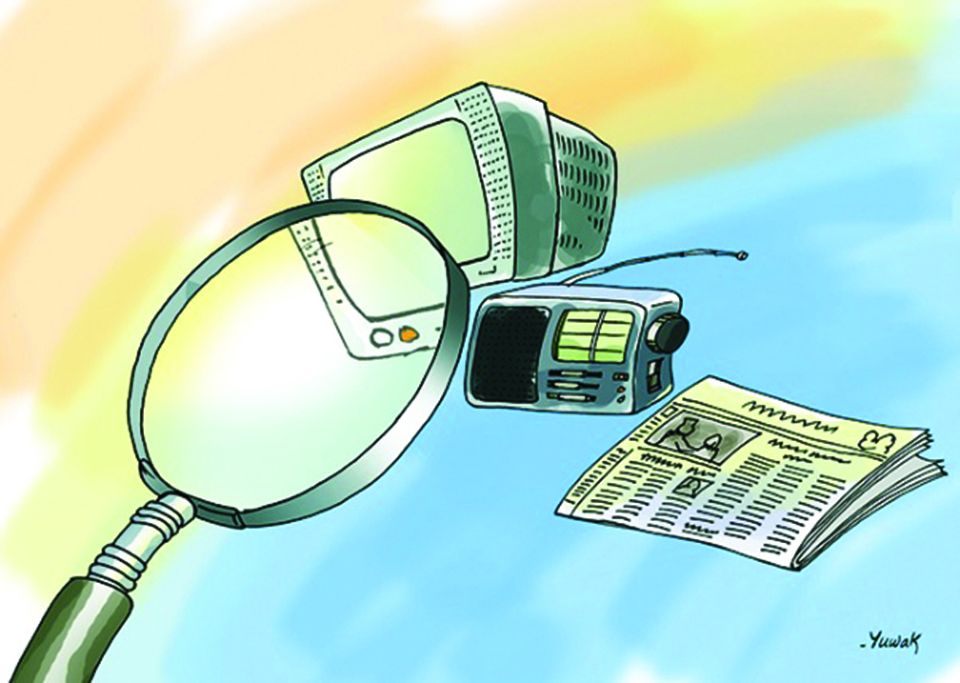
When the three pillars—the executive, legislature, and judiciary—falter, the fourth pillar, the media, must take on an even greater responsibility, with civil society playing a critical role, especially when democracy itself is at risk. The media, tasked with informing and guiding public discourse, must act with accuracy and restraint, while civil society must promote reason over outrage. When they fail in this duty, the consequences of misinformation, sensationalism, and unchecked passions can quickly spiral into deeper political chaos, putting democracy itself in jeopardy. Has our media been responsible enough before the Gen Z uprising? The answer, in part, lies in why the Hilton Hotel was razed.
Beyond state failures, we must ask: is Nepalese media acting responsibly? In today’s digital age, online platforms and influencers wield enormous power, yet many abuse it by spreading misinformation, disinformation, and unverified narratives. While investigations continue into arson and the killing of innocents, the larger question looms: what fueled such anger, and to what extent did distorted media narratives fan the flames? At this critical juncture, confronting media accountability is as essential as restoring public trust in Nepal’s political institutions.
The rise of digital platforms has amplified both responsible journalism and reckless reporting. In Nepal, corruption is a reality, and the media has courageously exposed many cases. Numerous outlets operate with integrity, uncovering wrongdoing, reporting irregularities, and holding those in power accountable. Yet the same media can also shape public perception by labeling certain institutions as tax defaulters or linking them to alleged corrupt politicians. How can such institutions evade taxes if a legitimate government exists to enforce compliance? And if obligations remain unmet, isn’t the failure ultimately governmental? When media coverage distorts facts and channels public outrage, democracy itself suffers—and accountability becomes essential.
Are we a private–public partnership–friendly democracy, or a private-hate society? The arson targeting hotels, supermarkets, foreign-invested companies, private schools, and other properties during the Gen Z uprising revealed deep cracks in Nepal’s ability to balance private enterprise, public institutions, and media influence. Media reports about these institutions may have sparked public outrage. Even if such reports contain elements of truth, truth can never justify arson. These attacks remain criminal acts demanding accountability—from both the protesters and the media that may have provoked them. The government’s Subba-Khardar–style approach to employment generation cannot replace the dynamism and innovation of the private sector. When media narratives vilify businesses without verification, and government oversight is weak, public anger can escalate rapidly into destruction. In a healthy democracy, the media must inform and investigate responsibly—not become a source of suspicion, hatred, or chaos—and civil society must not take pleasure in that hatred.
Brexit day of reckoning: parliament to vote on Johnson's deal

Some users on digital platforms attributed the unrest to external powers, suggesting foreign interference. In a healthy democracy, such claims must rest on verifiable evidence—but no intelligence reports supported these assertions. Responsible journalism and public discourse require that every claim—especially those implying foreign involvement—be rigorously substantiated. In reality, the root of the problem lay closer to home: inefficiency, poor governance, corruption, and public indifference created fertile ground for unrest. A well-functioning government leaves little or no room for external interference; when domestic institutions falter, the nation itself becomes vulnerable.
The irony is that Nepal has long been governed by leaders with limited formal education in governance and economic development. Many rose to power from movements of conflict and insurrection, carrying the instincts of revolution rather than the skills of administration. Their experience in political struggle offered historical insight and party legacy but little understanding of governing a modern economy or navigating a digitally connected society. To their credit, they recognized that sections of the media were acting irresponsibly and spreading misinformation. Yet, they lacked the tools and knowledge to address the issue constructively. They understood that the media must be responsible, accountable, and unfettered—but failed to realize that the government itself bears the same responsibility.
Post–Gen Z, Nepal faces a fragile political landscape: a weak and temporary government, fractured democratic institutions, if not collapsed, low morale of law enforcement agencies, and questionable credibility of the judiciary. In this environment, the role of the media becomes even more critical. If it turns negative, sensationalist, or irresponsible, the nation risks repeating the chaos of the uprising—another disaster waiting to unfold.
Nepal’s media has closely watched crises in Bangladesh and Sri Lanka, warning that similar chaos could strike at home. Yet it seems to have learned little. In Bangladesh, journalists faced investigations and lost accreditation for spreading false news during unrest. In Sri Lanka, strict laws punished fake news and hate speech with jail and fines after the 2019 Easter attacks. These examples are a stark warning: unchecked media irresponsibility can destabilize societies—and Nepal cannot afford to ignore it.
The media wields immense power to inform, guide, and protect the public, but it must ensure that freedom does not slide into recklessness. Professionals, educators, and public figures also bear responsibility, leading by example to foster civic discipline and truth-based discourse. Without collective vigilance and ethical commitment, even free elections cannot safeguard the nation from unrest—as the recent uprising has shown.
The Gen Z uprising revealed the fragility of our institutions. The steady erosion of credibility through misinformation undermines public trust. Sensationalism and half-truths may grab immediate attention, but they inflict lasting social and economic harm. Lessons from Bangladesh, Sri Lanka, and Nepal itself show that unchecked falsehoods can destabilize entire societies. These events underscore the urgent need for ethical conduct, media accountability, and informed public oversight—without compromising press freedom. The lesson is clear: accountability applies to all, whether the media or civil society. Journalists must uphold the highest standards of accuracy, verification, and fairness. But so must the executive, legislature, judiciary, professionals, and educators. Civil society, too, bears responsibility, as it often passively consumes or even encourages sensational media narratives. In fact, the media frequently produces content that reflects what civil society demands—meaning the blame lies not with journalists alone, but with society itself.
Finally, the riots of the Gen Z uprising demand a rigorous investigation: Who caused the violence, how, and why? The media has rightly criticized misgovernance, as it must in any functioning democracy. Yet if misinformation contributed to the destruction of private property and public order, the media must also face a reckoning. How much responsibility are its actors willing to accept—and are they prepared to face consequences? Only by confronting these hard questions about their own actions can Nepalese media and online influencers claim the right to scrutinize others and help build a more accountable, ethical, and resilient democracy. Civil society, too, shares this responsibility, as its consumption and encouragement of sensational narratives shapes media behavior. Can our democracy be safeguarded? That depends not on any single pillar, but on the commitment of the media, civil society, and all institutions to act responsibly.
The author is Associate Professor at Tennessee State University, US.





-1782782519.webp)


