

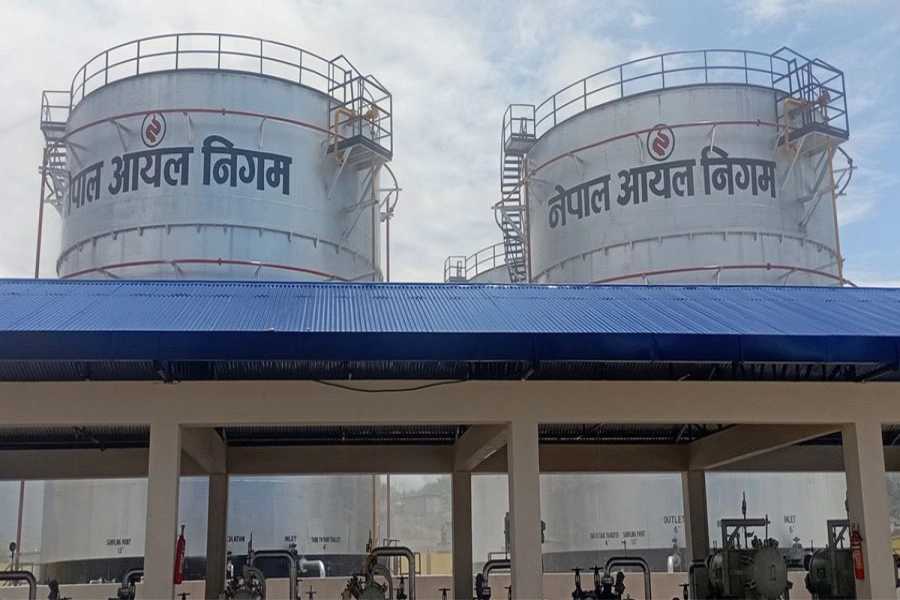
Nepal’s decision to build a nearly Rs 10 billion fuel depot at Lothar in Chitwan is a welcome move for a country that has long lacked a modern depot and depended almost entirely on its southern neighbor for petroleum supplies through tanker trucks. The project is about more than adding storage tanks. It addresses a fundamental weakness in Nepal’s fuel system: limited storage, heavy reliance on road tankers, and a distribution network that quickly comes under strain when transport is disrupted. The depot, being built by Nepal Oil Corporation, will have a capacity of 91,900 kiloliters for petrol, diesel, kerosene, and aviation fuel. Spread across more than 23 bigha, the greenfield terminal will be Nepal’s largest fuel storage facility once completed. It will also include modern truck-loading facilities, reserve tanks, and a large water reservoir for fire safety. The bigger development, however, is the extension of the Motihari–Amlekhganj petroleum pipeline to Lothar. The 10.65-inch pipeline will be able to carry up to 273 kiloliters of petroleum products an hour, or around two million tons a year. India will provide an estimated Rs 4.29 billion grant for the pipeline extension, while Nepal Oil Corporation will finance the storage infrastructure. The project is expected to strengthen supplies to Kathmandu Valley, Pokhara, and other major consumption centers. That pipeline connection is important because Nepal’s fuel system remains heavily dependent on tanker trucks even after the Motihari–Amlekhganj pipeline came into operation.
Fuel imported from India still has to move through a road-based distribution network exposed to traffic disruptions, damaged roads, delays, and other logistical problems. The weaknesses become most obvious when supplies are disrupted. Long queues, uncertainty, and panic buying can emerge quickly because Nepal lacks enough strategic storage to cushion a prolonged interruption.
CAAN reduces fuel surcharge following drop in aviation fuel pri...

The recent difficulties in keeping the domestic fuel market supplied have again shown how vulnerable the system can be when distribution does not work smoothly. Nepal imports almost all of its petroleum products from India. That dependence, by itself, is not necessarily a problem. India is Nepal’s most practical supply partner, and the cross-border pipeline has already made imports more efficient. The bigger problem is that Nepal has not built enough infrastructure around that supply arrangement. Bringing fuel through a pipeline but relying heavily on tankers to move it onward leaves the system only partly modernized. Lothar could change that. Extending the pipeline deeper into Nepal and connecting it to a major storage facility will give the country more flexibility in moving fuel to different markets. It should cut tanker movements and transportation costs while reducing the risks of leakage, theft, and contamination. More importantly, larger reserves would give the government breathing room when imports or transportation are disrupted.
But a large depot should not become another project that looks impressive on paper and falls short in practice. Storage capacity matters only if fuel can reach consumers efficiently. NOC must therefore strengthen the secondary distribution network, improve tanker management, and introduce reliable digital systems to track stocks and deliveries. The government should also see Lothar as part of a broader national fuel security plan. The proposed Siliguri–Jhapa pipeline and Jhapa Greenfield Terminal should move forward without unnecessary delays. Future storage facilities should also be planned across different regions so that Nepal does not simply replace one point of vulnerability with another. Most importantly, Nepal needs clearly defined minimum strategic fuel reserves and transparent rules for releasing them during emergencies. Better demand forecasting, regular stock reporting, and strict safety audits should go hand in hand with the new infrastructure. If managed properly, the depot could mark a turning point in Nepal’s fuel security. The goal should not be merely to build bigger tanks, but to create a distribution system that can keep the country running when disruption hits.


