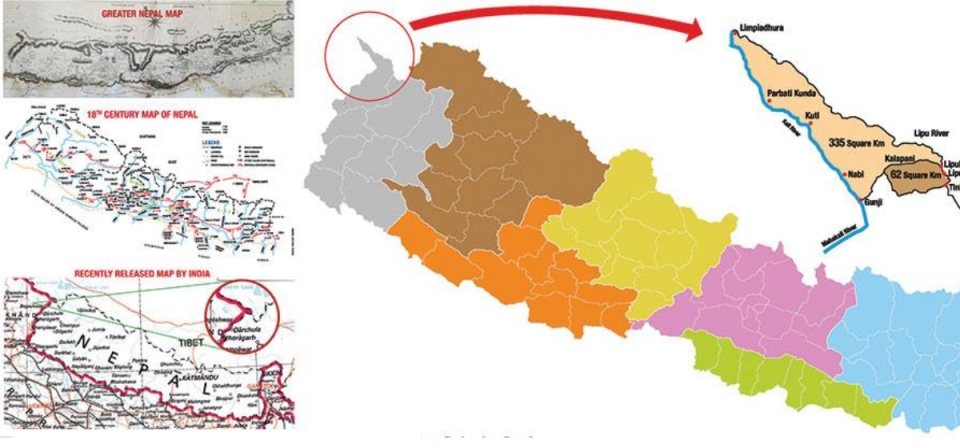
India and China have agreed to reopen the Lipulekh trade route after a six-year pause. Kathmandu responded, as it always does, with a statement reaffirming that Lipulekh, Kalapani, and Limpiyadhura are Nepal’s territory and that the dispute must be resolved through diplomacy. India, predictably, rejected the claim. The ritual is complete.
The problem is that it remains only a ritual. A note verbale is not foreign policy. On Lipulekh, Kathmandu repeatedly arrives late to a conversation it should be leading.
Nepal’s foreign policy establishment has long operated on the belief that protest is the same as strategy. It is not. Putting a territorial claim on record is the minimum requirement of diplomatic seriousness—but minimum requirements do not produce outcomes. Since India and China first reached an understanding on the Lipulekh pass in 2015, Nepal has objected repeatedly. And in all that time, what has changed on the ground? The ground has shifted, but only against Nepal.
This is the pattern that needs to break.
Nepal now faces a new government with a substantial mandate, led by 35-year-old former Kathmandu mayor Balendra Shah, who last August used social media to sarcastically urge then-Prime Minister KP Sharma Oli to remind China and India of Nepal’s territorial claims during the 25th Shanghai Cooperation Organization summit in Tianjin.
But a government with that kind of mandate cannot behave like an opposition force armed with a microphone. Outrage is easy; statecraft is harder. In this case, statecraft begins with an honest admission Kathmandu has avoided for too long: Nepal has a claim, but no doctrine. It has a position, but no playbook.
India signals openness to talks with Nepal over Lipulekh disput...

Policymakers in Kathmandu also need to face an uncomfortable truth. Lipulekh is not just a border dispute—it sits at the intersection of India-China normalization, Himalayan security, and the emerging connectivity between two of the world’s largest economies. Treating Lipulekh purely as a matter of national sentiment, with notes verbales and map amendments, preserves the rhetoric while ceding initiative.
Nepal cannot afford to treat sovereignty and functionality as the same question. In international affairs, states often separate final ownership from interim use—not because sovereignty does not matter, but because rejecting all interim arrangements can leave the weaker side excluded from both process and payoff.
There are instructive precedents. Peru and Ecuador, after a long border conflict, moved toward peace in 1998 through a framework that went beyond drawing a line. It included border integration, shared development, and improved lives in frontier regions. The lesson was simple: a disputed boundary can be managed as a site of gain, not just grievance, if diplomacy is smart enough.
A more relevant example is the Malaysia-Thailand Joint Development Area in the Gulf of Thailand. Both countries had overlapping claims and neither relinquished them. Instead of waiting forever for perfect sovereignty, they created a joint management mechanism: shared costs, shared benefits, and no concession of legal position. It worked because it favored practical management over deadlock.
Closer to home, India itself has accepted that sovereignty and access are not always identical. Under the India-Bangladesh land boundary arrangements, India agreed to lease the Tin Bigha corridor in perpetuity so Bangladesh could access Dahagram-Angarpota. The broader process became one of South Asia’s rare examples of turning a messy territorial triangle into a negotiated settlement that then opened the door to wider cooperation. This undercuts the assumption in Kathmandu that New Delhi would never accept a framework separating formal title from practical use—it already has, when it suited its interests.
None of this means Nepal should abandon its claim. It should not. The claim over Kalapani, Lipulekh, and Limpiyadhura must remain on record, formally and publicly, regardless of what India and China agree between themselves. No bilateral understanding can legally settle what Nepal has not agreed to. That point must not be softened.
But firmness on the claim is different from having no ideas beyond the claim. Nepal should stop framing the choice as one between silence and surrender. There is a third path, and it begins with a clear doctrine: sovereignty preserved, access regulated, benefits shared.
In practice, that means four things. First, Nepal must insist that its territorial position remains fully intact and that no India-China arrangement can be treated as a boundary settlement. Second, any interim trade, transit, or connectivity use of Lipulekh must be designated as without prejudice to final settlement. Third, Nepal must stop accepting economic exclusion. If India and China want to use a route Nepal claims as its own, Kathmandu should demand a seat in the conversation and a share of the returns—transit revenues, logistics, pilgrimage management, and border infrastructure. Not theatrical trilateralism, but practical recognition that Nepal is a direct stakeholder. Nepal should make clear that it is not opposing connectivity itself; it is opposing exclusion. This makes a stronger argument, is more defensible internationally, and is harder for both neighbors to dismiss. Fourth, Nepal should push for a standstill on further military or commercial expansion while diplomacy is active. A country that does not ask for restraint is not doing diplomacy; it is only filing complaints.
Some in Kathmandu will resist this line. They will argue that Nepal should never discuss the use of land it claims as its own. It sounds patriotic—but it is not policy. It confuses legal principle with diplomatic method. Nepal has been repeating this for over a decade. The territory has not moved.
A smaller state does not strengthen its position by narrowing its options. It does so by turning geography, legal claims, and two neighbors who need this route into leverage. But leverage matters only when it is turned into actionable terms and outcomes. Otherwise, it is just slogans shouted from outside the room.
Nepal has been outside that room for years. The real question is not whether this government should protest—it must. The question is whether it has the confidence and imagination to propose something more: not just “this is ours,” but “here is how we will be part of this, on our terms, without giving up what is ours.”
That is harder to say. It requires preparation, legal clarity, diplomatic creativity, and political courage. It requires a foreign ministry doing more than drafting the next note, and a prime minister who understands the difference between registering displeasure and shaping outcomes.
Kathmandu’s foreign policy establishment has a choice. It can stick to the familiar script of late statements, symbolic protest, and domestic chest-thumping—or it can act like a serious state and offer a rules-based diplomatic formula that protects Nepal’s claim while placing Nepal inside the corridor’s economic and political reality.
The real failure would not be a compromise—it would be another year of arriving late, another ritual statement, and another cycle of outrage followed by drift. Nepal has a habit of speaking after the file has already moved in Delhi and Beijing. Breaking that habit is the only way to change what comes next.
(The author is a leader of the Nepali Congress party and a former Emmy-nominated journalist.)