

Nepal Darts Association (NDA) was formed just around a year ago and was registered with the NSC on 26th December, 2008. Though art admirers claim that the game had entered Nepal in the 1980´s, it was only played as a recreational game then. For lack of proper knowledge about the scoring system and rules and regulations, was just played within the confines of elite clubs.
Dart historian Patrick Chaplin, who has conducted research into how the game entered Nepal, has written in his book, “In 1990 Darts entrepreneur Eddie Norman visited Kathmandu and tried to form Dart Association but failed to convince Nepali sports authorities that dart is a serious game and needs organized effort to develop.”
NDA general secretary Dinesh Thapa echoed similar sentiments, “Many top businessmen in Nepal have been playing darts in their homes and offices for fun since 1990. However, they have not taken it as a serious sport.” Thapa, however, added that the game has gained popularity in recent days. “That´s why we tried to organize the sport and registered Darts with the NSC.”
NDA held Darts National Referee Training, Dart School Promotion Project, and National Darts Coaching Clinics in the last 8 months to promote the game in the country. As a result, 9 District Darts Associations have been formed and 12 schools in the valley are participating in the competitive level of Darts regularly.
At present, the NDA is looking forward to take darts beyond national border. That´s why the NDA has applied for International affiliation. The World Darts Federation (WDF) is organizing Darts World Cup in Minnesota, North Carolina, US from September 23-27. The WDF has permitted Nepal to present its membership proposal during that period when WDF also held their Annual general Meeting (AGM). Nepal is optimistic that it would get the membership. The NDA has also planned to organize National Open Darts championship this year.
Darts is gaining popularity in Nepal not only because it is easy but also because it is not expensive. In fact, dart probably is one of the cheapest sports. One can start practicing darts just by investing Rs 500 for which one can get a dartboard and three darts. If Nepal succeeds in taking darts to the international level, it may as well fetch money and medals for the country.
History of the game
The dartboard may have its origins in the cross section of a tree. An old name for a dartboard is a ´butt´, and from this, folk etymology infers that the bottoms of wine barrels were the original dartboards; this word in fact comes, via archery, from the French word butte, meaning target.
There is speculation that the game originated among soldiers throwing short arrows at the bottom of the cask or at the bottom of trunks of trees. As the wood dried, cracks would develop, creating "sections". Soon, regional standards emerged and many woodworkers supplemented bar tabs by fabricating dart boards for the local pubs.
The numbering plan generally in use today has a 20 on top; however, a great many other configurations have been used throughout the years and in different geographical locations.
The standard dartboard is divided into 20 numbered sections, scoring from 1 to 20 points, by wires running from the small central circle to the outer circular wire. Circular wires within the outer wire subdivide each section into single, double and triple areas.
Darts is played in various formats but usually it is played in two formats singles and doubles (or pair) and in odd number “legs.”
Dartboards
A regulation board is 47.08 cm (17¾") in diameter and is divided into 20 sections. Each section is separated with metal wire or a thin band of sheet metal.
Height and distance
In the standard game, the dartboard is hung so that the bull´s-eye is 5 ft 8 in (1.7 m) from the floor: eye-level for a six foot person. The oche - the line behind which the throwing player must stand - is generally 7 ft 9¼ in (2.37 m) from the face of the dartboard measured horizontally. (WIKIPEDIA)
Related story
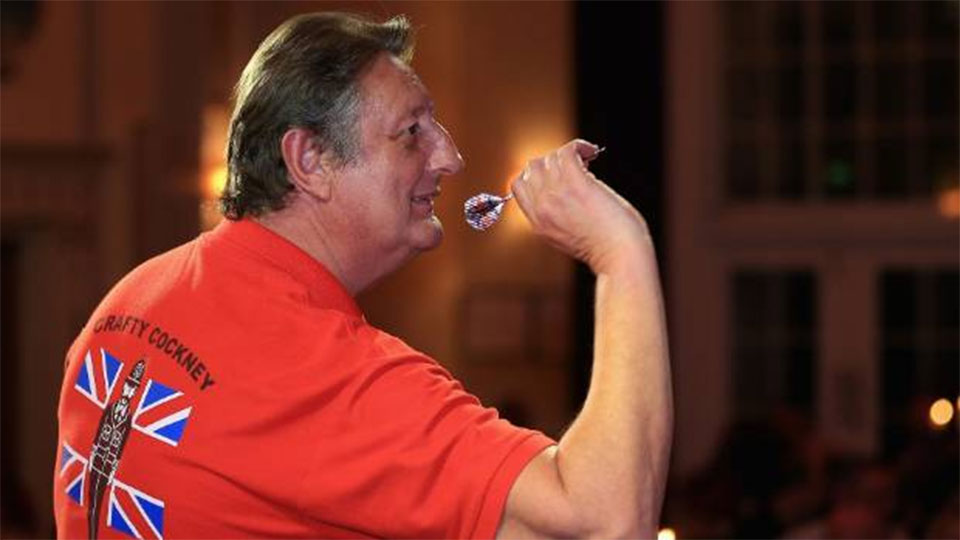
Darts - Five-times world champion Bristow dies aged 60

-1779943688.webp)


-1200x560-1779899638.webp)










-1779842101.webp)






