


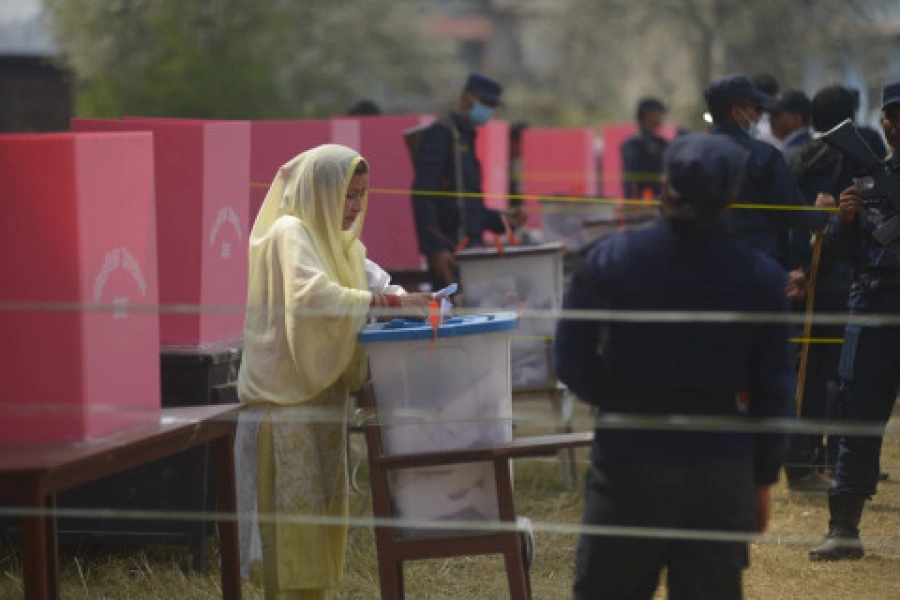
KATHMANDU, Nov 28: Should local elections be fought along party lines, or should candidates compete independently without party symbols?
With local elections approaching, this question has once again entered Nepal’s political debate, with civil society groups, political leaders and some political parties calling for a shift to a non-party system at the local level.
The debate gained fresh momentum after the Election Commission recommended making local elections non-party as part of its suggestions for constitutional amendments. Several citizen groups and political leaders have since urged the commission to remove party symbols from local elections and allow candidates to compete independently.
The demand, however, has met resistance and uncertainty within the political establishment, with questions being raised over whether a non-party local election is compatible with Nepal’s constitutional framework and existing election laws.
The ‘Non-Party Local Government Campaign’ and the ‘Independent Citizens Campaign’ recently submitted memoranda to the Election Commission demanding that party symbols be removed from local elections. The Rastriya Swatantra Party (RSP) had already made non-party local elections part of its political agenda.
Ujyalo Nepal Party Chairman Kulman Ghising also submitted a memorandum to the commission, while Rastriya Prajatantra Party leader Prakash Chandra Lohani has expressed support for the idea.
Nepali Congress (NC) President Gagan Kumar Thapa has also spoken positively about the concept. During a meeting with representatives of the Non-Party Local Government Campaign on October 19, Thapa said he was also discussing the issue and that the NC was positive about it. However, the party has yet to make a formal decision.
The emerging support, therefore, cuts across political lines, but it does not amount to institutional consensus among political parties.
The case for going non-party
Supporters of non-party local elections argue that local governments should be less vulnerable to partisan politics and factional bargaining.
They say local governments are the tier of government closest to citizens, so voters should be able to judge candidates on their competence, integrity, performance and understanding of local needs rather than their party affiliation.
Political influence is already visible in areas ranging from development planning and budget allocation to the formation of consumer committees, staff management and service delivery, critics of the existing system say.
In some localities, competition between elected representatives has also become a matter of party prestige rather than differences over development priorities or public services.
Former Chief Election Commissioner Ayodhi Prasad Yadav said the idea of non-party local elections had been discussed even during his tenure at the Election Commission, but it failed to move forward because of a lack of political consensus.
“There were extensive discussions about non-party elections even when I was at the Election Commission, but it could not move forward,” Yadav said. “Since it ultimately depends on political parties reaching an understanding, political consensus is necessary.”
Based on his experience, Yadav said local governments are closely connected with the social, economic and political lives of citizens, making it possible to elect independent candidates without necessarily creating institutional problems.
'I will work as people's servant, not their master'

He said such a system could also provide greater opportunities for leadership development and potentially have positive economic effects. He also argued that a non-party system could help reduce the cost and complexity of elections.
Supporters further argue that removing party competition could reduce political factionalism at the village and neighbourhood levels, create space for competent independent candidates and shift the focus of elections toward local issues.
But would removing party symbols remove party politics?
Not necessarily, according to Yadav.
Removing party symbols from ballot papers would not automatically end political influence at the local level. Candidates could still have political affiliations, ideological leanings and connections with political parties.
Political parties could also continue to support candidates informally even if they did not officially field them.
The debate, therefore, goes beyond whether a party symbol should appear on a ballot paper. It raises a broader question about the role of political parties in local government and the accountability of elected representatives.
A legal and constitutional hurdle
Nepal’s existing legal framework also complicates the proposal.
Articles 215 and 216 of the Constitution provide for the formation of rural and municipal executives and establish the election of chairpersons, vice-chairpersons, mayors and deputy mayors through secret ballots under the first-past-the-post system. The Constitution does not explicitly state that candidates for these positions must belong to political parties.
However, the Local Level Election Act, 2017 provides for party candidates, official party tickets and the use of party symbols.
Sections 17, 18 and 26 of the Act contain provisions related to party-based candidacy, official nominations and election symbols. Therefore, the absence of an explicit constitutional requirement that local candidates must be party members does not automatically invalidate the existing legal provisions.
The Non-Party Local Government Campaign has itself called for amendments to these provisions in its memorandum submitted on November 20.
There is also a broader constitutional question.
Nepal’s Constitution defines the country’s system of government as a federal democratic republican system based on a competitive multiparty democratic system. The preamble expresses a commitment to competitive multiparty governance, while Article 74 establishes it as the form of governance. Articles 269 and 270 also provide constitutional protection for the formation and operation of political parties and political competition.
Former National Assembly member and Constitution Assembly member Ram Narayan Bidari said local elections could not simply be made non-party without amending the Constitution and relevant laws.
Bidari said he had personally pushed for non-party local elections during the second Constituent Assembly but faced opposition from the NC and CPN-UML.
His argument is that if the Constitution is to permit a system different from the broader multiparty framework at the local level, the relevant constitutional and legal provisions would first have to be clarified or amended.
UML leader and lawmaker Guru Baral also argued that the existing constitutional and legal framework does not permit local governments to be made non-party.
“The Constitution and laws have been formulated according to principles that promote a party-based system. The Constitution does not envisage a non-party system,” Baral said. “Therefore, it cannot be made non-party under the existing constitutional arrangement.”
Is constitutional amendment necessary?
There is no complete agreement even on this question.
Janamat Party Chairman CK Raut has argued that a non-party practice could potentially be introduced without amending the Constitution by allowing candidates to contest without party symbols and by not binding elected representatives to party whips.
At the same time, the Election Commission has included non-party local elections in its recommendations for constitutional amendments, pushing the issue further into the constitutional debate.
Analysts say that if a constitutional amendment becomes necessary, Article 274 requires the support of at least a two-thirds majority of the total number of members currently in both houses of Parliament.
That means the Election Commission cannot independently introduce a non-party local election system merely through an administrative decision.
Nepali Communist Party Coordinator Pushpa Kamal Dahal has also said upcoming elections should be held under the existing Constitution and laws. Ram Prasad Chaulagain of the Shram Sanskriti Party has similarly argued that declaring local elections non-party would not be enough to make the system work in practice.
There are also reports of differences within the RSP over how the concept should be implemented, suggesting that while the idea may be gaining popularity as a political slogan, its institutional design remains unsettled.
Would a non-party system improve inclusion?
Supporters believe it could.
They argue that removing party structures and political gatekeeping could make it easier for women, Dalits and minority communities to enter local politics, particularly those who may not have strong connections within established parties.
But critics point out that political parties also serve as institutional mechanisms for ensuring representation and inclusion.
Without clear safeguards, a non-party system could instead increase the influence of wealthy, socially powerful and well-connected individuals, potentially making local politics less inclusive rather than more democratic.
Former chief election commissioners have also differed over whether the entire local election system needs to be changed.
Former Chief Election Commissioner Bhojraj Pokharel has highlighted the growing cost of elections and problems related to political financing, while identifying independent candidacy at the local level as one possible area of reform.
Neil Kantha Uprety has argued that the existing local election structure is broadly appropriate and that minor weaknesses should be corrected, with greater priority given to reforming the federal and provincial election systems and representation.
Former Chief Election Commissioner Dinesh Thapaliya has also emphasized controlling election expenditure, enforcing the code of conduct, cleaning up voter rolls and consolidating fragmented election laws rather than fundamentally changing the existing system.
More than a question of election symbols
The debate ultimately concerns more than whether candidates should have party symbols beside their names on ballot papers.
Local governments are the third tier of Nepal’s federal structure. They are not merely administrative bodies responsible for delivering services; they exercise executive and legislative powers and have local assemblies, executive bodies, judicial committees and authority to formulate local laws.
That gives local elections a political and institutional significance that goes beyond choosing representatives for municipal offices.
For supporters of non-party elections, the priority is to reduce partisan influence and make local representatives more directly accountable to citizens.
For opponents, however, political parties remain central to Nepal’s constitutional system, and removing them from local elections without resolving the constitutional and legal questions could create more confusion than reform.
The real question, therefore, may not simply be whether local elections should be party-based or non-party.
It is whether Nepal can make local governments more transparent, inclusive and accountable while ensuring that political competition does not overwhelm the local issues these governments are supposed to address.


