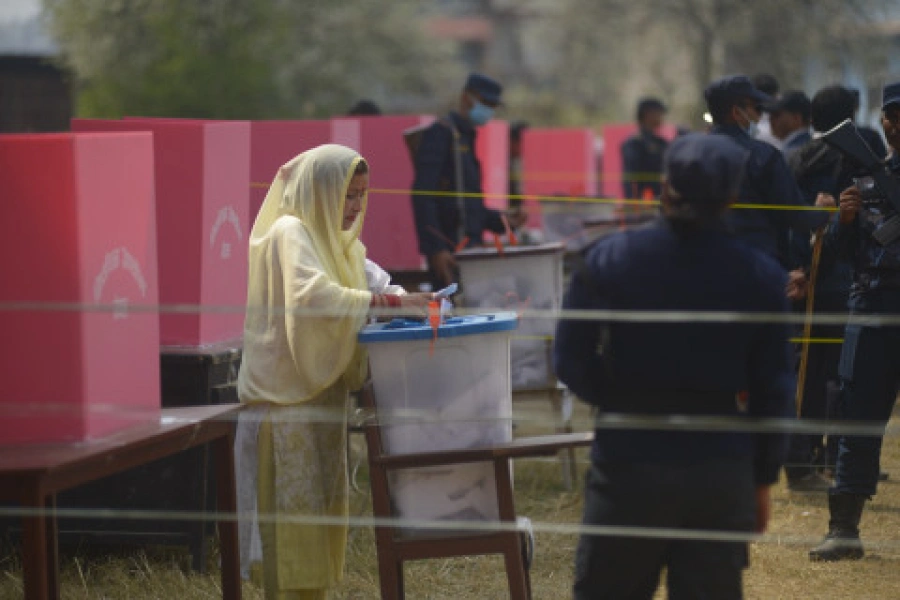
Nepal’s March 5, 2026 election to the House of Representatives (HoR) has delivered one of the most striking political shocks in the country’s electoral history. In a stunning display of voter anger and impatience with the political establishment, the Rastriya Swatantra Party (RSP) won a landslide with 182 seats in the HoR, leaving the country’s traditional powerhouses—the Nepali Congress (NC) and the Communist Party of Nepal–Unified Marxist–Leninist (CPN-UML)—flabbergasted by an unprecedented electoral rejection.
What unfolded was more than a routine change of government; it was the eruption of years of accumulated anger and frustration over corruption, poor governance, political mismanagement, the perceived arrogance of entrenched political elites, and the growing disconnect between Nepal’s political leaders and its citizens.
Nepal’s political landscape since the transition to republicanism has been dominated by a small group of parties and leaders. Governments led by the NC, the CPN-UML, and the newly rechristened Nepal Communist Party (NCP) rotated in and out of power, often through unstable coalitions and internal political bargaining rather than clear policy mandates.
While these parties played historic roles in shaping Nepal’s political transformation, their prolonged dominance gradually fostered a culture of complacency. Corruption scandals, bureaucratic inertia, and weak service delivery deepened public distrust. The perception that a small circle of leaders continued to monopolize power—while ordinary citizens struggled with unemployment, inflation, and migration pressures—fueled resentment. The March 5 outcome is therefore not merely a vote for change; it is an unmistakable rejection of the political status quo.
A Failure to Read the Zeitgeist
Ironically, the very conditions that paved the way for the RSP’s rise were largely created by the ruling establishment itself. The government shaped by the alliance between the NC and the CPN-UML under the leadership of KP Sharma Oli appeared strikingly disconnected from the national mood. Political leaders seemed convinced that the electorate would continue to accept the familiar patterns of coalition politics. Yet outside the corridors of power, dissatisfaction was steadily intensifying.
Equally troubling was the apparent inability of state institutions to detect the magnitude of this shift. Security agencies and intelligence bodies—whose responsibility includes monitoring political stability—appeared to have completely misread the evolving public sentiment. The political class as a whole seemed unaware of the growing demand for a decisive break from the old order.
Sensing the depth of public anger, the NC made a last-ditch attempt to reform its image by convening a special party convention. The move appeared designed to distance the party from years of corruption allegations and from its controversial cooperation with the CPN-UML in forming a coalition between the two largest parties.
However, the effort came too late. For many voters, particularly younger ones, the convention looked less like genuine reform and more like an attempt to wash away accumulated political guilt. Instead of restoring confidence, it reinforced the perception that the traditional parties had failed to grasp the changing political mood of the country—especially the expectations of a new, politically conscious Generation Z.
The Gen Z Revolt and the Crisis of Legitimacy
Public anger intensified after the deaths of 19 young protesters during the demonstrations of September 8, 2026. The tragedy became a defining moment for the emerging youth-driven political movement. Yet the government led by KP Sharma Oli refused to accept moral responsibility for the incident.
Beauties, build the thick skin

Instead, the unrest that followed on September 9, 2026 was attributed by the government to alleged infiltration by foreign forces seeking to destabilize the administration. This narrative failed to convince many citizens and further deepened the sense that the leadership was unwilling to acknowledge legitimate grievances.
In the aftermath of the protests, Oli consolidated his control over the CPN-UML by convening a general convention widely viewed by critics as largely symbolic. For many voters, these moves confirmed the growing perception that the established leadership was more interested in preserving power than in addressing the underlying causes of public unrest. Oli’s capture of the party under the guise of a general convention further irritated its cadres and well-wishers and angered the youth who had demanded a change of guard in the political parties and subsequently in the government.
The Politics of Selective Justice
Another factor that fueled the electoral wave in favor of the RSP was the controversy surrounding Rabi Lamichhane. Accused of misappropriating funds from cooperative institutions, Lamichhane spent nearly nine months in detention after failing to secure bail.
Many citizens viewed the handling of the case as disproportionate, especially when compared with the treatment of other political figures facing allegations of financial misconduct. Leaders such as Dhanaraj Gurung of the NC and the spouse of Rishi Pokhrel of the CPN-UML were perceived to have avoided similar legal consequences.
This contrast fed a widespread narrative promoted by the RSP that the charges against Lamichhane were politically motivated—an act of retaliation by the political establishment. Whether justified or not, that narrative resonated strongly with voters who already distrusted the fairness of the system.
When the Wave Became Unstoppable
By the final weeks of the campaign, the anti-establishment wave had gathered unstoppable momentum. The decision by Gagan Kumar Thapa to shift his constituency from Kathmandu-4 to Sarlahi-4 illustrated the political uncertainty within the traditional parties. Yet the situation grew even more complex when Amresh Kumar Singh—a two-time winner in that constituency—joined the RSP just days before the campaign reached full intensity.
Singh’s prophecy came true, as he had predicted that the NC would win fewer than 40 seats and the RSP would secure over 160 seats. He also declared that he would commit suicide if Balendra Shah and he himself lost the election. Singh defeated Thapa by a margin of 12,850 votes, securing 35,688 votes while Thapa received 22,838.
The scale of the political tide soon became evident. Analysts began remarking, only half jokingly, that even KP Sharma Oli himself might have comfortably won an election had he contested under the RSP’s election symbol—the “bell.”
The final results confirmed the depth of the upheaval: both the leadership of the NC and the CPN-UML suffered unprecedentedly humiliating electoral defeats. Oli lost by a wide margin of 49,640 votes, as Shah secured 68,348 votes while Oli managed only 18,734 votes in the constituency widely regarded as the election’s epicenter. During the campaign, Oli had ridiculed Shah, but the result turned the tables. As the saying goes, pride goes before a fall. Oli had once declared that “defeat” did not exist for him.
In proportional representation (PR) voting as well, the RSP made a clean sweep, securing 5,161,289 votes (47.80%). The NC received 1,756,474 votes (16.27%), and the CPN-UML obtained 1,453,140 votes (13.46%), far below the votes both parties had received in the previous HoR election.
The Meteoric Rise of the RSP
Into this vacuum stepped the RSP—a relatively young and initially loosely organized political movement that rapidly captured the imagination of voters. A major catalyst for this surge was the entry of Balendra Shah into national politics. Shah’s popularity, particularly among urban youth and reform-minded voters, injected fresh energy into the party’s campaign and helped transform the RSP from a fringe challenger into a credible alternative.
The outcome has been extraordinary: a near-total sweep that has effectively sidelined Nepal’s traditional powerhouses—the NC, the CPN-UML, and the NCP. For the first time in years, Nepal’s political map appears fundamentally redrawn.
With the final distribution of seats, the RSP commanded a dominant majority—182 seats, just two short of a two-thirds majority—in the HoR. Such a mandate provides unprecedented legislative authority. Constitutional amendments, major governance reforms, and institutional restructuring could become feasible within a relatively short period.
However, overwhelming power can also create intense political pressure. The party’s leadership may face strong demands from supporters to pursue aggressive action against figures associated with past corruption and abuse of power. Calls for accountability are likely to be loud and persistent, raising the risk that reformist momentum could evolve into politically driven retribution.
How the RSP balances justice with political stability will be one of the defining tests of its leadership. History offers many examples of movements that achieved spectacular electoral success only to struggle once confronted with the complexities of governance. The RSP now faces precisely this challenge.
The party’s rapid rise means its organizational structures remain relatively new and untested. Managing internal cohesion, building policy expertise, and delivering tangible governance outcomes will require institutional maturity that cannot be developed overnight.
Moreover, Nepal’s parliamentary system contains built-in checks that could complicate the RSP’s reform agenda. Even if it dominates the lower house, the government could face resistance from the National Assembly if that chamber remains under the influence of established parties. Legislative gridlock, therefore, cannot be ruled out.
Regional and Geopolitical Implications
The dramatic political shift in Kathmandu will also attract close attention from Nepal’s powerful neighbors—India and China—both of whom maintain significant strategic interests in the Himalayan state.
Nepal’s political instability in recent years has often provided external actors with opportunities to shape outcomes through diplomatic engagement and economic leverage. A strong single-party government, if it materializes, could alter this dynamic by offering greater policy coherence and negotiating capacity.
At the same time, the new leadership will need to navigate Nepal’s delicate foreign policy balance. Maintaining constructive relations with both neighbors while safeguarding national autonomy will remain a central diplomatic challenge.
The Fate of the Monarchy Sealed
One broader implication of the election result appears increasingly clear: speculation about the revival of the monarchy—occasionally raised in moments of political frustration—has been decisively sidelined for the foreseeable future. The electorate’s message is not a call to return to the past but a demand for a more accountable and effective republican system.
Yet the deeper significance of the March 5 elections lies in something more fundamental. Nepali voters have demonstrated that they are willing—and able—to radically reshape the political landscape when their patience runs out. For the traditional parties, the lesson is stark: reform or disappear. For the RSP, the challenge is equally daunting.
Transforming electoral momentum into sustainable governance will require discipline, humility, and institutional competence.
Nepal’s youthquake has already occurred. Whether it ultimately leads to renewal or merely another cycle of disappointment will depend on how the country’s new leaders respond to the extraordinary mandate they have just received.




-1200x560-1774606010.webp)
-1200x560-1783685616.webp)