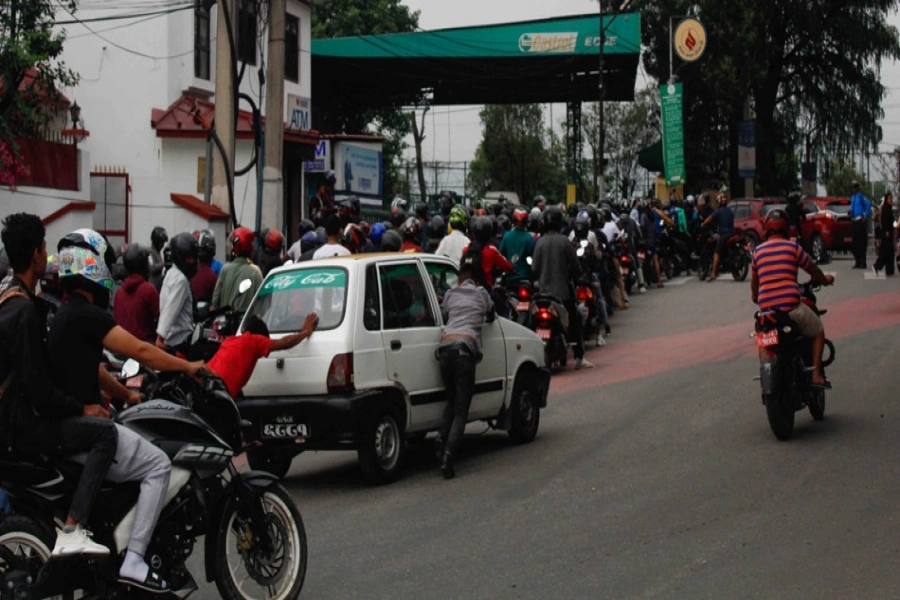
Long queues at fuel stations, anxiety over cooking gas, and repeated price hikes have brought a familiar reminder: Nepal remains far more vulnerable to imported fuel shocks than it should be. This is not simply a story of temporary disruption. It is a sign of a deeper structural weakness. Nepal is one of the world’s low energy economies. It has vast hydropower potential, abundant water resources, and unusually large foreign exchange reserves. Yet it is still highly exposed to imported petroleum. Nepal looks safer than many fragile economies, but much of that safety rests on forces beyond its control. Its resilience is real, but much of it is borrowed.
Low Energy, High Dependence
Start with the first fact. Nepal uses very little energy. Per capita energy use is only about 520 kilograms of oil equivalent, less than one-third of the world average and well below India. It is a sign of limited industrialization, modest mechanization, low transport intensity, and a still-thin subsistence economy. Nepal uses little energy largely because it still produces too little energy-intensive activity.
The second fact is even more revealing. Even this low level of energy use is not strongly electrified. Traditional biomass still accounts for 59 percent of Nepal’s total energy consumption. Petroleum accounts for about 22 percent, while electricity accounts for less than 10 percent. This is a poor outcome for a country so often described as energy-rich. Nepal has rivers, but it has not built enough electrification in cooking, transport, industry, and daily life. Too much of that life still depends either on traditional biomass or on imported petroleum.
That is what makes the third fact so striking. Nepal’s broad fuel imports amount to about 8 percent of GDP, the highest in South Asia. Nepal uses little energy, yet the fuel it does import places a very large burden on the economy relative to its size. India uses much more energy, but its ratio is lower. Nepal, by contrast, carries a heavy imported-fuel burden without having built the productive base to support it.
Celebrating the inspiring stories of women’s courage, resilienc...

This dependence is not merely numerical. It is structural. Nepal buys petroleum through the Indian Oil Corporation channel. That arrangement gives Nepal continuity of supply, and in the current crunch it is fortunate that the system is still functioning. But it also means Nepal’s fuel security rests not only on its bilateral arrangement with India, but on India’s own upstream exposure. About 52 percent of India’s petroleum imports come from the Middle East, meaning that a similar share of Nepal’s petroleum imports can be traced to the same region. India has diversified more than Nepal could ever do directly. Even so, Nepal still relies on a supply chain it does not control.
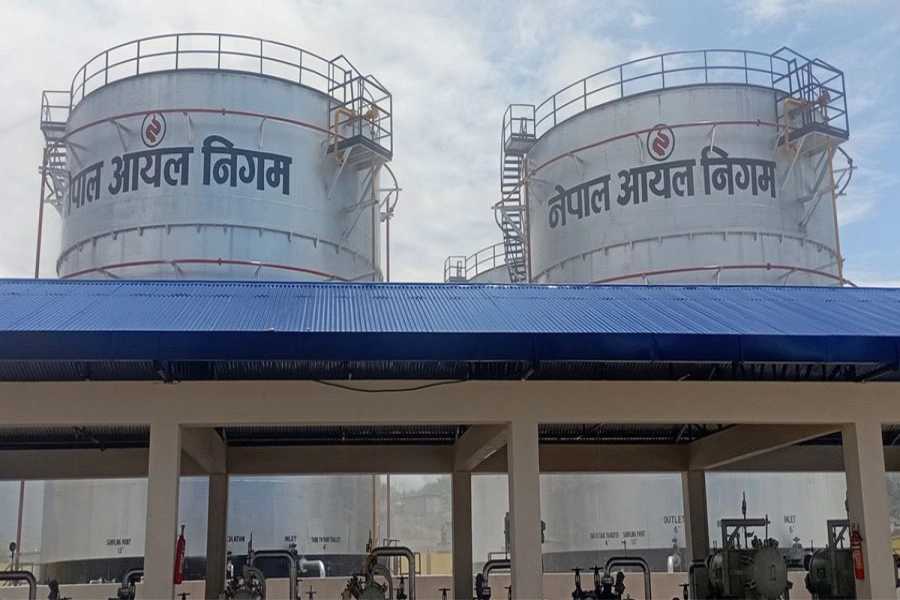
Nepal has also done too little to protect itself against supply disruption. A decade after pledging to build strategic reserves covering around 90 days of demand, the country still appears to have storage capacity for only about 10 to 13 days. In a country so exposed to imported fuel shocks, that is not a minor administrative lapse. It is a serious failure of preparation.
Buffer, Not Strength
Among the three petroleum products, the burden of this dependence is not borne equally. Diesel and petrol ripple through the whole economy by raising transport costs, food prices, and the cost of doing almost everything. LPG reveals a different side of the problem. Of total LPG consumption, roughly three-quarters goes to the residential sector, with the remaining quarter used in commercial and industrial activities. Residential LPG use is concentrated in urban and better-off households: 96 percent of Kathmandu households use it for cooking, compared with only 20 percent in rural areas. Among the poorest fifth of households, just 13 percent use LPG. Any broad subsidy on LPG would therefore disproportionately benefit urban and richer households. As an instrument of poverty relief, it would be poorly targeted.
Import dependence, however, is only half the story. The other half is how Nepal finances it. A country can sustain a large fuel bill for some time if it has a reliable source of foreign exchange. In Nepal, that source is overwhelmingly remittances. In 2024, remittances reached about 26 percent of GDP, one of the highest ratios in the world. The regional pattern matters as much as the total. About 40 percent of Nepal’s remittances come from the Middle East. This means that a significant share of the foreign exchange Nepal uses to finance imports comes from the same broad region that matters for its fuel security.
That is what makes Nepal’s vulnerability so distinctive. A shock in the Middle East can raise Nepal’s fuel import bill while also weakening the labour markets that generate the remittances used to pay for it. Fuel dependence and remittance dependence are therefore not separate stories. They are tied to the same geography of exposure.
And yet Nepal is not entering this period from a position of immediate macroeconomic weakness. On the contrary, its foreign exchange reserves are very large. Nepal’s foreign exchange reserves in mid-March this year stood at about 56 percent of GDP, enough to cover roughly 18.5 months of goods and services imports. By these measures, Nepal stands above India and China and ranks among the highest in the world. But a large reserve cushion is not the same thing as a strong underlying economy. It does not remove vulnerability. It only means Nepal is not yet cornered. The country has time.
Borrowed Resilience
But time is not the same as strength. This is where the idea of borrowed resilience matters. Nepal’s reserves do not reflect a broad export base, strong industrial competitiveness, or a decisive shift toward electrified production and transport. They are sustained by foreign exchange earned by Nepalis working abroad. Nepal’s reserve comfort should therefore not be mistaken for proof that the underlying structure is sound. It is better understood as the visible result of a model in which the country exports people, imports fuel, and accumulates foreign exchange without transforming its domestic economy enough.
The right conclusion is not that Nepal faces imminent collapse. It does not. The harder conclusion is that Nepal has a strong buffer but a weak structure. It has bought time, not solved the problem. For now, its reserves provide room to adjust. But that room rests heavily on foreign exchange earned by sending workers abroad, while the domestic economy remains too weakly electrified, too fuel-dependent, and too narrow in its export base.
That is why this moment matters. Nepal should use this period of reserve comfort not for self-congratulation, but for reform. It needs faster electrification of cooking, transport, and industry. It needs stronger strategic fuel storage and better supply preparation. It needs a wider export base and a more productive domestic economy. Above all, it needs to create more of its stability at home rather than renting it from distant labour markets and imported energy chains.
Nepal’s reserves are real. Its flexibility is real. But without real reform, they may once again do more to postpone transformation than to produce it.