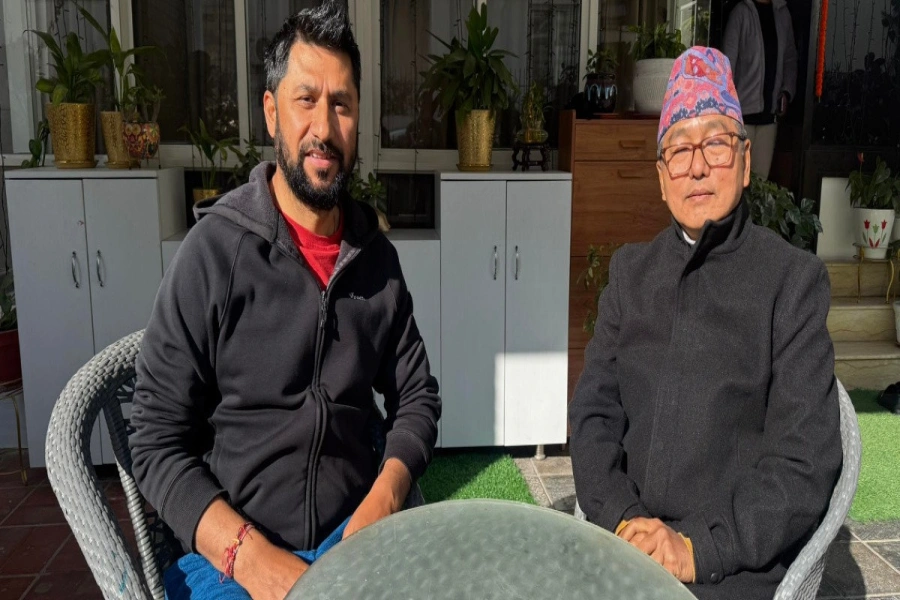
“Please don’t lock the handles,” his partner reminds another customer who has just parked his scooter. “I’ve been working here for eight years. There’s no way I can cause any dent or scratch,” says Sapkota when asked about the possibility of damage while parking two-wheelers in such close proximity. But he agrees that when new parking facilitators are hired, they cause some “small” blunders which, in his terms, are small dents and scratches. [break]
The parking areas around the busy streets in the capital are always full, the condition much worse during the morning and evening hours. In the busy areas like New Road, Bhotahiti, Pako, finding a parking space can be a big relief to the riders. In such situations, there’s very little the riders can complain about the parking conditions.
These parking space operations, though run by local clubs or private organizations, need to ask for permission from the concerned municipality. Rajya Prakash Pradhananga, chief of revenue department at Kathmandu Metropolitan City (KMC), says that there are a total of 30 parking lots around Kathmandu that have been authorized by KMC.


Photos: Bijay Gajmer
“Permission for parking lots are mainly acquired for ward numbers 22 and 25,” he adds. Both these wards are around the New Road area, Ward 22 covering from Sundhara to Pako while Ward 25 is the Basantapur area.
Managing parking lots has become a good source of revenue for the facilitators, local clubs and even Kathmandu Metropolitan City. Sapkota says that he earns a profit of around Rs 300 daily after handing over Rs 900 to the local club and distributing the remaining earnings among the other two parking facilitators. KMC, on the other hand, earns five million Rupees every year from renting out the public spaces for parking lots.
Though KMC may have been collecting considerable amount of revenue from the parking lots, there is no sign of it when it comes to the regulation of these parking spaces. According to the rule, the KMC-authorized parking lots are required to charge five Rupees per hour for two-wheelers and Rs 10 per hour for the four-wheelers. But this rule has been rarely followed.
“It’s been ages that I’ve paid only five Rupees for parking my bike. The general tariff nowadays is Rs 10 and so I readily comply with that. But if they ask me more than Rs 10, I start haggling,” says Bibek Pradhan, 26. But he adds that he was never given a ticket by a parking facilitator and nor has he asked for one, either.
Sapkota, however, says that he has never charged more. “I’ve always charged five Rupees for an hour or less and increased the pricing likewise as the hours increase,” he says. But just nearby the parking lot operated by Sapkota, another parking facilitator is adamant that the price is Rs 10 per hour for two wheelers.
Though it seems Sapkota is true to his words, when it comes to doling out parking tickets, he slyly says that they only give tickets only to the ones who ask for it. “Printing tickets is very expensive, so we don’t give it to everyone,” he says as an excuse for not providing tickets.
Pradhananga confesses that KMC has not been able to regulate the rampant parking charges. “We’ve heard that the parking lots charge more than they are supposed to. At some intervals, we’ve sent investigation teams to inquire about the status of the parking lots and their charge and have warned a few who have been violating the rules. But we’ve realized that’s not sufficient,” he says.
He also mentions that there has been an irregularity in the issuing of tickets. Not only the parking facilitators refrain from providing tickets, they are also seen issuing invalid tickets with wrong dates or even incorrect names of the organization, according to Pradhananga.
But he adds that they have formulated new plans with better regulations over the parking lots. The new plan has also allocated 40 additional parking areas around the capital. “We’ve decided on a total of 70 parking lots with much organized space with proper lanes and time cards,” he says. But the matter is now in court due to disagreements by different groups over using certain spaces for parking lots. Pradhananga assures that as soon as their new plans come into action, they will be more vigilant about proper parking, including security and parking charges.
He also points out that though KMC is falling short in regulating the authorized parking lots, it has been actively watchful over any illegal parking. Dhanapati Sapkota, chief of KMC’s security department, says that they have taken action against 8,400 motorcycles in this fiscal year, earning revenue of Rs 8.4 million from fines.
“Some vehicles are parked on the sidewalks blocking pedestrians . At other times, illegal parking also obstructs smooth traffic flow,” says Sapkota. Since the last two months, in collaboration with the Metropolitan Traffic Police Division (MTPD), two-wheelers parked on illegal spots are immediately towed away and the vehicle owners need to pay a fine of Rs 1,000.
The problem of traffic congestion, however, is not only caused by illegal parking but even the authorized parking lots are to blame for the unnecessary traffic jams in the busy market areas like Khicha Pokhari and Bishal Bazar. Though the roads in those areas are fairly wide, half of the space is occupied by parking lots.
DSP Pawan Giri, spokesperson of MTPD, also says that they are only authorized to take action against vehicle owners who have parked on spaces which aren’t designated as parking zones. But he agrees that KMC-authorized parking spaces are is also responsible for traffic jams during peak hours. “The road extension drive is meaningless if the sides of the wider roads are rented out for parking lots,” he says.
Pradhananga also agrees with DSP Giri that certain authorized places have also hampered the smooth flow of traffic on busy roads. However, he points out that the new plan of action will revise such spaces with the help of MPTD.
But DSP Giri is against renting out road spaces for parking lots. “Roads are being widened to ease traffic congestion. When road spaces are allotted for parking, it definitely doesn’t serve the right purposes of the roads,” he says. However, he adds that there is no other option unless KMC or the government brings alternatives to the present parking lots. “Multi-storey parking facilities are the present requirement to mitigate Kathmandu’s parking problems,” he says.
With a steady increase in the number of vehicles in Kathmandu, many small parks, open spaces and roads have been turned into parking lots. Though this trend has emerged as a profitable business, lack of proper rules regarding appropriate lanes and standard fees have been a big hassle to vehicle owners. Apart from that, unorganized parking makes the whole city look unattractive.
As vehicles keep on increasing, the parking lots will have more opportunity to charge as they like in the absence of proper regulating and inspecting bodies. Therefore, it is high time that KMC and other concerned authorities addressed this issue with the urgency it requires and came up with a plan to address the growing need of parking facilities in the capital.
Parking lots need for regulation
Riju Shrestha, 23, never prefers parking her vehicles at parking lots nearby busy streets. After many instances of her friends’ vehicles were damaged at those parking spaces, she prefers to leave hers in the underground parking of commercial buildings or malls which she considers to be more secure.
“But underground private parking spaces charge way higher, that too on hourly basis,” she says. She remembers one incident when she had to visit a commercial building for a month and spend around six hours daily. “I had to pay Rs 60 everyday for parking even though I had work in the same building. I think that was pretty unfair,” she says.
According to the 2011 Census, 23.62% of the total population rides two-wheelers while 4. 03% drives four-wheelers. The maximum percentage of vehicle owners living in Kathmandu, the number of private parking areas in the capital has also increased significantly. Underground parking lots have also been a big relief to vehicle owners when the Kathmandu Metropolitan City office is closely monitoring illegal parking. But owing to the lack of proper parking spaces, these parking lots have been charging exorbitant fees.
“We charge higher because we want to discourage vehicle owners other than our customers to park at our premises,” says Shiva Basnet, procurement manager of Blue Bird Mall. He adds that they had no intention to charge for parking but they were forced to do so. “Other people from around the area started parking here and our customers had hard time finding parking spots, so we decided to start charging fares,” he says.
Parking inside Blue Bird premises costs a four wheeler Rs 25 per hour and two-wheelers Rs 10. Though he claims that they were not looking to make money through their parking space, Blue Bird collects Rs 2,500-3,000 per day from parking charges. For the customers, however, parking is still free of charge. “The customers can ask for a parking slip that waives parking fees,” says Basnet.
The underground parking of United World Trade Centre (UWTC) also follows the same approach, according to Sharada Shrestha, front desk officer at the commercial centre. “The shopkeepers can issue a slip to their customers that will waive the customers of parking charges. But the charges will be registered in the name of the issuing shop but will be charged only half of the fees,” she says.
The underground parking space at UWTC hosts up to 500-600 two-wheelers and 10-20 four-wheelers per day. Shrestha claims that the parking system at UWTC is more systematic due to the electronic process of keeping records of a vehicle’s timing.
“Our parking lot is also secure compared to other parking lots as we have guards keeping an eye on each and every movement of the patrons,” she says. They charge Rs 20 per hour for cars while Rs 10 per hour for bikes.
Civil Mall’s two-storey underground parking space that has the capacity to host about 120 four-wheelers and 200 two-wheelers also charges the same rates as that of UWTC. But unlike in UWTC and Blue Bird, the parking lot at Civil Mall offers no concession even to its clients.
“Earlier, we used to charge Rs 10 and 20 for two-wheelers and four-wheelers respectively regardless of the hours taken for parking. But we had to change the policy due to overcrowded vehicles that rarely belonged to the staffs or customers of the mall,” says Bishwo Maskey, General Manager of Civil Mall.
Apart from underground parking, the Mall also has an open two-wheeler parking space right in front of the complex. The open parking lot is also considered as the busiest one in the capital. Due to the popularity of the movie theatre inside the Mall, many vehicle owners park in the parking lots of the Mall for considerable amount of time.
“Theatre visitors will obviously park their vehicles for more than three hours at least for the duration of a film,” agrees Maskey but confesses that he is unaware of any subsidy provided for the movie theater visitors. Civil Mall has rented its parking space to another company and does not look after the management of the parking lot like the other two commercial centers mentioned above. But this is definitely not the reason to ignore customers’ pleas for the overcharging of parking space.
Maskey, however, says that about 60-70% of the parking lot has been covered by the shop owners and various employees inside the different outlets at the Mall which is provided free of charge. “But this situation is changing after a month. We’re planning to charge a minimum fee from the shop owners and their staffs and waive a certain amount of parking fees to our customers,” says Maskey.
Though private parking areas may charge higher than the KMC-authorized parking lots due to the presence of security guards and cameras installed in the underground parking lots, these areas are regarded as more secure than open areas.
But Astha Karki, 25, a marketing officer, says that the underground parking is also not reliable when it comes to security issues. “If they were concerned about security, why would they put a board about parking at your own risk? It’s so stupid to be paying parking fees to those parking lots that aren’t ready to take responsibility of the vehicles parked inside their premises,” she says.
And if they are vigilant, according to her, there is no way one can charge rampantly for parking their vehicles. “The private parking follows no rules and they are free to charge as they wish,” she adds.
While Kathmandu Metropolitan City is busy dealing with proper regulations of its authorized parking lots and the mushrooming of illegal parking in public places, the regulation of parking charges for private parking spaces may be too much to ask for. But as more commercial buildings and malls are being built, private parking may also pose as a grave problem in a few years.
mail2asmita@gmail.com
Related story
Company awarded parking contract of Nepalgunj Airport mounts pr...