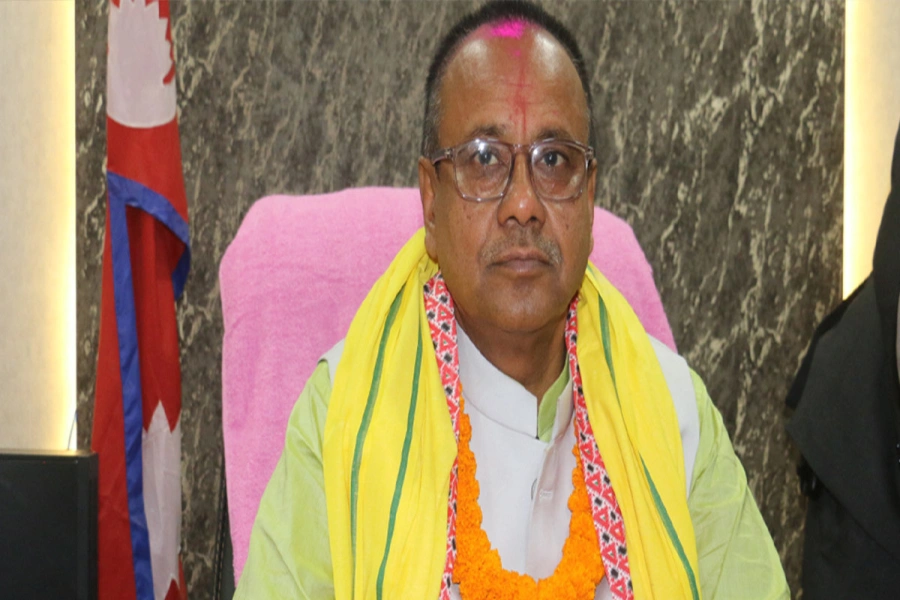
KATHMANDU, Nov 16: Prime Minister Balendra Shah is preparing to visit India from November 22 to 25, in what is being viewed as an opportunity to give a new dimension to Nepal-India relations. The visit will be Shah’s first official foreign trip since he took office eight and a half months ago.
Although neither government has officially announced the itinerary, Nepal’s Ministry of Foreign Affairs and India’s Ministry of External Affairs have stepped up preparations. Shah is scheduled to hold talks with his Indian counterpart Narendra Modi.
India is Nepal’s most important neighbour in political, economic, trade, security and strategic terms. However, longstanding issues, including border disputes, the Eminent Persons’ Group (EPG) report, the widening trade deficit, air entry routes and water resource sharing, continue to raise concerns over Nepal’s national interests and economic independence.
Border disputes involving Kalapani, Lipulekh, Limpiyadhura and Susta are expected to feature prominently in the discussions. Nepal should push for a high-level bilateral political mechanism and regular talks to resolve these disputes on the basis of historical documents, treaties and evidence.
The EPG report, prepared in 2018 to recommend ways to make Nepal-India relations more equal and relevant to changing times, has yet to be formally submitted to the two prime ministers. Former foreign minister and finance minister Prakash Sharan Mahat says the report should not continue to be ignored. He also recommends reviewing provisions of the 1950 Treaty of Peace and Friendship that Nepal considers unequal.
Mahat says Shah’s visit requires thorough preparation and should go beyond ceremonial meetings and project inaugurations. It should focus on building trust, implementing past agreements, reducing the trade deficit and promoting Nepali exports.
He argues that Nepal must maintain friendly and practical relations with India without compromising its sovereignty or national interests. Border disputes and other sensitive issues should be addressed through diplomatic dialogue backed by facts and historical evidence rather than emotional rhetoric.
Way to solve India-Nepal border dispute

Trade deficit stands at Rs 952 billion
Nepal’s widening trade deficit with India remains one of its biggest economic challenges. According to Nepal Rastra Bank data, the deficit stood at around Rs 951.95 billion in fiscal year 2025/26.
Nepal imported goods worth approximately Rs 1,210 billion from India during the period, while exports amounted to only Rs 258.65 billion.
Mahat says reducing the deficit requires strengthening domestic production and export capacity rather than relying solely on import controls. He identifies agriculture, herbs, tea, coffee, cardamom, processed food, cement and hydropower as sectors with export potential.
Nepal should seek easier access for its products to the Indian market, mutual recognition of quality certification, simplified customs procedures and the removal of non-tariff barriers.
India accounts for more than 63 percent of Nepal’s total foreign trade. Given the unequal size and competitiveness of the two economies, Mahat argues that Nepal needs special arrangements to protect and promote sectors in which it has a comparative advantage.
Long-term cooperation in energy
Hydropower is another key issue Nepal should raise during the visit. Nepal wants greater Indian investment in hydropower projects and guaranteed markets for its electricity. India and Bangladesh are important potential markets.
Expanding cross-border transmission lines, securing long-term power purchase agreements and facilitating regional electricity trade should be priorities.
Projects such as Pancheshwar and Budhigandaki should also move forward with fair sharing of costs and benefits related to water, electricity and irrigation. The prolonged delay in the Pancheshwar multipurpose project and difficulties in electricity trade have prevented Nepal from fully exploiting its hydropower potential.
Nepal seeks additional air entry routes
Despite substantial investment in Bhairahawa and Pokhara international airports, both remain below capacity because of limited international air entry routes.
Mahat says Nepal should raise the issue of securing additional entry routes from both eastern and western directions with India. Better access would support tourism, international trade, investment and the services sector.
He also cautions against allowing past commitments to remain unimplemented. Many pledges made by Modi during his 2014 visit to Nepal are still pending. Shah should press for progress on agreements and projects concluded by the two countries, Mahat says.
Proposal for $2 billion in assistance
Nepal is preparing to seek an economic assistance package worth around $2 billion from India during the visit. The proposed support would help rebuild infrastructure damaged by last September’s floods and finance major infrastructure projects.
Other agenda items include expanding electricity trade, constructing cross-border transmission lines, advancing the Lower Arun hydropower project and reviving the stalled Pancheshwar multipurpose project.
QR payment agreement awaits implementation
Nepalis are still unable to make QR code payments in India, despite an agreement reached three years ago. Indian citizens can make QR payments in Nepal, but the arrangement has not been extended in the opposite direction.
During former Prime Minister Pushpa Kamal Dahal’s visit to India, the National Payments Corporation of India and Nepal Clearing House Ltd agreed on May 31, 2023, to connect their systems and introduce cross-border digital payments.
An agreement was also reached during Foreign Minister Shishir Khanal’s visit to India last May to facilitate cross-border person-to-person digital remittances.
However, merchant payments by Nepalis in India remain unresolved. Nepal Rastra Bank says the arrangements for person-to-merchant transactions and digital transfers from Nepal to India are still under process.
Under the existing arrangement, Indian citizens can transfer up to INR 15,000 per transaction and INR 100,000 a month. Nepalis and Indians in India can also transfer up to INR 200,000 per transaction to Nepali bank accounts.
Shah is expected to lead a delegation of around 36 to 40 members, including four ministers: Foreign Minister Shishir Khanal, Energy Minister Birajbhakta Shrestha, Physical Infrastructure Minister Sunil Lamsal, and Culture, Tourism and Civil Aviation Minister Khadkaraj Paudel.