

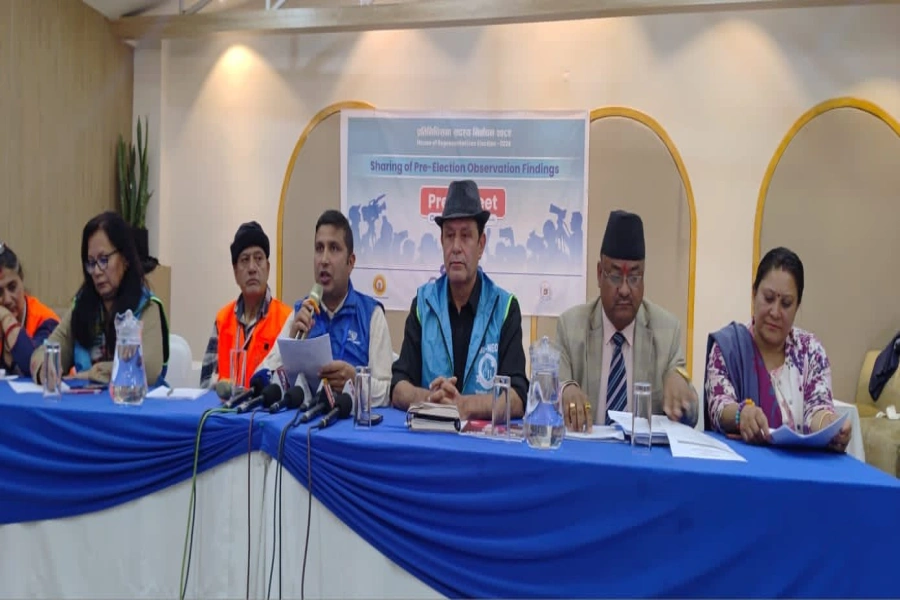
KATHMANDU, Feb 28: With the House of Representatives (HoR) election scheduled for March 5, four major election observer organisations have concluded that logistical and security preparations across the country are largely complete, although violations of the election code of conduct—particularly on digital platforms—are on the rise.
At a joint press conference organized in the capital on Saturday, the National Election Observation Committee Nepal (NEOC), the NGO Federation of Nepal (NFN), the General Election Observation Committee Nepal (GEOC) and the Election Observation Committee Nepal (EOC) said the Election Commission (EC) has finalised necessary arrangements for polling.
Arjun Bhattarai, president of the NGO Federation of Nepal, said more than 4,000 observers from the four organisations have been deployed nationwide. He stressed that their objective is to ensure a free, fair and disinformation-free election. “We will make our findings public both before and after the election,” he said.
According to the observers, a joint security mechanism comprising the Nepal Police, Armed Police Force, National Investigation Department and the Nepal Army has arranged special security measures in sensitive areas. Election personnel have been deployed, essential materials and ballot papers have reached all districts, and national and international observers have also been mobilised.
Despite an overall positive atmosphere, the organisations reported a noticeable increase in violations of the election code of conduct. While previous elections were marked largely by physical violations, this election has seen a significant rise in digital misconduct.
EC summons EU mission chief over poll observation code violatio...

Observers cited the spread of hate speech, abusive content, defamatory posts, and false or misleading information on social media as key concerns. Such activities, they said, involve not only candidates and party cadres but also voters, influencers, journalists, artists and social activists.
Dr Gopal Krishna Shivakoti, president of the National Election Observation Committee, said the monitoring process has focused on compliance with election laws and constitutional provisions, the institutional capacity of the EC, voting procedures, out-of-country and inter-district voting arrangements, and voter education. He noted that the presence of observers acts as a deterrent to irregularities. “Our goal is to ensure a clean, credible and independent election,” he said.
Krishnaman Pradhan, general secretary of the General Election Observation Committee, said the four organisations, which previously worked independently, are coordinating jointly until the final results are announced. He urged the EC to go beyond issuing clarification letters and take decisive action against those who violate the code of conduct.
Shreekrishna Subedi, president of the Election Observation Committee Nepal, raised concerns over the tone of some campaign activities, saying they have at times turned into mockery. He recommended stricter oversight of campaign practices and greater care in the allocation of election symbols.
The pre-election report also documented incidents of posters and banners placed in public spaces, gatherings exceeding permitted limits, the use of children and schools for campaigning, involvement of government employees and teachers in political activities during office hours, and misuse of state resources. In some areas, observers noted hate campaigns against competitors, rallies exceeding legal limits, and excessive use of loudspeakers.
The role of the media has also come under scrutiny. Complaints were received about one-sided reporting, misleading projections and the dissemination of misinformation. Some media outlets have reportedly been asked to clarify their coverage. Limited media access in rural areas remains a challenge to ensuring the flow of impartial information.
Approximately 915,000 new voters have been registered for the upcoming polls. However, the absence of voting arrangements for Nepalis living abroad and the lack of inter-district voting facilities within the country risk disenfranchising a significant number of voters. Observers also pointed to issues such as duplicate entries, technical errors in the online system and delays in updating the voter roll.
The report noted that voter education programmes remain largely traditional in approach, have not adequately reached rural communities, and lack robust impact assessment. Targeted outreach to youth, women, senior citizens and persons with disabilities has not been sufficiently expanded.
Concerns were also raised over campaign finance practices, including exceeding legal spending limits, failure to disclose actual expenditures, and the growing influence of money in the electoral process. Election manifestos were criticised for lacking clear implementation plans and accountability mechanisms, and for prioritising popularity over national priorities.
The EC has instructed stricter enforcement during the campaign silence period and imposed a ban on the sale and distribution of alcohol. Observers have also urged enhanced security arrangements on polling day.
The four organisations said they will continue monitoring nationwide and called on all stakeholders to uphold their responsibilities to ensure a clean, fair and fraud-free election. While the overall environment remains peaceful, they emphasised the need for heightened vigilance against digital misuse, financial irregularities and potential disputes.
At the programme, Professor Dr Kumum Shakya expressed concern over women’s representation, noting that women constitute only 11 percent of candidates in the current election despite making up a majority of the population and voter base.
Election Observation Call Centre to Open
The National Election Observation Committee Nepal announced it will establish an election observation call centre to provide comprehensive information on polling day. The centre will track developments throughout the day and publicly disseminate updates from morning until evening.





-1200x560-1783083574.webp)





