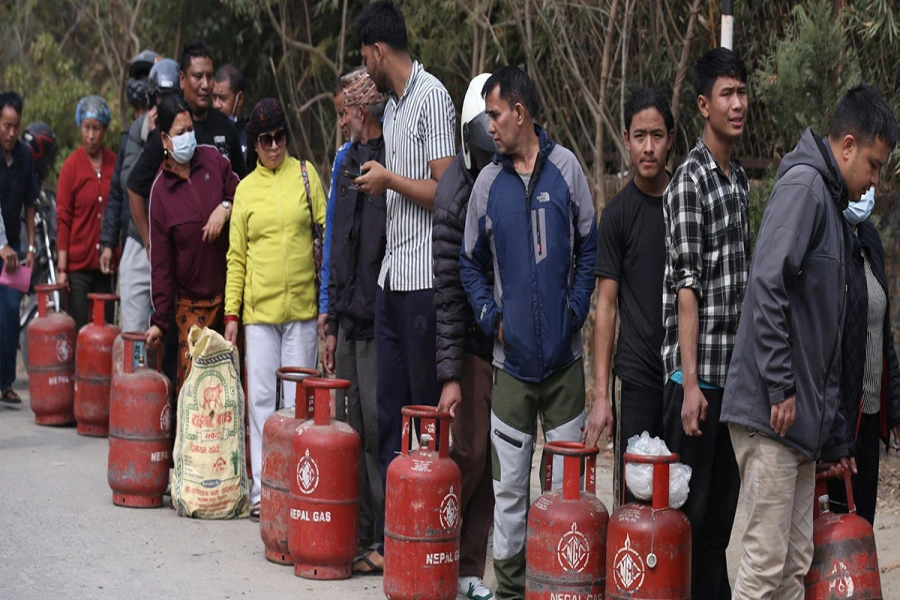
POKHARA, March 21: With a surge in demand for cooking gas, the Nepal Oil Corporation recently decided to supply cylinders filled with half capacity (7.1 kg) to the market. Following the decision, gas industries also began distributing half-filled cylinders. However, tourism entrepreneurs say the move has increased their losses.
According to business owners, hotels and restaurants use multiple cylinders at once and operate high-pressure stoves, making half-filled cylinders impractical for the sector. They have also informed the Kaski administration that full-capacity cylinders (14.2 kg) are necessary for tourism businesses.
President of Pokhara chapter of Restaurant and Bar Association of Nepal (REBAN) Bishwaraj Paudel said that large hotel and restaurant kitchens rely on multiple cylinders simultaneously and high-pressure stoves, making half cylinders inefficient. “Half cylinders work fine for household use, but they create problems for high-pressure stoves. It’s not that they don’t work at all, but losses have increased,” he said.
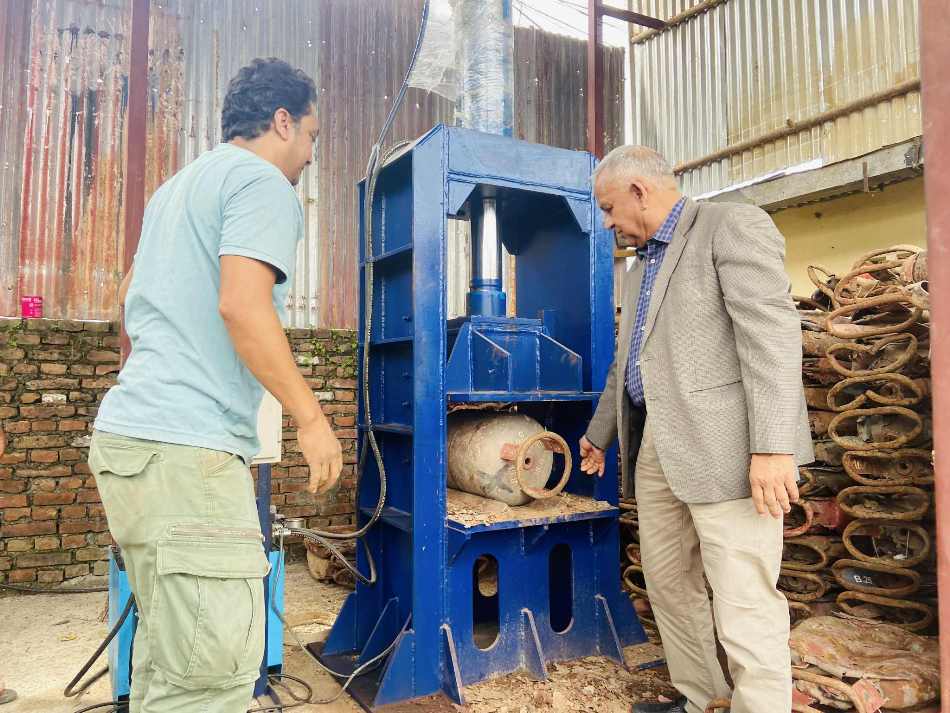
Om Gas Udhyog Pvt Ltd destroys expired gas cylinders

He explained that when using full-capacity cylinders, around 2 kg of gas would remain at the bottom of each cylinder. This leftover gas would either go to waste or be used on smaller stoves. But now, even with half cylinders, nearly the same amount—around 2 kg—remains unused.
“Earlier, we could use about 12 kg of gas from a full cylinder. Now, from a half cylinder, with 2 kg remaining unused, only about 5 kg is effectively utilized,” he said. “Since 2 kg remains unused in every cylinder, losses have increased. The same amount of gas is wasted in both full and half cylinders.”
According to Paudel, the loss from two cylinders amounts to around 4 kg of gas. When using seven cylinders, the accumulated unused gas equals nearly one full cylinder. “Half-filled cylinders are piling up, creating more problems,” he added.
He also noted that the pressure of half-filled cylinders is lower than full ones, affecting kitchen operations. “In situations where large quantities of food need to be prepared, gas consumption is high, and high-pressure stoves are used. Unlike household settings, efficiency cannot be maintained in large kitchens,” he said. “There should be full cylinders for tourism businesses and half cylinders for domestic use.” He added that the Kaski administration has assured them of taking initiative on the issue.
Hotel Association Pokhara President Laxman Subedi also said half cylinders are causing problems in large kitchens. “So far, we have managed somehow. Some businesses have already started using half cylinders, but they increase losses in high-pressure stoves,” he said.
He suggested that instead of half cylinders, supplying full-capacity cylinders would be more practical. “If you provide 10 half-filled cylinders, give five instead, but make them full-capacity cylinders,” he said.
Suppliers say they are simply following the Nepal Oil Corporation’s directive.
Bhimraj Lamichhane, general manager of Grihalaxmi Gas Industry, said supplying different cylinder sizes through the same dealer is difficult. “Gas is distributed to the tourism sector through dealers, so it is not feasible to send cylinders of two different weights to the same dealer,” he said. “It would only be possible if industries directly supplied gas to hotels and restaurants. Otherwise, managing two different cylinder sizes is complicated and requires approval from the corporation.”