KATHMANDU, March 13: With the counting of proportional representation (PR) votes now complete, political attention in Kathmandu has begun to shift from the ballot box to the corridors of power. The central question dominating discussions is no longer who won the election, but how the new government will take shape—and who will hold the decisive influence in selecting the cabinet.
The Rastriya Swatantra Party (RSP), which has emerged as the dominant force in the election after securing a commanding position under both the First-Past-The-Post (FPTP) and PR systems, is preparing to form the next government under the leadership of Senior Leader Balendra Shah, widely known as Balen. During the election campaign, the party had projected Balen as its prime ministerial face, reinforcing expectations that he will lead the new administration.
Even as public speculation grows, RSP leaders say formal discussions on government formation will begin only after the completion of all procedural steps related to the PR system. The Election Commission has already finalized the allocation of PR seats and has written to political parties asking them to submit the names of their proportional representation lawmakers.
Within the RSP, however, attention has increasingly turned to the question of cabinet formation—and the balance of influence between party chairman Rabi Lamichhane and the party’s prime ministerial candidate, Balen.
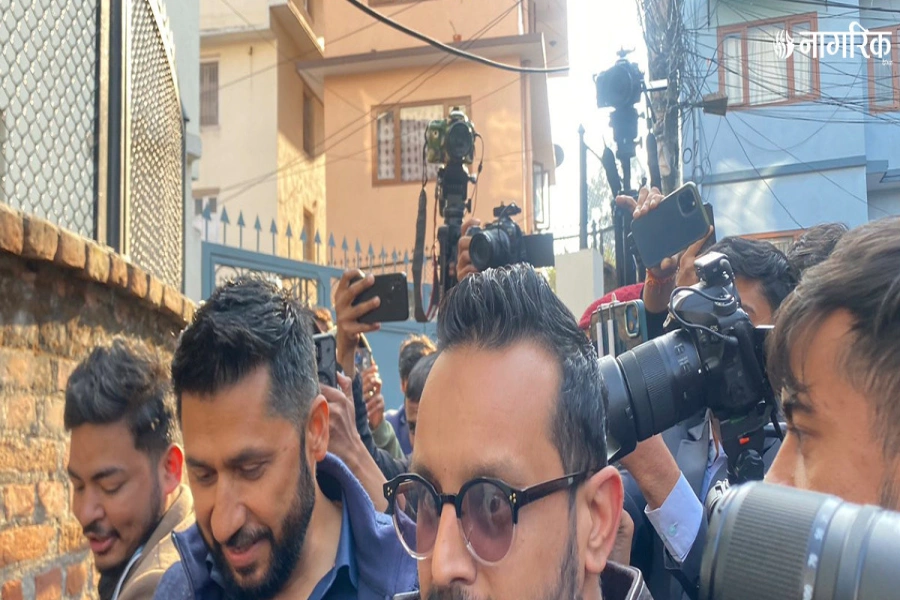
Balen and Rabi conclude their second one-on-one meeting in Lali...
According to RSP central committee member and former Minister for Education, Science and Technology Shishir Khanal, both Lamichhane and Balen will play key roles in selecting ministers. His remarks suggest that while Balen may lead the government, the party leadership will remain closely involved in shaping the cabinet.
Yet some voices within the party hint that the final word may rest with the prime minister himself. Earlier, RSP leader Asim Shah wrote on social media that there is little need for lobbying or campaigning for ministerial positions. Once Balen assumes office as prime minister, he is expected to personally select the members of his team.
Shah argued that Balen is well acquainted with the capabilities and qualifications of the party’s elected lawmakers, which could help ensure that cabinet appointments are based on merit rather than political pressure.
The RSP is also signalling that it intends to keep the size of the cabinet relatively small. While the party’s election manifesto proposes an 18-member Council of Ministers, leaders suggest that the initial cabinet could be limited to around 15 members.
Such a move, party insiders say, is aimed at projecting a message of good governance, transparency and fiscal prudence—principles that formed a central plank of the RSP’s campaign.
Beyond the cabinet, the party is also considering institutional mechanisms to guide the government’s functioning. RSP leaders have floated the idea of forming a separate coordination committee in the future to facilitate cooperation among the government, the parliamentary party and the organisation. The body would provide policy guidance and help ensure alignment between the party’s political agenda and the government’s decisions.
For now, however, the focus remains on a more immediate question: when the new government will be formed—and whether the choice of ministers will ultimately reflect the vision of Balen, the authority of Lamichhane, or a careful balance between the two.



_20230226123652.jpg)