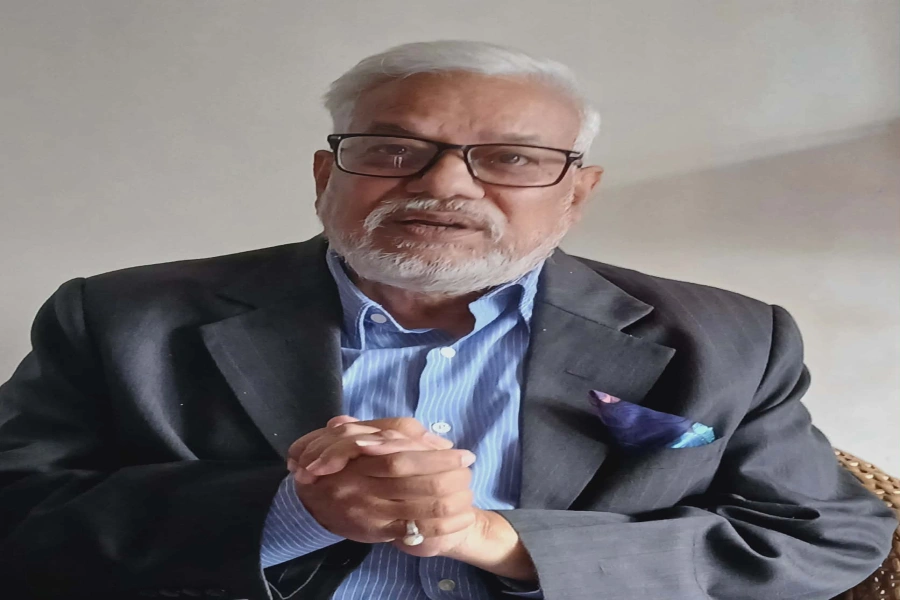
Shankar Prasad Koirala, a retired government secretary, brings decades of experience in Nepal’s Home Ministry, including serving as Chief District Officer (CDO) in multiple districts. He has extensive experience coordinating election security and overseeing general law and order across the country. Koirala also dedicated significant time in Peace and Security Division of the ministry, responsible for monitoring nationwide security, guiding district administrations and ensuring cooperation among various security agencies. Republica's Editor Kosh Raj Koirala spoke with Secretary Koirala to gain insight into the security and administrative challenges facing Nepal as it prepares for elections scheduled for March 5.
Excerpts:
The government is now preparing to hold elections, which are not very far away. How do you assess the current security situation ahead of the elections?
The security situation is being prepared with the elections in mind. However, after the Gen Z movement—particularly following the incidents on September 8 and 9—the situation became extremely complex and highly challenging. Weapons surfaced in various locations, and prisoners convicted of serious crimes escaped from jails. Many fled. As a result, the general public strongly felt that the security threat had increased. Bringing such a serious situation back to normal was a daunting task.
In particular, the morale of the Nepal Police had declined. When other security agencies were unable to provide adequate support, the Nepal Police—stationed on the front line to maintain law and order—faced even greater challenges. On one hand, police weapons were looted; on the other, police personnel were beaten and even killed. Police posts and stations were vandalised, torched, and destroyed. Managing the situation under such circumstances was extremely difficult.
Gradually, however, a sense of tolerance emerged among the Nepali people. Citizens themselves helped rebuild buildings of security agencies. In some cases, they assisted in recovering looted weapons and provided information about escaped prisoners hiding in villages. Due to this public cooperation and improving coordination among security agencies, the security situation has been gradually improving.
Now, as for the period leading up to the election, stronger security arrangements are required. Elections carry the risk of undesirable activities—whether from political parties, clashes between candidates, or infiltration aimed at destabilising law and order. Therefore, election security must be made even more reliable and credible.
What needs to be done to ensure this?
First of all, as I understand, the Ministry of Home Affairs is preparing an integrated security plan, which is nearly complete. The concept of an integrated security plan began during the second Constituent Assembly election. Prior to that, security plans existed but were not integrated. Since then, the plan has been refined and improved.
Trust-Building Ahead of HoR Polls
The plan itself is sound. However, the key issue is implementation. How effectively will the four security agencies and supporting institutions coordinate and cooperate? Leadership—particularly from the Ministry of Home Affairs, which leads election security—is crucial.
Security coordination meetings have already been held in various provinces, which is a positive step. However, effective security requires joint coordination between provincial ministries (including internal affairs ministries), core security agencies, and other bodies that directly affect security. This largely depends on how proactive the federal government—especially the Ministry of Home Affairs—is.
We are now in a federal system. Provinces have their own internal affairs ministries, and local governments also exist. Coordination across all levels of government is essential for security. Logistics management and the mobilisation of local security personnel—present in every municipality—are equally important. Overall, the federal government must take a leadership role and earn the trust of provincial and local governments to strengthen election security.
Based on your long experience working in the home ministry and with many home ministers, how do you assess the performance of the current political leadership?
From my initial assessment, it appears that during the Gen Z movement and the subsequent incidents, the political leadership of the Home Ministry failed to exercise effective leadership. The Home Ministry is responsible not only for peace and security but also for good governance and corruption control. Chief District Officers represent the government in every district.
Public expectations—especially those of the Gen Z youth—regarding good governance, corruption control, and security were not met. This dissatisfaction is widespread. I also feel that far more could and should have been done.
For instance, individuals within the security agencies who failed to responsibly carry out their duties should have been identified. While Gen Z members themselves were not involved in arson or vandalism, serious crimes were committed in the name of the movement. National heritage sites, administrative and judicial buildings, and corporate houses were attacked. These acts should have been taken seriously, and those responsible should have been brought under the law.
Burning cultural, administrative, and judicial heritage sites indiscriminately is unacceptable. Corporate houses play a vital role in employment generation. Arson against such businesses does not only damage property; it directly affects the livelihoods of many families. If these acts are not addressed legally now, there is a risk they will be repeated.
Investigations should also have distinguished between those with criminal intent and those who merely joined protests impulsively. Looting, vandalising, and destroying physical structures to erase evidence through arson cannot be justified under any circumstances.
What immediate steps should the Ministry of Home Affairs take to ensure robust election security?
First and foremost, elections are contested by political parties, along with some independent candidates. Above all, the government must gain the trust of political parties. Building confidence in the security arrangements is essential, and this responsibility lies with the Home Ministry’s political leadership.
One cannot claim to be preparing for elections while avoiding dialogue with political parties. In my experience working with many home ministers, they personally led discussions with political parties, stakeholders and the media. Administrative leadership supports this process, but political leadership must take the lead. At present, the public perception is that the Home Ministry’s political leadership appears weak.
There is also debate about whether the election should be held in a single phase or multiple phases. The government has announced plans to recruit around 150,000 temporary police personnel. From a practical standpoint, which approach is better—single-phase or multi-phase elections?
If security arrangements are strong and the government can assure both the public and political parties, there should be no security-related obstacles to holding elections. Nepal has sufficient human resources—the Nepali Army, Nepal Police, Armed Police Force—and additional temporary police are also planned. Based on experience, a single-phase election is more efficient and manageable than a multi-phase one. Multi-phase elections require repeated redeployment of security personnel, longer timelines, prolonged storage and guarding of ballot boxes, and greater manpower. A single-phase election reduces these complications and is feasible if all security agencies and public institutions cooperate.
Logistics and polling staff are also crucial. In some cases, errors by polling staff themselves have contributed to security disturbances. Therefore, the government must work comprehensively to create a conducive environment. Regarding the proposed number of temporary police, recruiting 150,000 seems excessive. While the number of registered voters has increased, the number of polling centres has actually decreased. More voters do not automatically require a proportionate increase in security personnel. Moreover, many young voters are abroad, meaning actual turnout has not increased significantly.
Overseas Nepalis—who support the economy through remittances—have been deprived of voting rights, which is deeply unfortunate. Even within the country, many citizens living away from their home districts face difficulties voting. Pilot projects allowing people to vote where they work—especially in major cities—could have been implemented without much difficulty. This would have prevented the loss of potentially decisive votes.
Regarding the deployment of the four security agencies, the integrated security plan clearly defines roles—first ring, second ring, and third ring security—as well as deployment at polling centres, voter movement, ballot box security, and overall procedures. The plan is tested and reliable. District Chief Officers lead implementation in coordination with chief election officers. Problems arise only when agencies fail to follow the plan. Accountability must be ensured, and disciplinary action should be taken when necessary.
What role does intelligence play in election security, and how effective is Nepal’s intelligence apparatus at present?
Intelligence plays a crucial role. Nepal’s National Investigation Department (NID), now under the Ministry of Home Affairs, has been criticised for being largely ineffective. Recruitment practices since 2046 BS were flawed, with political appointments undermining professionalism. Intelligence cannot function without resources—it must be funded. However, resources must go hand in hand with integrity and systems to verify information reliability. Professionalism must be strengthened through better recruitment, training, exposure, and ethical discipline.
Nepal also lacks a proper counter-intelligence wing. In today’s globalised world, it is essential to monitor both internal and external actors. This is an area that now requires serious attention. Finally, turning to governance and service delivery: the Gen Z movement demanded good governance, corruption control, and effective service delivery. It has now been 101 days since the Gen-Z backed government came into office.
What tangible changes have people experienced so far, and what should be done differently?
Not much has changed in substance. Apart from lifting the social media ban and a few actions taken by the anti-corruption commission, there have been no significant improvements. Service delivery remains burdensome. Except for one or two ministers, there has been little meaningful contribution toward reform.
Investigating the assets of officials since 2008 could have been done through a dedicated commission. Frequent transfers of Chief District Officers during the interim period have further weakened service delivery. Corruption control is primarily the government’s responsibility, not just that of the anti-corruption commission. Ministries themselves have not taken visible action against corruption or service delivery failures. As a result, the public has not felt real change. Whether due to a lack of political will or a lack of vision, the outcome remains the same.