

KATHMANDU, Dec 9 : The open border of the Nepal–India has long enabled easy trade — and an equally active, shadowy parallel economy. At its center lies a sprawling smuggling network that thrives on access, profit and weak enforcement.
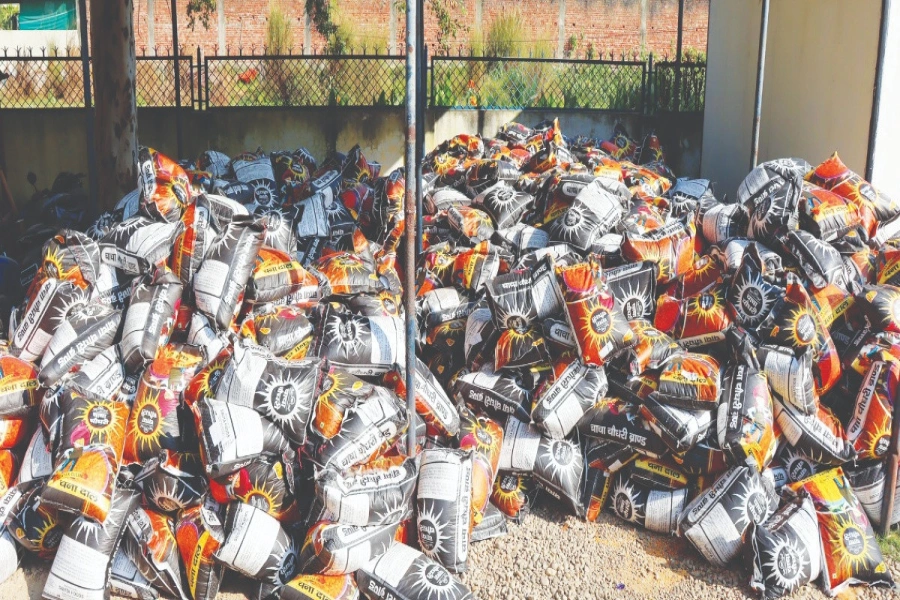
A recent police raid on Muskan Traders, a warehouse near Bardiya Bus Park in Nepalgunj-1, has offered a rare window into this hidden system. Officers seized 33,900 kilograms of peas (1,130 sacks) — a commodity whose import into Nepal is officially banned. More than just an illicit food shipment, the haul is being viewed as the signature of a well-organized, well-protected smuggling chain built on money, influence, risk-sharing and institutional blind spots.
Because pea import is prohibited, such a massive consignment could not have slipped through a crowded checkpoint like Jamunaha, nor through any informal trail, without coordinated facilitation. Police are now questioning how — and from where — the consignment entered. If it indeed passed through the Integrated Check Post (ICP), the issue stretches far beyond one trader to the integrity of the entire regulatory system. How many officials looked the other way? How many tacit approvals kept the operation running? And how long has this collusion been in place?
Nepali, Indian traders have set up offices in Hong Kong to faci...

The seized peas were found in the warehouse of Muskan Traders operated by Mubarak Ahmad Kawadia. Investigators say no individual would take such a risk alone; in large-scale smuggling, risk is distributed across many actors. Different people coordinate transport, paperwork, customs clearance, storage and distribution — all linked by a network designed to bend rules and evade oversight. Kawadia, police say, may not be the mastermind but is a key node pointing to larger players on both sides of the border.
Nepalgunj’s border belt has long been considered a favourable corridor for smuggling: an open border, weak surveillance, political protection and lucrative margins make it ideal terrain. This latest case suggests an operation far more systematic and possibly shielded than routine petty smuggling. It has raised suspicion of an entrenched cross-border arrangement involving traders, transport groups, local-level officials and individuals with access to customs procedures — an arrangement quietly functioning for years.
“It is extremely difficult for such a large volume to enter through a single checkpoint unnoticed,” said SP Angur GC of Banke District Police Office. His statement underlines two critical questions: Where is the real entry gate for these consignments? And where exactly is coordination failing among state agencies responsible for border and customs control? If loopholes exist even at high-security posts like the ICP, the smuggling network is bound to grow stronger.
Police describe the Muskan Traders haul as only one phase of a much larger movement. No one knows how many similar consignments have already entered, how many reached the market undetected or how many more are en route. What is clear, however, is that smuggling in the Nepalgunj corridor has evolved from sporadic trade violations into an institutional structure.
Breaking that structure, police officials say, will require more than police raids. It demands customs reform, transparent management, technology-driven border monitoring and firm checks on local political influence. The 33,900-kilogram pea seizure is only a sample — but it exposes a network that is broader, deeper and more entrenched than previously acknowledged.
Police have handed the seized consignment to Nepalgunj Customs Office and are continuing their investigation.






-1782782519.webp)


-1200x560-1774606010.webp)


