KATHMANDU, Nov 26: Until about a decade ago, women and girls in Nepali society were particularly at high risk of domestic violence, physical assault and sexual violence.
However, with the evolution of information technology and easy access to the internet, the nature of violence has changed. In recent years, women and girls have increasingly found themselves severely affected by “digital” and “online” violence.
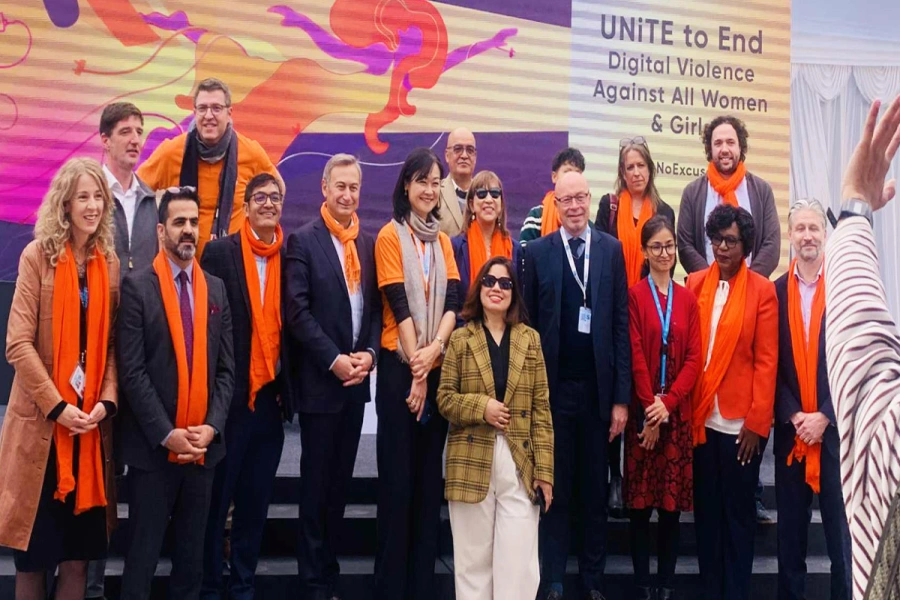
As such violence, stemming from the misuse of technology, takes a more severe form, stakeholders have stressed the need for strict measures to immediately control and regulate it. On the first day of the “16 Days of Activism Against Gender-Based Violence,” which began on Tuesday, speakers at a special program organized by UN Women discussed the alarming rise in online and digital violence against women and girls, emphasizing the need for integrated efforts from both the state and society to curb it.
‘Digital terror that makes women feel unsafe even inside their homes’
Addressing the event, UN Resident Coordinator for Nepal Hanaa Singer-Hamdy remarked that with technological development, gender-based violence has now entered homes through mobile phones and the internet.
She said, “You no longer need to step outside or walk through dark alleys to feel unsafe. Now, messages and threats come online, making you feel unsafe even in your own bedroom and inside your house.”
Desperate search for missing girls as nearly 80 dead in Texas f...

Hamdy presented data showing the rapidly increasing impact of digital violence in the Asia-Pacific region, especially in Nepal. Citing a recent UN report, she said, “Sixty percent of women worldwide have faced some form of digital or online violence.”
According to her, women active in public life—politicians, journalists, and women from marginalized communities—are more frequently targeted through technology. She pointed out that the situation is especially concerning for women journalists. According to her, 73 percent of women journalists globally have experienced such violence.
“This kind of abuse through online and digital means is not just a trivial joke or drama—it is a serious violation of human rights and a form of violence against women,” she said. She noted that such violence causes lifelong psychological trauma, damages social reputation, leads to family breakdown, and pushes victims backward economically. She also said that threats against women politicians through digital platforms are increasing in the Asia-Pacific region.
Shocking data: 62 cybercrime complaints filed each day
According to government data, about 65 percent of Nepal’s population currently has access to the internet. While online platforms have created unprecedented access to information and knowledge, they have also opened new avenues for violence against women and girls.
The latest report from the Cyber Bureau of Nepal Police, presented at the event, revealed a frightening situation. According to the Cyber Bureau’s data, a total of 18,926 cybercrime cases were registered in the last Fiscal Year (FY) alone. This averages out to 62 cybercrime cases registered with the police every single day.
A significant share of these complaints is related to women and girls. According to the data, 7,900 complaints are directly related to incidents where women and girls were the victims. When categorizing complaints of violence against women at the Cyber Bureau, around 1,900 cases were found to be of a serious nature. These include 1,095 incidents of online abuse, 195 cases of hate speech, and 184 cases of sexual misconduct.
Similarly, there are 27 cases of character assassination based on false allegations. Alarmingly, 176 complaints are related to violence against minor girls through online means. These figures clearly show how unsafe Nepal’s digital space is becoming for women and children.
Commitment to policy reform for a safe internet
Speaking as the chief guest, Minister for Communication and Information Technology Jagdish Kharel said that although it is impossible to stay away from the online world in the digital era, safe usage remains the key issue today. He acknowledged that threats, hate messages, trolling, and cyberbullying through online platforms have created fear in society.
Minister Kharel said, “Online violence has also hindered people’s right to free speech and freedom of expression. To address this, the government is taking steps to amend laws and policies in a timely manner.” He said efforts are underway to reform cyber policies and laws, promote digital literacy at the school and community levels, and ensure safe internet use to make Nepal digitally secure. “We are committed to making social media and digital platforms safe, respectful, and free from fear for all women and girls,” he said.
‘Opportunities won’t come until safety is ensured’
UN Women Nepal Representative Patricia Fernandez Pacheco said that information technology cannot become a tool for development and opportunity for women until it becomes safe for them. She said, “Let’s make information technology safe first—only then will it become a door of opportunity for women.”
According to Fernandez, although the 16 Days of Activism Against Gender-Based Violence have been observed annually, this year UN Women has decided to focus the campaign on “digital violence,” a new and complex form of violence against women. This year’s theme is “Unite to End Digital Violence Against Women.”
She said that although the world is becoming increasingly technological and digital, providing opportunities for economic growth, the same medium has become a weapon against women. “Various studies conducted in Nepal have shown that women politicians who participated in local elections and women with public identities have been widely targeted with character assassination and hate speech through digital platforms,” she said. Such an environment, she noted, discourages women from speaking freely, using digital platforms for economic opportunities, and stepping into leadership roles.
The program featured a detailed panel discussion on various dimensions of online violence, the nature of violence against women and girls through digital content, and measures for safe internet use. UN Women also screened a video highlighting the forms of online violence faced by adolescent girls, showcased murals, and displayed awareness-oriented digital content to mark the beginning of the 16-day campaign.
Stakeholders drew the government’s attention to weak law enforcement and a lack of digital literacy, which allow perpetrators to escape and victims to suffer further.