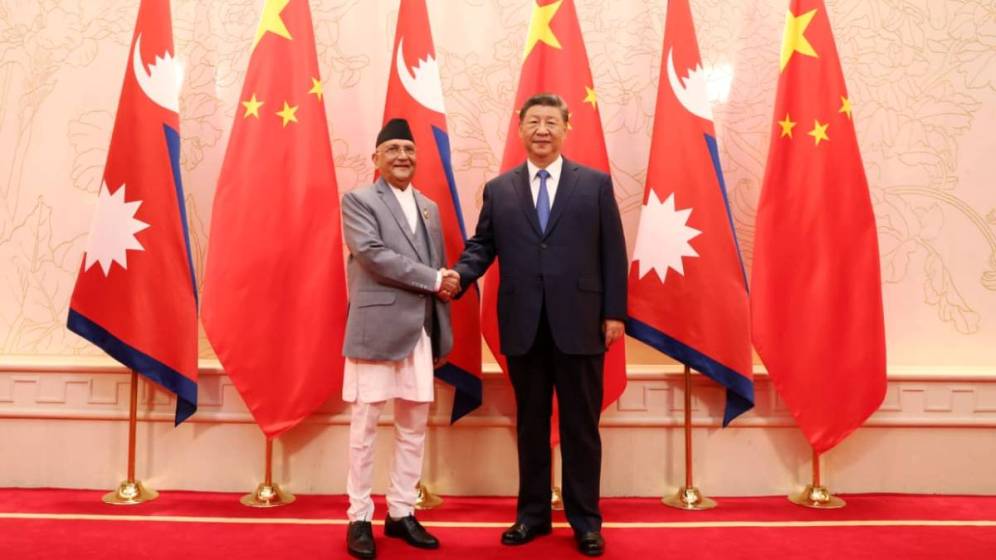
KATHMANDU, Sept 2: Even a decade after signing a transport agreement with China, it has yet to be implemented. Although the agreement was reached during Prime Minister KP Sharma Oli’s visit to China in March 2016, Nepal has not been able to utilize its benefits. The transport agreement and its protocol remain limited to paper.
Nepal’s foreign trade with third countries depends almost entirely on India. As a landlocked country, Nepal has been conducting imports and exports with third countries via India’s Kolkata port. Since Nepal has no direct access to the sea without using Indian territory, the agreement with China was intended to provide access to seaports through China for trade with third countries, thereby reducing dependency on India. Although the agreement was signed during the 2015 blockade by India, no implementation process has been initiated since then.
Former Secretary of the Ministry of Industry, Commerce, and Supplies, Purushottam Ojha, says the transport agreement with China has remained limited to political rhetoric. “After India’s blockade, the transport agreement was signed as a political move,” he said. “No work has been done to operationalize it since then.” Ojha noted that Nepal could use Chinese ports for trade with countries such as Japan, Vietnam, South Korea, and Taiwan. Nepal conducts billions of rupees’ worth of import and export trade with these countries, but so far, all of it has been routed through India’s Kolkata port. Despite repeated visits by Nepali prime ministers to China since the agreement, no initiatives have been taken to develop the necessary infrastructure for its implementation.
In Chitwan, youth entrepreneurs are producing paper from elepha...

In the last fiscal year (FY 2081/82 BS), Nepal’s trade with China amounted to Rs 341 billion in imports and Rs 2.63 billion in exports. Similarly, Nepal imported goods worth Rs 6.59 billion from Japan and exported Rs 1.91 billion. Trade with Taiwan amounted to Rs 2.43 billion in imports and Rs 200 million in exports, while trade with South Korea stood at Rs 6.83 billion in imports and Rs 476.5 million in exports.
The process for providing transport facilities—including where to transport goods and where to deliver them—remains incomplete in the protocol. Authorities say there must be a clear agreement between the two countries on the transport process. The government also needs to create an environment for private companies to transport goods. “There seems to be no study on costs or transit times,” Ojha said. “Signing the agreement alone serves no purpose.”
Although the Nepali market is flooded with Chinese goods, regular supply through the Tatopani and Kerung border points has not been possible. Road infrastructure and other issues have caused intermittent disruptions. As a result, goods from China often still have to be brought via India’s Kolkata port. Although there has been talk of transporting goods by rail from China, even basic road upgrades have not received attention.
It was expected that Nepal’s access to seaports via China would boost the trade sector. However, since overall trade between China and Nepal is relatively small, Chinese authorities have not prioritized it, as they have numerous other foreign trade options, government officials say. “For China, which dominates the global market, Nepal is a minor concern,” said an official from the Ministry of Industry, Commerce, and Supplies. “Even though it is important for Nepal, we have not been able to take sufficient initiative.” Traders say that since the government has been unable to maintain regular operations at the main Chinese border points—Tatopani and Rasuwagadhi—it is doubtful that Nepal will be able to import goods from third countries via China.
The 17-point protocol signed with China at the time mentioned trade through six border points between the two countries. Although there was an agreement to use Tatopani, Kerung, Kimanthanka, Korala, Yari, and Olangchungola, implementation has not occurred. Even the operational Tatopani and Kerung border points open and close intermittently.
Olangchungola, Kimanthanka, and Korala have not been formally opened. The 1982 United Nations Convention on the Law of the Sea stipulates that landlocked countries must also have access to the sea. International norms allow such access only if there is a transport agreement with the country whose territory connects the landlocked nation to the sea.