

Convinced that the leaders of the UCPN (Maoist) have realized the status quo would help none of the parties, least of all themselves, the prime minister was in an upbeat mood. The Maoists have realized the futility of their protests and are serious about finding a way to end the stalemate, he said.
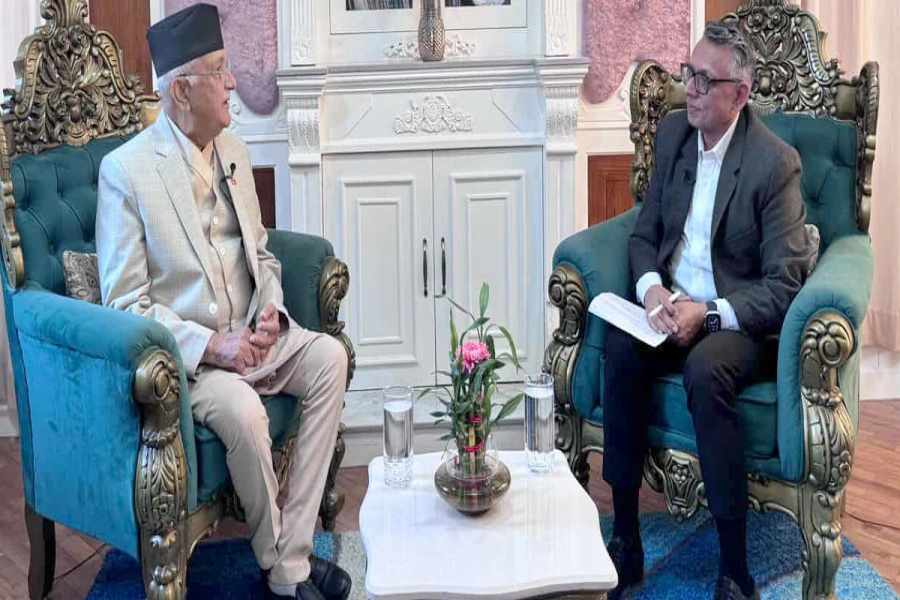
Myrepublica.com´s Ameet Dhakal and Damakant Jayshi caught up with the prime minister at his official residence at Baluwatar Thursday morning for an interview on contemporary issues.
Excerpts:
Myrepublica.com: The three parties met recently to find a way out. What is the government´s view on resolving the political deadlock?
Prime Minister: There is a possibility of ending the deadlock. The other day I went to participate in a meeting of the Constituent Assembly. Actually, I wanted to hold discussions with them (Maoists). They responded positively to my suggestion on holding a dialogue to end the deadlock, and we have met twice since then. The meetings in themselves are positively significant. But the media somehow missed that significance. Those who would not even shake hands are meeting and talking. That is a positive sign.
Even within the Maoist party there are people who want to resolve the problem and find a way out. There is realization of the need to reach a mid-point since no one can pull the other over to its side. A search is on for such a mid-point.
One thing is clear, though; we cannot drag the president into any controversy or place him in a difficult situation. The UML cannot agree to that, the Nepali Congress cannot agree to it, nor will other coalition partners.
There´s one contention of the Maoists that is worth considering: they worry not over an incident but fear whether a similar incident will work as a precedent. That shows they are worried about the future. So I reminded them about their real worry, that is, whether an incident will become a precedent. If the worry is about the future, why give so much weight to what has happened in the past? We suggested to the Maoists to look to the future and not to the past.
The future worry is whether the president will become autocratic, whether he will abuse his powers or whether there will be imposition of president´s rule. So why not agree on a constitutional arrangement bearing these factors in mind. That could be in the form of a joint resolution.
First part is analyzing the incidents that took place in the past. No matter who made the mistakes there are serious differences and misunderstanding among us. The need of the hour is understanding and consensus.
The second point is how to forge that consensus. For this, the important thing is defining the president´s rights and duties and the powers of the executive prime minister. The problem now is how to express our commitment to civilian supremacy, isn´t it so? We are committed to it; we never said anything to the contrary.
Myrepublica.com: If the worry is about not setting a bad precedent, doesn´t that imply that the president´s move and your recommendations were wrong?
PM: Is that so? What if the (then) prime minister´s move itself was wrong? Someone might argue that the president acted to correct the PM´s wrong move. Another may defend the prime minister´s action. Someone else might say only a prime minister commanding majority support could act in that way. A counter-argument could be that the PM is capable of taking any action irrespective of his status. We will define this as time passes.
.jpg)
Myrepublica.com: So the way out, you say, is reviewing the role of the president and the prime minister?
PM: No, there won´t be any review of past incidents. That won´t help resolve the problem. The important thing is trust. The Maoists also need to think where they went wrong. We need also to see how the current situation arose. The subsequent events (after Pushpa Kamal Dahal resigned) prove that the Maoists took their decisions in haste - whether it was seeking clarification from the army chief, or sacking him or Dahal resigning. They made mistakes. There was no need to resign.
The Maoists have always maintained that they want to change the status quo. So they could have accepted the president´s decision (to block the sacking of the army chief). That would have been an example of kram bhanga (breaking of continuity).
Myrepublica.com: Do you see any flexibility in the Maoist party to yield a way out?
PM: There are people within the party who are flexible.
Myrepublica.com: The three parties - Maoist, NC and UML - have had two recent meetings. Are these leading toward any solution?
PM: I had proposed a meeting several times in the past to break the deadlock. But they (Maoist leaders) did not respond immediately. Perhaps the time was not ripe; you see, everything takes time to mature, to ripen. In my view, the time now is right. There are people with reason in the Maoist party and they are the ones who can play a role in resolving the impasse.
Myrepublica.com: Will a common sankalpa prastav (resolution motion) find a way out? How much time will it take to finalize a common draft?
PM: We should not take everything as a definite deadline. These things take time. But I am optimistic.
Myrepublica.com: Did the UML give its consent for seeking an explanation from the army chief?
PM: Our party chairman had said that an explanation could be sought from the army chief but he had expected the Maoist leadership would hold consultations over the issues before seeking the clarifications. But there was no consultation preparatory to seeking clarifications.
Myrepublica.com: Of the two issues raised by the Maoists - ´correcting´ the president´s move and leading the new government - it looks like the current discussions are focusing only on the former. Isn´t that so?
PM: Who has prevented them from leading the government if they feel only they can lead it? If they get a majority, can anyone stop them from leading the government? They always have that right. As soon as they get the majority, they can form the government.
Myrepublica.com: So you mean to say that the parties need to resolve the first issue after forging an understanding, and so far as a national government is concerned, they need to first muster a majority?
PM: This is already a national government. It has a majority. They (Maoists) are in opposition, a kind of government-in-waiting. But as the opposition, one may have to wait five years or wait until the next election. We have been in government, we have also played our role as an opposition. In Japan, they had to wait for 50 years for a change in the government.
The parties that have supported the government are firmly behind it.
If the Maoists grow too impatient, they will be the biggest losers. Confusion will only lead to unthinkable consequences. Try to understand my indication. The Maoists have the key to make the situation better or worse.

Myrepublica.com: Are you suggesting that if the situation is not resolved soon enough, there could be president´s rule or some other alternative?
PM: The Maoists have been spreading a rumor that there has been something underhand in this regard. There must be something behind what they are saying. They might have some indication, information or some clues since they were in government for nine months. I heard that the Maoist leaders changed their apartments after coming across such information. Those who are involved in politics get such indications. It is said that whales change their movement when a storm rocks their ocean. It is just like that in politics as well.
Myrepublica.com: The major political parties are sitting together for a politics based on consensus. Nevertheless, the Maoists have been seeking an alternative government under their own leadership. What do you say to this?
PM: You can launch efforts to form a government if there is no government. They (Maoists) can then claim to lead the government. Did we ever say such things when the Maoist government was in place? One can do so when there is no government. All parties can stake claims to form the government under their leadership when there is no government in place.
Myrepublica.com: So the Maoists need to muster a majority first before they can lay claim to forming the government?
PM: Yes. There is no alternative.
Myrepublica.com: But some of your own party (CPN-UML) leaders have been saying that this government may not last.
PM: Just this morning, the party chairman (Jhala Nath Khanal) categorically said that there is no alternative to this government. He said the government will last its full term. So it is not true that my own party is not behind the government. This government has the responsibility of drafting the new constitution and holding fresh elections.
Myrepublica.com: Some leaders have been saying different things at different times, one of which is that the Maoists could lead a national government after forging a consensus. So isn´t this factionalism in the UML making the government unstable?
PM: There´s no instability due to the UML. Some issues have been raised within the UML. We are trying to sort out the differences. These are internal party matters and we will resolve them.
Myrepublica.com: Some leaders have accused you and chairman Khanal of promoting factionalism within the party for your own vested interests. What do you have to say?
PM: See, I am a very busy person (as prime minister) and I do not have time for all that. I am here to accomplish the tasks of the prime minister. There are many things that I need to do. People have a lot of expectations and there is hardly enough time. I am like a horse moving forward fast. My catchword is ´fast, fast, fast´. Factionalism and machinations are not in my nature. I have had an important role in building the party. So no one should even imagine that I could harm the party. Of course, we have not been able to give the party the required attention due to our busy schedule, but we need to pay attention to it.
Myrepublica.com: Recently, you accused some leaders of your party of acting improperly. Five UML leaders accused you of exacerbating differences between chairman Khanal and K P Oli so as to re-establish yourself as leader of the party.
PM: That is not true. I don´t have such plans. I have my hands full as prime minister. In fact, I had already planned a tour of Africa. Had I not become prime minister, I would have gone to South Africa and other countries.
Myrepublica.com: It was your party that forwarded your name for prime minister and the chairman himself proposed it at a party meeting. Do you think he did so under compulsion? Did he want to become PM himself?
PM: How can you conclude whether or not he wanted to become prime minister? Is it proper to accuse him of that even though he proposed my name? Similarly, I proposed his (Khanal´s) name as general secretary, thinking that he was competent enough to lead the party. Who will be a bigger fool than me by making such a proposal and then regretting it? Of course, others may have wanted to be party chief. I have no regret over my decision.
Myrepublica.com: If there is agreement and the deadlock is broken, discussions over the constitution may move forward. But the constitution cannot be written and passed by a two-thirds majority without the Maoists supporting it. If they insist that the constitution-writing will be completed only if they lead the government, what will happen then?
PM: Will taking such a stance help? I don´t think so. What would you do if a person insists that he would not allow anything to take place unless he is made prime minister first?
Myrepublica.com: What if they continue to remain obdurate?
PM: What will everyone say? I entered the football field and could not score goals. If someone else scores, can I say I too need to score or else no game? What kind of attitude is that? Why blame others for your own fault?
Myrepublica.com: There is a deadline of two years to complete drafting the constitution and there cannot be any amendment to the constitution over the president´s role. Maoist rigidity over their leading the government also continues. Under these circumstances should the Maoists be allowed to form a government under their leadership in order to bring them into consensus?
PM: This is akin to surrender. Why would one stick to a certain party if it means surrender? What if others do the same thing, that is, demand a change in the rules of the game right in the middle of it? Aren´t they aware they could be in the same position we are in now?
Myrepublica.com: How important is your visit to the United Nations in New York?
PM: Very important. First of all, the UN General Assembly this year is going to focus on the impact of climate change. We will present Nepal´s position on that.
Secondly, US President Barack Obama has invited me to take part in a meeting of the 10 nations contributing the largest number of troops to UN peacekeeping missions. That will be an invaluable opportunity for me to highlight Nepal´s peace process. Thirdly, British Prime Minister Gordon Brown has given me an invitation, impressed over the progress made by Nepal in the health sector. If I can meet Japan´s Prime Minister (Yukio Hatoyama), I will be very happy. I had met him last year in Japan when he was deputy leader of his party (Democratic Party of Japan). We wished each other well. He also wished me luck in becoming prime minister.
Myrepublica.com: You are visiting China after your visit to the UN. There has been some kind of debate and controversy surrounding relations with China and India. What is your approach to China and India?
PM: Of course, Nepal´s interests are key. Friendship, understanding and cordial relations with neighbors are what we look for. I am always guided by these principles.
Myrepublica.com: Some say that Nepal has special relations with India while many others argue that Nepal should maintain equi-distant relations with both India and China? What do you say?
PM: I do not want to use words like equi-distant and equi-proximity. Both countries are our most needed friends. And our relationship with both countries has remained very friendly. Nepal could benefit from the economic progress made by both the countries. Therefore, peace and stability in both countries are in the best interests of Nepal. We should be able to realize the concerns and worries of both countries.
Myrepublica.com: There was talk of ´democratization´ of the army in the recent meeting of the National Security Council. How significant this is in the context of the dispute between the last government and the last army chief?
PM: Democratization of the army has been mentioned in the Interim Constitution. It is not a new concept. Yesterday, I met a group of intellectuals and asked them about ways to bring about democratization in the army.
Myrepublica.com: Did you ask the NSC to prepare a plan?
PM: Yes. I asked them to prepare a plan for democratization and integration.
ameetdhakal@gmail.com
damakant@myrepublica.com
Related story
Week display of world’s most expensive smart phone


-1765616104-1765618344.webp)












-1765616104.webp)