That the Maoists frequently engage in revolt talks is understandable; for, that is what they find in their revolutionary guidebooks. But that the non-Maoist camp, including the political parties and a large section of the mainstream media and “civil society” activists, should use the same phrases with equal passion looks a bit out of place. Maoist “designs” [of revolt] and Maoist “true intentions” [of revolt] are frequently invoked by non-Maoist camps. The Maoists, in the meantime, seem to be wallowing in the power liberally bestowed upon them by their opponents. The fact, however, is that other than the vague notion of “capturing the state” that will play out in urban Nepal, nobody seems to clearly know what a revolt really looks like, and how it is actualized. Is an urban revolt imminent?
To answer this question, it is worth examining the diverse social forces and sensibilities that went into the making of the Maoist insurgency during 1996-2006. First, the Maoists found favorable “structural” conditions during the period. The historical animosity between the country’s two powerful political parties, the Nepali Congress (NC) and the Communist Party of Nepal-Unified Marxist Leninist (CPN-UML) reemerged immediately after the 1990 political change. And both parties had been deeply suspicious of the King-Army camp. A section of the former Panchayat loyalists, whose social and political bases fast depleted, thanks to NC’s wholesale acceptance of Panchayat stalwarts, had been considerably ambivalent about the Maoists. Even the deposed king Gyanendra once remarked that the “terrorists” had good intentions. Add to this the pseudo-contradiction between the then royal palace and the Indian establishments. And yes, it was a pre-9/11 world order. Not surprisingly, the former US ambassador to Nepal Ralph Frank has gone on record sympathizing with the Maoist causes.
The role of urban intellectuals and activists was even more curious. These activists, who later became active in the name of civil society, had successfully carved for themselves a political space in the course of the 1990 movement. Consequently, a large number of urban intellectuals, journalists, and activists contributed to the Maoist causes in myriad ways. Militarization of society, state terrorism, and dialogue thus became the staple of urban political discourse in the course of insurgency. Curiously, nobody seriously contested the Maoist goals. Even the mainstream journalists could not help but report, in a good frequency, the Maoist bravery tales.
The Maoist “strategies” thus found a hospitable place in urban Nepal, and it is wrong to assume that these conditions were “masterfully” created and manipulated by the Maoists. What the Maoists successfully did was to create an urban fantasy zone in which diverse groups and international forces could imagine their stakes. The insurgency thus grew with the urban fantasy that neatly mapped onto the flurry of Maoist guns in rural Nepal.
But where do the Maoists stand in 2011?
First, most structural conditions discussed above have radically changed now. The pseudo-contradiction between Narayanhiti and the Indian establishments has been resolved, at least temporarily. The ideological differences between the NC, CPN-UML, and the monarchists are all but vanished in the face of Maoist class threat. This is the post-9/11 world order, marked by powerful late-capitalist economic, military, and cultural forces. Maoist “sympathizers,” including many Western Europeans, will resist should the Maoists radically depart from their promises. Moreover, the army has remained intact, and it has increasingly asserted its autonomy from the political classes since its historical low during the People’s Movement II. The Maoists know very well that the barrel of a gun greatly matters when it comes to pursing revolutionary goals.
Second, the urban fantasy had never been a carte blanche to the Maoists. Urban activists and “progressives” hardly meant a class and cultural upheaval—definitely not both at the same time, as the Maoists have aimed at—when they fantasized New Nepal in the Maoist insurgency. Civil society activists who collectively and meticulously crafted an urban space for the Maoists are fragmented, with virtually no one publicly sympathizing with the Maoists. Many still consider the Maoists a “progressive” force, but they are hard pressed to find one or two reasons to firmly support the Maoists.
The Maoist inability to penetrate urban political space in the post-People’s Movement II can be seen in a series of student and professional body elections. Despite their impressive showing in urban areas in the Constituent Assembly elections in 2008, the Maoists have failed to make any headway among the urban educated class. Student union elections, held at the time when the Maoists were in power, for example, placed the Maoists as a distant third force after the NC and UML student wings. The election results of a number of professional bodies, including those of powerful actors such as journalists and lawyers, only showed that the Maoists were no match for the NC and UML. Urban space has thus considerably shrunk for the Maoists.
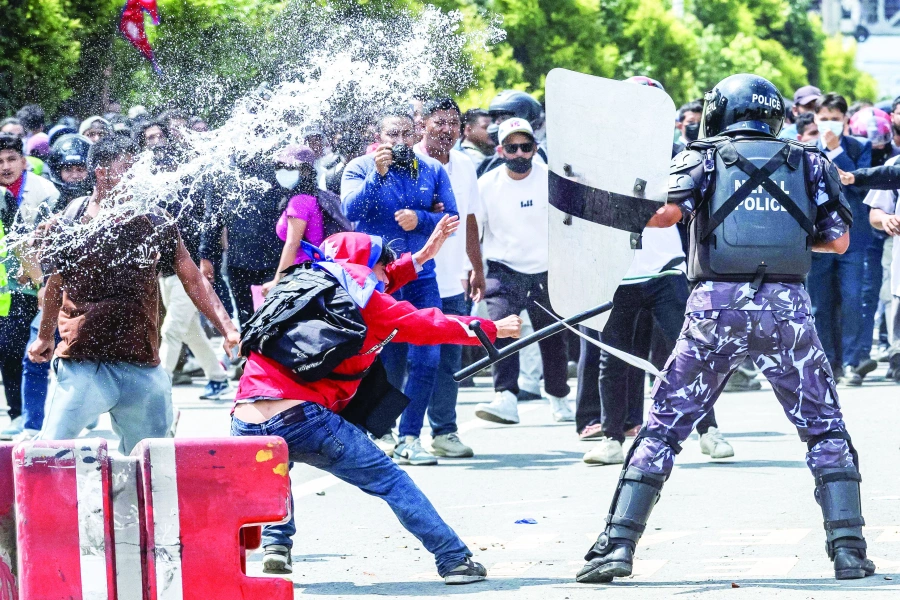
It is not then hard to see why the Maoist image of master strategists has been wildly exaggerated. The Maoists did have an opportunity for a real revolt when millions had marched on the streets at the height of the People’s Movement II in 2006. The Maoists could have used those moments of methodical madness to fashion a class-based revolt. But they chose, perhaps wisely, not to pursue that path. Back in May 2010, the Maoists experimented with a “final” revolt. The revolt, however, proved to be little more than a farce. It is unlikely that the Maoists have forgotten such sage words from Karl Marx: “Men make their own history, but they do not make it as they please.” Given the consistent brandishing of revolt imageries in Maoist public speeches and official documents, the fear of revolt on the part of non-Maoist parties looks legitimate; in private, NC and UML leaders, however, seem to be convinced that the Maoists are not stupid enough to go for a revolt.
But why do both the Maoists and non-Maoists incessantly engage in revolt talks?
It appears, firstly, that the cacophony of revolt talks serves other purposes. The Maoists seem to have assumed that revolt talks will scare their “enemies.” If that is true, the Maoists have failed to understand that their enemies are actually inviting them to go for a revolt. Secondly, the Maoists perhaps find revolt talks useful to keep high the morale of their fighters. In either case, the Maoists have been squandering historic opportunities to show the people that Nepal’s rulers need not be the same, and that they come from a different breed. The current constitutional setup and power equation allows the Maoists to do a million good things for the people, and the good news is that such programs will not be anti-revolutionary!
The non-Maoist camp, on the other hand, by revolt talks, seems to have thought that they can keep intact their old privileges and prolong the “good” old days. Revolt talks have lately also become an excuse in fomenting an anti-Maoist opportunistic coalition that is resistant to change and timely completion of constitution writing. The non-Maoist camp can do better if they realize that revolt talk is no substitute for their meaningful participation in solving the current political mess, which is in part their own making.
Still, the question remains: What if a revolt is actually launched by the Maoists? After all, revolutionaries are known for fighting against all the odds. If by revolt the Maoists mean burning tyres for a few days or even weeks, they are perfectly capable of doing that. They can perhaps even return to the jungle to relaunch the insurgency in an extremely inhospitable environment, but that is not the same thing as carrying out a successful class-based revolt from below.
For now, it is likely the cacophony of revolt serves other purposes. If that is true, revolt talks will be innocuous, but the downside is that it diverts attention from pressing social and political issues and will not go very far in solving the current political mess.
The writer is the professor of sociology at the Central Department of Sociology/Anthropology at Tribhuvan University. He can be reached at cbasnet@gmail.com
Related story
Elections after the Gen Z Revolt: Old Parties, New Fears