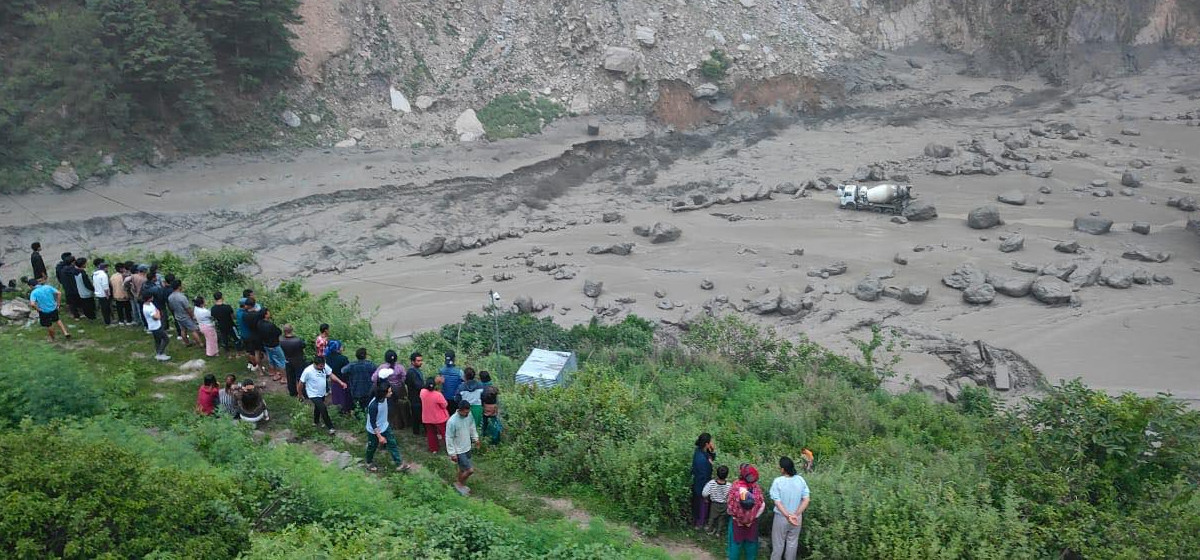
The devastating Bhotekoshi–Trishuli flood has left Nepal grieving for lives lost, families displaced, communities damaged and critical infrastructure destroyed. Right now, the priority is rescue, relief and support for those affected.
But as the country begins to look beyond the immediate crisis, there is one question worth considering—not to assign blame, but to think about how we can strengthen what is already in place:
What if technology and better coordination could give people even a few more minutes to respond?
We cannot prevent every natural disaster. Some events will always develop with little warning. But we can work to reduce the time between recognising a hazard and giving people a warning they can understand and act on.
Nepal already has important elements of an early-warning system, including flood monitoring, hydrological stations, community-based mechanisms and mass SMS alerts. During the recent disaster, warnings reached hundreds of thousands of people. That response matters and deserves recognition.
The question is not simply how many alerts are sent. It is how much actionable time the system creates for the people who receive them.
Those minutes can be gained at different points: detecting hazardous conditions earlier, verifying information faster, making quicker decisions, delivering warnings sooner and giving people clearer instructions.
This distinction matters. Detecting a flood after it has begun is different from detecting the conditions that could produce one. The earlier a developing hazard can be recognised, the more opportunity there may be to prepare downstream communities.
Getting Information on Time
Even a small increase could matter. Someone near a riverbank might have time to reach higher ground. A driver approaching a vulnerable crossing might turn around. A local official might alert nearby households or close a vulnerable road.
Vehicle pulled out from Bhote Koshi River, two passengers still...

These are not estimates of lives that would have been saved. Every situation is different, and it would be irresponsible to make that claim. The value of additional warning time depends on the location, the speed of the hazard and the actions available to people. The point is simply that every avoidable delay deserves attention.
This also means thinking beyond SMS.
A text message depends on someone receiving it, noticing it and acting on it. A phone may be silent, unavailable or out of power. During a major disaster, communications and monitoring infrastructure can also be damaged.
One option worth exploring is Cell Broadcast, which can send emergency alerts to compatible mobile devices within a defined geographic area. Unlike conventional SMS, it does not require people to subscribe to a particular warning list. Someone travelling through a vulnerable river corridor could receive a geographically targeted alert without having registered for a local service.
The Common Alerting Protocol (CAP) can help connect these channels, allowing one authoritative warning to reach mobile networks, radio, television, sirens, public-address systems and digital platforms.
The principle is simple: if someone misses one warning, another may still reach them.
But an alert is only useful if people understand what it means. A strong warning should communicate what is happening, where it is happening, how urgent the situation is and what people should do next. Reaching the right person is only part of the job; helping them make the right decision is the other part.
There are useful examples elsewhere. Japan’s J-Alert system connects national emergency information with local disaster-prevention systems, public-address infrastructure and mobile warnings. In the United States, Wireless Emergency Alerts provide geographically targeted notifications for imminent threats, including flash floods.
These systems operate in very different institutional and technical settings from Nepal, but they demonstrate the value of using several channels at once. Japan and the United States are not templates to copy; they are examples of how different layers can work together.
Nepal does not need to start from scratch. Many of the building blocks already exist. The opportunity is to connect them more effectively so information can move quickly from monitoring and other sources to authorities and, ultimately, to communities.
That means looking at the whole chain:
Detect → Verify → Decide → Alert → Deliver → Understand → Act.
A warning is not truly effective simply because it reaches a phone. It has to reach the right people, convey the level of risk clearly and give them enough practical time to respond.
The question, then, is where along that chain the next five or ten minutes can realistically be gained.
Cross-Border Cooperation
For a transboundary hazard, the warning chain can begin before the hazard reaches Nepal. Many of the country’s major rivers originate beyond its borders, and a rapidly developing hazard upstream can become a serious downstream threat very quickly.
Where a hazard can cross a border within minutes, reliable information needs to move just as quickly. In that sense, timely upstream information is part of the downstream warning system.
This is not about assigning responsibility to one side or another. Rivers, glaciers, landslides and other natural systems do not recognise political boundaries. Better coordination and faster information sharing between neighbouring countries can give communities more time to prepare.
There is already a foundation for this cooperation. Nepal and China have recently agreed to exchange meteorological information. Building on that, there is an opportunity to explore how information about rapidly developing hazards can be shared more quickly in the future.
The same principle applies within Nepal. We should measure an early-warning system by more than the number of alerts sent. We should look at how quickly a hazard is detected, verified, turned into an official warning, delivered, understood and followed by action.
Speed, however, cannot come at the expense of credibility. Repeated false or unclear warnings can cause people to ignore future alerts. The system therefore needs to be both fast and trusted.
Resilience also means planning for failure. Monitoring stations need backup power and, where possible, redundant sensors. Communication networks need alternative routes and failover capacity, while warning platforms should continue operating even when parts of the infrastructure are disrupted. A major disaster should be treated as a situation in which something may fail—and the system should be designed so that one failure does not silence the warning.
The Bhotekoshi disaster should therefore not simply lead us to ask whether an existing system worked or failed. It should prompt a broader conversation about what we want Nepal’s early-warning systems to look like five or ten years from now.
The measure of an early-warning system should not be only how many messages it sends, but how much trusted, actionable time it creates for people to respond.
That is perhaps one practical lesson we can take from this tragedy.
The author is a technology entrepreneur and founder and CEO of Genese Solution, focused on applying cloud, AI and emerging technologies to build more resilient digital systems.