



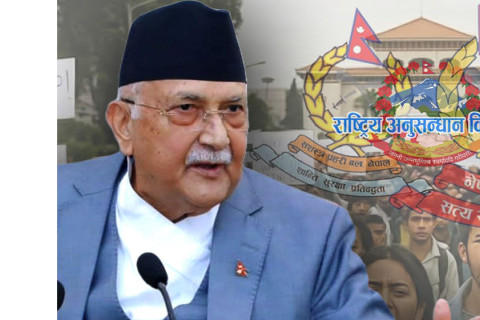
KATHMANDU, Oct 15: It is revealed that all three security agencies had briefed then–Prime Minister KP Sharma Oli about the violent Gen Z protests that took place on September 8 and 9 about a month ago, warning that the situation could spiral out of control.
According to sources, the security agencies had informed PM Oli that students from private colleges were communicating through digital platforms and that the movement could be infiltrated.
The agencies had also warned that groups seeking to exploit the royalist protest of March 28, 2025, could attempt to merge with dissatisfied factions of the Rastriya Swatantra Party and the CPN (Maoist Center) to infiltrate the movement. “We briefed the prime minister about the structure of the digital uprising, but he brushed it off, saying, ‘You do your job.’ After that, there was never any discussion about the Gen Z protests with the security bodies,” a senior security official said.
Heart to Heart with Malvika

The official added that Oli was also briefed about cyberattacks targeting both government and non-government infrastructures and about the Ministry of Home Affairs being run haphazardly. “There were cyberattacks on state and non-state systems. False and misleading information was spreading rapidly. At such a time, the home administration was operating purely on impulse. We had become mere executors of orders. Reporting directly to the prime minister is often criticized as ‘crossing the channel,’” the official said.
According to him, the prime minister was also briefed shortly after the March 28 incident about growing youth dissatisfaction and the digital mobilization of private college students in Kathmandu. “The security agencies delivered timely intelligence, but the government failed to respond on time,” he added.
Separate reports had been submitted by Nepal Police, the Armed Police Force and the National Investigation Department. Officials had verbally clarified that the internal security situation was deteriorating. “Developing a mechanism to set priorities for internal security and giving clear direction requires a national security policy. To implement such a policy, there must be strategies, plans, and programs. Nepal Police and the Armed Police Force should have been mobilized under an internal security strategy, but no one seemed interested. Where systems fail and merit is ignored, policies are never implemented,” he said.
The official added that they had discussed these same concerns with Oli regarding the March 28 incident and the growing pressure on the home administration. “Our final reporting channel was the prime minister himself. It took great effort to make our voices heard,” he said.
He further noted that unless lessons are learned and an effective internal security strategy is adopted to minimize the loss of life and property, Nepali youth will not find peace. To successfully conduct the election scheduled for March 5 next year, he said, the morale of the police, civil servants and voters must be restored. “It takes time for the wounds in people’s minds to heal,” he added.
According to the source, the security agencies had also conducted detailed briefings on issues raised on digital platforms such as rising organized crime, corruption, narrow communal and regional divisions, the use of technology in crime and obstacles to the rule of law — all concerns echoed by the youth.
The agencies had also informed Oli that the Ministry of Home Affairs lacked security expertise, which had caused problems in command and control during crises. They noted that instead of appointing experienced and capable officials with knowledge of internal security, the ministry often brought in politically loyal but weak and demoralized personnel, worsening the situation.
“Officials may be skilled at managing political leaders and generating resources, but when security challenges arise, they hide under the table and disappear when needed most. We told the prime minister exactly that, but he only smiled and said he would look into it,” the senior official said.





