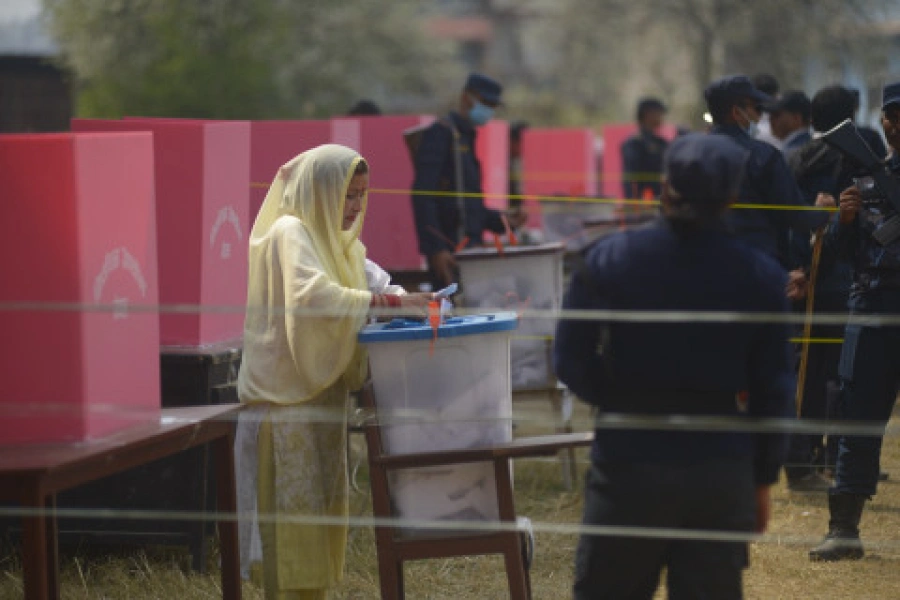
Even though the actual number of potential voters who have registered with the Election Commission to vote in the scheduled November 19 polls is down by 5.5 million—from 17.6 million to 12.1 million—since the last CA vote, there is little to suggest that the enthusiasm among the people to vote for a new constitution has diminished much in the last six years.
According to the latest census report, the national population of those above 18 years who are eligible to vote is 16.4 million; and the latest economic survey suggests as many as three million Nepalis might be working abroad. This leaves only a small population of eligible voters, a few million, who might be in the country but didn’t register. [break]
According to the Election Commission, the most important factor behind lower registration this time is the new electoral rolls with photos and biometrics, which has significantly cut down on fraudulent registration, duplication and other errors that had artificially inflated voter rolls for the 2008 CA polls. Most election observers in the country concur that the portion of those who might have willingly opted out is small.
This suggests that contrary to popular perception, a large section of the population is still very eager for a constitution through the CA mechanism. It has long been believed that the dissatisfaction among common people, and especially the youth who apparently want quick fixes, had grown to such levels that many would simply not bother to vote this time around. Even though the actual number that turns up on the voting day might be lower, the participation in the registration process gives encouraging signs.
The level of frustration with the political parties, especially the major parties, is undoubtedly high. But rather than ditching the electoral process, a bedrock of any democracy, people seem determined to express their dissatisfaction through the ballot box, as should again be the case in a functioning democracy. Everywhere, national election has a touch of festivity about it, with people taking time off chores to take part in this common celebration of democracy. The importance of the occasion and people’s sense of responsibility is heightened by the fact that this will be no ordinary election, but once in a lifetime opportunity to have a say in the drafting of the supreme law of the land.
With this resounding expression of common people’s faith in the democratic process, the onus is now on the political actors to get their act right and make sure that election takes place on the scheduled date. As the major parties prepare for the roundtable with CPN-Maoist and other agitating forces, there is still a distinct whiff of uncertainty over November 19 election.
Election postponement is one of the major conditions of CPN-Maoist. It will be up to the Big Four to try to accommodate as many of the dissenting groups’ demands (on such vital areas like CA size, the size of its PR component and electoral constituency delineation) without causing a major disruption in the status quo that could jeopardize prospects of timely polls. This is no small challenge. It cannot be achieved unless the parties on other side of the table are also ready to negotiate in good faith and keep the best interest of the country in mind. At this point it is hard to see how any political party can benefit in any way by standing against free, fair and timely election.
Related story
Nepali Congress blasts govt, terms latest move a 'bad omen' for...