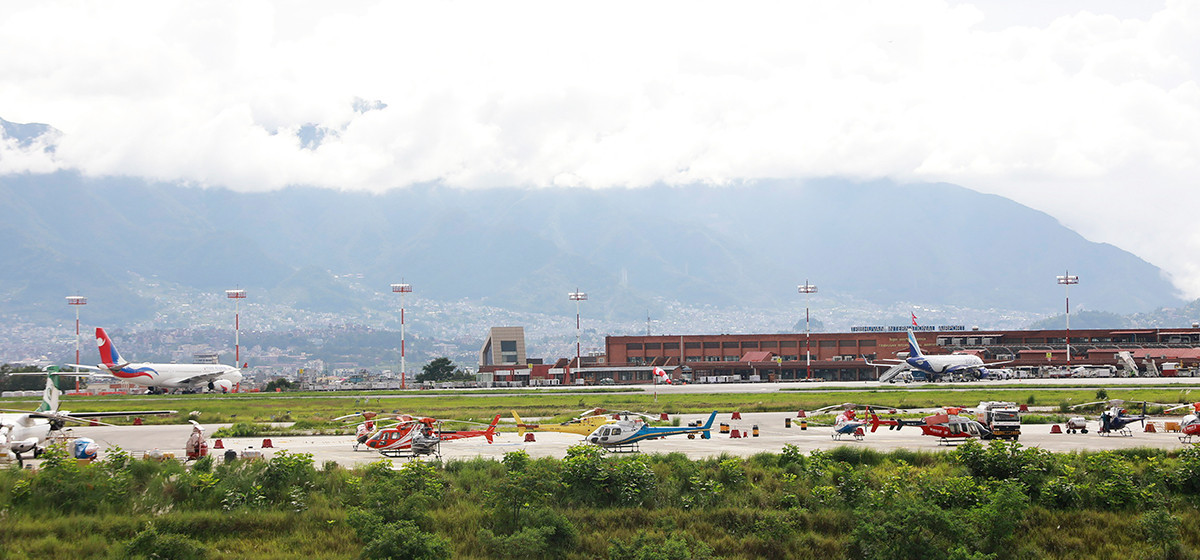
Traveling home by air during Dashain has become increasingly difficult for many Nepalis, as airline fares often skyrocket—even when booking months in advance. Despite early planning, many travelers face inflated ticket prices and limited availability.
Although airlines offer online booking, securing a seat during the festive season is a major challenge. Discounted fares are virtually unavailable, and even standard-priced tickets are hard to find.
For instance, the airfare from Kathmandu to Dhangadhi—one of the farthest destinations—can exceed Rs 17,000, while a flight to Biratnagar costs around Rs 9,700.
Nisha Pandey from Dhangadhi spent days searching for a flight ticket despite the high cost. She finally managed to buy one at an inflated price, but now worries about how she’ll get back to Kathmandu after the holidays.
Travellers suffer as contractors continue to delay maintenance...

Vasantraj Joshi from Bajhang faced a similar struggle, just as he had in previous years. Sangita Sapkota of Morang, unable to get a plane ticket to Biratnagar, was forced to travel by road instead.
With public complaints growing over expensive airfares, the Civil Aviation Authority of Nepal (CAAN) has repeatedly instructed airlines to keep fares reasonable. In light of the surge in holiday travelers, the Ministry of Culture, Tourism, and Civil Aviation recently held talks with CAAN officials and airline representatives to address the issue and ensure smoother travel during Dashain.
Asked why airfare hikes recur every Dashain, CAAN Information Officer Gyanendra Bhul dismissed the idea that airlines are overcharging arbitrarily.
“Everyone is saying fares are too high, but we’ve been continuously directing airlines to reduce them,” he said. “In response, Buddha Air, Yeti Airlines, and Shree Airlines have adjusted their systems, showing that the previously set maximum fare of Rs 17,000 to Dhangadhi has now been brought down to Rs 12,500.”
Bhul emphasized that this recurring issue underscores the need for a clearer and more transparent airfare system. According to the Civil Aviation Authority Act, 2053, CAAN recommends fare structures, the government approves them, and CAAN monitors their implementation. If airlines fail to comply, the Director General of CAAN has the authority to take punitive action.
There are two key sets of regulations under the Act: one for service providers and one for regulatory enforcement. These include the Airport Service Charge Regulation (2078) and the Civil Aviation Regulation (2058).
For international fares, pricing is determined through bilateral air service agreements. Nepal currently has such agreements with 42 countries. In most cases, an "open fare policy" is followed—meaning prices are dictated by supply and demand.
Domestically, the government sets both minimum and maximum fare limits based on airline operating costs. Airlines are not permitted to charge above the maximum limit. Fares for scheduled and charter flights must be approved by CAAN, with separate pricing structures for each.







_20210408095531.jfif)


-1784277548.webp)