



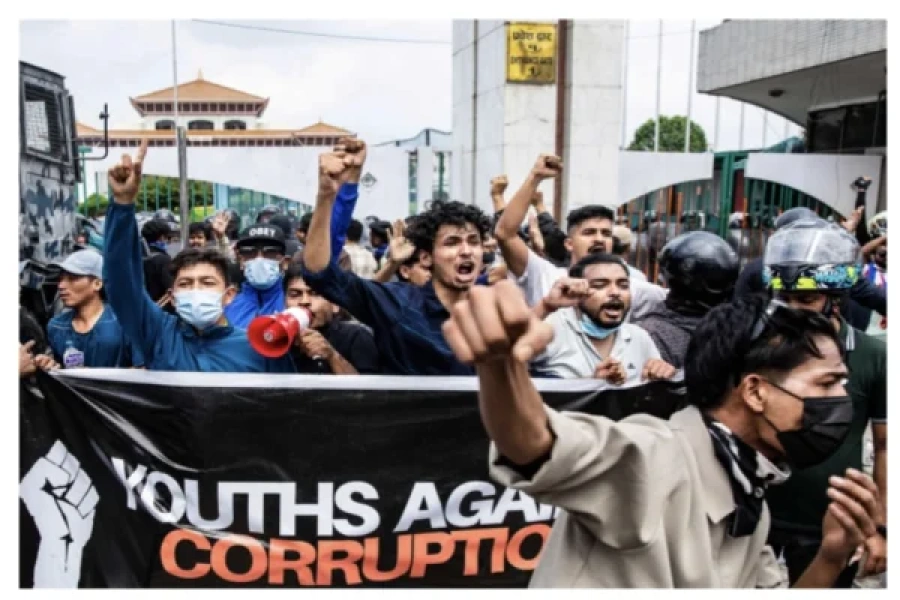
Gen Z is often described as impatient with old democratic rituals, but that diagnosis misses the point. The real divide is not ideological but temporal, a disagreement over how much of the future this generation must already carry and how much of the present can still be trusted. It is a split in perception rather than in values, shaped by the experience of navigating political institutions under conditions of relentless acceleration. Reinhart Koselleck’s notion of the widening gap between the space of experience and the horizon of expectation captures this tension precisely.
Long before youth frustration hardened into a headline on September 9 or became a convenient political talking point, I was noticing the fracture taking shape and writing about it, particularly in three opinion pieces from the mid-2010s: No Country for the Young, published in The Kathmandu Post on April 8, 2015; Youth of the Nation, published in The Kathmandu Post on February 20, 2015; and Quiet Riot Brewing, published in Republica in 2017. Together, these essays examined how young people were repeatedly invoked as the nation’s future while being denied real economic opportunity and political agency, producing not open rebellion but a slow and dangerous disengagement. The argument was that this quiet alienation, visible in migration, apathy, and the steady erosion of institutional trust, posed a deeper threat to democracy than episodic unrest, because a country that exhausts its youth ultimately hollows out its own future. At the time, neither the government nor society at large was prepared to listen.
Nepal now stands at precisely this juncture. If the future is not consciously integrated into democratic reform, the next rupture will be far deeper.
In the aftermath of the September 9 revolution, two distinct temperaments appear to be emerging within Gen Z. They are not adversaries, but parallel and rational responses to a world in which democratic institutions still move at an eighteenth century pace while technologies such as artificial intelligence advance exponentially. One temperament views stability as democracy’s most urgent asset after upheaval, while the other believes that without rapid adaptation to the age of AI, stability itself becomes an illusion. This reflects a classic problem of political decay. Societies are destabilized not by the absence of institutions, but by institutions that can no longer keep pace with social and technological change.
Status Quoist Gen Z
For this group, elections are not merely symbolic; they are the infrastructure of democracy. Nepal’s history explains this perspective. Periods of instability led to stalled development, uncertain governance, and a pervasive sense that everything was provisional. In this context, elections signify continuity. Continuity allows institutions to function, budgets to flow, and social trust to accumulate. Max Weber’s concept of legal-rational authority is visible here: legitimacy comes from predictable procedures rather than outcomes alone.
Apartheid is not peace

Democracy’s strength, for them, lies in repetition. Reform is not rejected but expected to occur within the system rather than through rupture. They hope for electoral victories by new parties and young leaders, yet always within procedural norms. Stability is not complacency; it is a public good that shields the most vulnerable. Edmund Burke’s caution is relevant: institutions carry accumulated social knowledge, and sudden disruption can harm those least able to absorb risk.
Economics reinforce this instinct. Youth unemployment in Nepal is high, and many jobs are vulnerable to AI. Life already feels precarious. Institutional stability functions as risk management. Elections, however imperfect, serve as guardrails against chaos. Repeating voting cycles, even when outcomes disappoint, prevents a slide into permanent exception. Karl Polanyi’s insight on this phenomenon is instructive: when economic forces displace people faster than society can respond, formal structures of protection become essential.
Pragmatic Futurist Gen Z
Alongside this outlook exists another equally grounded perspective. This group shares a commitment to democracy but focuses forward rather than backward. Their concern is not whether elections occur, but whether current electoral systems can govern a world that already exists. Estimates suggest that nearly half of Nepali citizens face barriers to meaningful participation, from geography and documentation gaps to digital exclusion. For these pragmatic futurists, this is not an administrative hiccup—it is a structural flaw. John Dewey’s argument that democracy is an experimental process that must continuously adapt to changing social and technological conditions resonates deeply. Nepal’s current electoral architecture, largely inherited from the Panchayat era, was never designed for today’s widespread internal migration, diaspora engagement, or digital realities.
Artificial intelligence is the pressure point that shapes this perspective. Automation is no longer confined to factories; it is entering clerical work, creative industries, logistics, and legal processes. The pace is compounding. Joseph Schumpeter’s notion of “creative destruction”—where innovation disrupts existing industries while creating new ones—now unfolds faster than society’s capacity to create meaningful work. In late 2025, Geoffrey Hinton, the so-called godfather of AI, warned that technology companies are replacing workers not for social benefit but for profit. Massive unemployment, he suggested, is a foreseeable outcome, not an accident. Hannah Arendt’s observation echoes here: societies organized entirely around labor risk collapse when labor itself becomes unnecessary.
For pragmatic futurists, this is timeline awareness. Economic insecurity undermines democracy. Citizens without stable income disengage or turn to destabilizing alternatives. Policies like Universal Basic Income (UBI) are not utopian; they are structural buffers designed to absorb technological shocks before they fracture society. T.H. Marshall’s insight—that political rights function meaningfully only on a foundation of social rights—applies directly here.
This concern extends to the mechanics of democracy itself. Millions of Nepalis live and work abroad. Others face barriers due to geography, disability, or digital exclusion. If democracy is measured by who is counted, exclusion is a systemic flaw. Robert Dahl’s insistence that legitimacy depends on inclusive participation, not just formal procedures, underpins this view. Pragmatic futurists see voting as a design challenge: who is excluded, why, and how can participation be broadened without undermining trust? Their aim is not to abandon elections but to ensure they reflect the population they claim to represent.
Divergence in Diagnosis
What separates these groups is not values but diagnosis. Status Quoist Gen Z fears instability. They worry that pushing too fast could break institutions built over decades. Democracy collapses, they believe, when rules stop mattering. Pragmatic futurist Gen Z fears obsolescence. Institutions may function procedurally but fail substantively. Democracy collapses when it loses connection to lived reality—for example, when voting proceeds while nearly half of the population cannot meaningfully participate. Both fears are rational: a democracy that collapses cannot adapt, and one that refuses to adapt will eventually collapse.
Nepal sits at a critical junction. It is a young democracy facing rapid technological change, job scarcity, and expanding digital connectivity paired with largely analog institutions. Here, the internal debate within Gen Z becomes consequential. Status Quoist Gen Z provides ballast: legitimacy still flows through elections, constitutional continuity matters, and patience is not surrender. Pragmatic futurist Gen Z provides radar: tracking weak signals, future shocks, and systemic shifts. Together, they form an internal check-and-balance within one generation.
This is not a culture war or moral divide. It is a design debate about how to maintain stability while redesigning systems under pressure. How to expand economic protections without undermining productivity. How to broaden democratic participation without eroding trust. How to govern when technological change ignores electoral timelines. Democracy is not a finished product. It is a living system operating under new constraints shaped by algorithms, automation, platform power, and global mobility. Treating it as static is as dangerous as dismantling it recklessly.
The Danger of Ignoring Tomorrow
The critical challenge for Nepal is not choosing between preservation and transformation but building institutions capable of integrating both perspectives. Traditional parties often align with the preservative mindset, leaving futurists to advocate alone. When demands for inclusion and institutional redesign are ignored in the name of short-term stability, democracies do not remain stable. Pressure accumulates, legitimacy erodes, and disruption becomes increasingly likely. Avoiding this outcome requires dialogue, not dismissal, and a willingness to engage emerging demands before they harden into rupture.
A telling sign of this failure is visible in the recently submitted proportional representation (PR) lists by all parties. Gen Z is largely absent across parties. Instead, the lists are dominated by familiar surnames, political offspring, celebrities, and wealthy elites—what many young voters dismiss as “nepobabies.” A few deserving Gen Z activists do appear, but like lollipops at a shop window, they are brightly displayed yet fundamentally ornamental. This is not symbolic neglect but structural erasure. A system meant to correct representational imbalance has been used to entrench it. When the demographic majority is reduced to decorative exceptions in the very mechanism designed to include them, democracy remains procedurally intact but substantively closed, deepening disengagement and accelerating future rupture.
Therefore, gen Z must engage seriously among themselves, without deferring to older generations. This is not about resentment or identity politics, but about recognizing that an AI driven future unfolding at unprecedented speed will shape their lives more profoundly than anyone else’s. Disagreement is not the danger. It is evidence of a generation alert to complexity and risk. The real threat is moving forward with only half the map. Proceeding with elections while effectively excluding nearly 50 percent of the population, particularly those sustaining Nepal’s economy through remittances and highly educated students studying abroad who are fully capable of making informed, rational decisions, raises fundamental questions about the legitimacy of the democratic process itself.
And five years from now, as democracy collides with technological acceleration driven by artificial intelligence, resulting in mass unemployment, it is the future pragmatists within Gen Z who are most likely to be proven right.
Shah is author of the book “Algorithmocracy: Democracy in the Age of Bitcoin, Ethereum, and ChatGPT"





