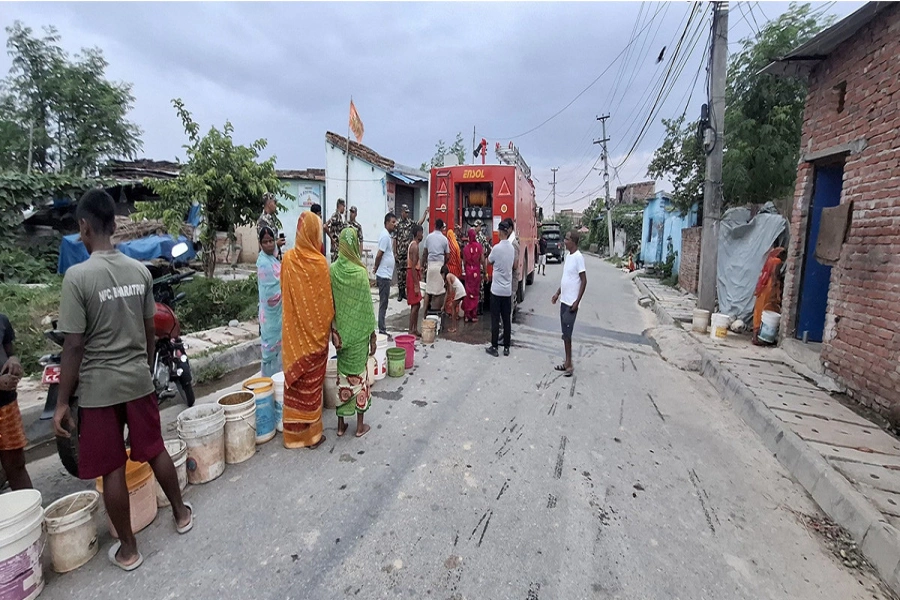
The security forces, operating from these FOBs, protect telephone towers, repeater stations, hydropower stations, airports, important bridges, and so on. They also carry out route clearances and provide convoy protection during times of conflict. Most of these forward bases tend to be in remote areas. Most of the time, the soldiers have to do without proper beds, running water, telephones or electricity. They have to fetch drinking water from some distance, toilets are rudimentary at best, and hot water is, of course, a luxury.
The FOBs in Nepal during the time of the decade-long insurgency, 1996-2006, tended to have no more than 40 soldiers, with only about 30 carrying weapons. Meanwhile, the rebels could concentrate hundreds of combatants on the individual FOBs, and try to overwhelm these posts through surprise and the sheer power of numbers. Given that the rebels were quite willing to sacrifice their fighters, the job of the defenders became all the more difficult. The security personnel thus had to rely on good training, discipline, leadership, comradeship, superior firepower and, of course, fortified defences.
These FOBs had to be fortified with wires, pickets, trenches, mines and booby traps. Automatic weapons had to be sited properly to beat rebel attacks. To make a comparison, the NATO and US troops who enjoy more superior fire power in their Afghanistan bases than the Nepal Army (NA), Armed Police Force (APF) of Nepal Police, could also call in artillery and air support. There was hardly any such possibility for the Nepali defenders. Very few of our outposts had night vision devices. Under the circumstances, the NA and other forces had to rely mostly on anti-personnel landmines as a deterrent to protect the FOBs.
Mines are made up of high explosives contained in a container with a firing device, which is mostly ‘target-activated’. The containers are either metallic or non-metallic, and are designed for use against either personnel or vehicles. Anti-personnel mines are very small compared to anti-tank or anti-vehicle mines. Mines can be laid either manually or mechanically. They can be scattered by artillery shells and aeroplanes to discourage enemy’s ingress into one’s territory.
In Nepal, during the conflict, the soldiers laid mines manually around their defences, the presences of these devices providing both a psychological challenge to the attackers as well as an actual break-up of the enemy’s attacks. When the army laid these mines, they were surrounded by barbed wire fences even in wars and ample sign-marking was done to discourage innocent civilians from entering the minefield.
These anti-personnel minefields helped in breaking up many rebel attacks in places like Solu-Salleri, Ratomate, Kapur Kot, Khara, Okhaldhunga and Beni. They also helped keep the casualties among the security forces low. Many lives were thus saved by these relatively cheap defensive devices.
Like any other army, the NA, too, has professional combat engineers who deal with mines and explosives. The combat engineers had, during the conflict, fortified all the FOBs of the NA with mines and booby traps. Those combat engineers who opted to join the APF once the latter was established similarly helped to strengthen the APF bases. Sanat Basnet, the present Inspector General of the APF, was trained in combat engineering and was responsible for the fortification of Bhaluwang APF Base, which stood fast against Maoist attack.
Whenever a minefield is laid, the combat engineer is supposed to record the location of the mines and keep multiple copies. Once the conflict or the war is over, it is the combat engineers’ responsibility to recover the mines and make the area safe for civilians. Meanwhile, the minefields are fenced and danger signs posted, as per the international norms. The NA did accordingly.
It must be kept in mind that while the NA followed the international regime on mine-laying and clearing, there is hardly any record of the rudimentary mines deployed by the Maoists. These mines were deployed on highways and in trails. More important than the mines placed by the rebels, however, are the thousands of Improvised Explosive Devices (IEDs,) ‘socket bombs’ and other types of explosives which have been spread across the countryside, without numerical counts or placement records. While these IEDs are of course, strictly speaking, not landmines, their clearance is also of utmost priority because the majority of civilians killed in Nepal by explosive devices post-conflict have been through these abandoned devices.
MINE ACTION
To meet the desired objectives of Comprehensive Peace Accord 2006, the Nepal Army Mine Action Co-ordination Centre (NAMACC) was established on Dec 1, 2006 to conduct humanitarian demining and other related tasks. The Ministry of Peace and Reconstruction chairs both Technical Committee and Nepal Mine Action Steering Committee, which were established on June 21, 2007 to supervise NAMACC operations.
The NA has been fully committed in the field of Mine Action Management (MAM). Out of the five-pillar tasks of MAM, the NA has been involved directly or indirectly in the following three areas: Demining, mine-risk education and victim assistance. So far, 62 percent of the minefields (established by the army during conflict time) have been cleared and the rest is scheduled to be cleared by the end of 2011.
The Ottawa Treaty or the Mine Ban Treaty came into existence in 1997. Besides stopping the production and development of anti-personnel mines, the party to the treaty must destroy all such mines in its possession within four years. This treaty covers only anti-personnel mines while mixed mines, anti-tank mines, cluster bombs and remotely-activated claymore mines are not covered. Anti-handling devices (booby traps) and other static devices or explosives used against the individuals do not fall within the ambit of the treaty.
The anti-personnel mines can be laid manually, delivered by artillery shells or dropped from aircraft. The air-delivered mines arm themselves once they hit the ground or after some stipulated time. Some of these air-dropped mines are supposed to disarm on their own, but all of them still need to be cleared by the laying authority. Interestingly, these air-delivered anti-personnel mines aren’t covered by the Ottawa Treaty.
Until April 2010, 156 countries had signed the treaty though most have yet to ratify it. 37 countries including the United States, Russia, China, India, Pakistan, and Myanmar haven’t signed on it. The Obama administration has formally decided not to sign the Ottawa Treaty, while some of the countries which have signed the convention are still in possession of the prohibited devices.
KEEP THE OPTION OPEN
As stated earlier, anti-personnel mines are cheap and useful for area defence. Along with wire and other obstacles, these have been found in Nepal, too, to be effective in breaking up the assaults by insurgents. The anti-personnel mines deployed by NA and AFP actually have proved their worth during the conflict, and were responsible for saving the lives of many soldiers who were deployed to defend the state.
The NA has never used the landmines indiscriminately, and it has kept proper records which has made the task of demining easy. While it is true that more than 150 countries have signed the Ottawa Treaty, the Nepal Government has to keep in mind the utility of landmines in Nepal given the possible nature of future insurgencies, the nature of our terrain, as well as the ancillary firepower and support abilities of the national army. Bear in mind that the countries which have signed the convention either do not have insurgency problems, or they have better and costlier system of personal protection of their foot-soldiers.
While it may sound attractive to be against landmines, we have to consider the matter dispassionately because there are lives of soldiers on the ground involved. In the case of the insurgency in Nepal, the mines were deployed defensively around FOBs, and they were well-recorded which has made demining easier. Given such responsible behavior by the NA, and given that they were used defensively against insurgents in the past conflict, it is important for civilian policymakers and parliamentarians to allow the national security forces with this option of self-protection, which is defensive rather than aggressive.
There must be a reason why four countries of the South Asian region have not signed the Ottawa Treaty. Protection of our soldiers’ lives is a prime government responsibility and due care must be given to this aspect. Our national security must not be compromised on the say-so of a few non-governmental organizations which have funding but no accountability. The government and parliament, on the other hand, are accountable to the citizens, which includes the soldiers who defend the state from rebels bent on destruction.
Writer is a retired Brigadier General of Nepal Army
Related story
Upper House committee to discuss landmines, explosives with sec...