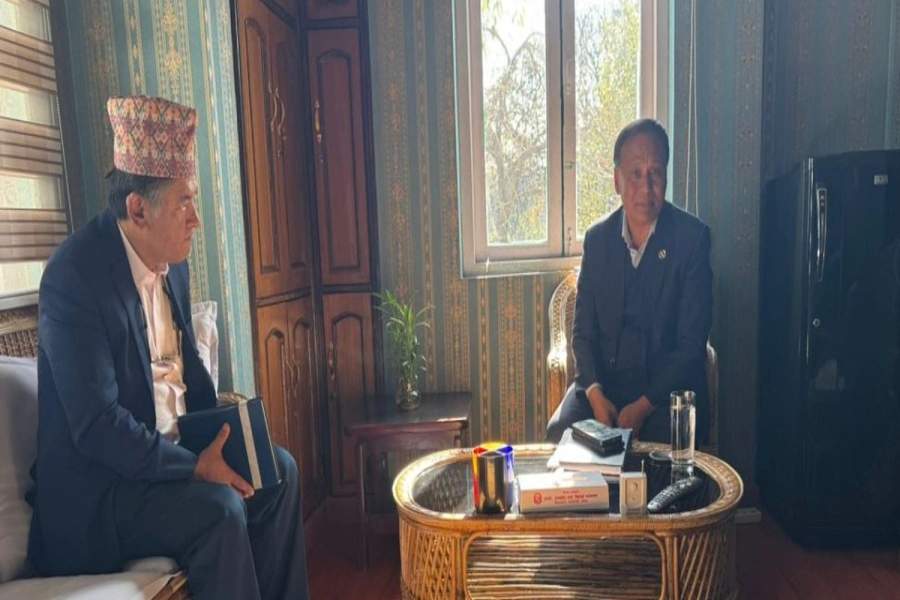
Biswas Baral spoke to Purna Man Shakya, a leading constitutional expert and one of the three lawyers who drafted the rules of procedure to govern the expired Constituent Assembly, to discuss to the options before the PM and the President, the chances of CA revival and the way out of the current impasse. [break]
How have you seen the recent standoff between the President and the Prime Minister? It appears like President Yadav is trying to assert his authority, and the PM Bhattarai doesn’t like it.
Probably the President is expressing his frustration on the inability of the government to break the ice. Probably he feels that the government is not doing enough. That is why the President has been so blunt against the government. But this is an issue that should be worked out between the two through free and frank discussions. The country cannot afford a situation where the President and the Prime Minister are pitted against one another. They should work together to solve the problems of the country. To that end, the two met on Tuesday, and the Prime Minister said the discussions were satisfactory. Let us hope they are able to work out something for the country.

You said the President might be frustrated because the government is not doing enough. Constitutionally, what are the options before the government?
A caretaker prime minister is also responsible for holding the election and he has the constitutional responsibility to assist and work for establishing a government with people’s mandate. A caretaker PM normally takes six months to hold the election and entrust the administration to the elected government. But four and a half months after the CA’s dissolution, the election is nowhere in sight. That might be the reason the President is not happy. I believe the President is trying to give a message, not only to the government, but also to the opposition, that he cannot remain a mere spectator, in the sense that if the political parties fail to work out a way for the reelection of CA, the President as the last resort will have to do something. The President giving out this message in public means he is very serious.
The President is also the custodian of the interim constitution. In this role, he has to ensure the government and other stakeholders abide by the interim constitution and work to fulfill the objective of the interim constitution. The objective is to go for CA polls and complete the writing of the constitution. The objective of interim constitution is definitely not to let the current situation continue for an indefinite period. That is the message the President has tried to convey.
Can you clarify how the objective of the interim constitution can be election of new CA when it clearly has no such provisions?
The last CA failed to give the country a constitution. Thus the objective of the interim constitution remains unachieved. The objective of the interim constitution as defined in its preamble is to see to the promulgation of a constitution through a Constituent Assembly. So much is loud and clear. The challenge of the moment is to ensure the promulgation of the constitution by doing the least violence to prevailing provisions of the interim constitution. Another thing is ensuring consensus to pave the path to new election. The President has the responsibility to make sure that nobody, including the government of the day, hijacks the right of the sovereign people to elect a government that they believe will deliver them a constitution.
For any way out the interim constitution must be amended. Some are in favor of amending it through a reinstated CA while others believe asking the President to remove difficulties will be equally legitimate. What is your take?
Reinstatement of the dissolved CA is one of the options former CA members are talking about. But reinstatement looks impractical for a couple of reasons. One, the politics has advanced a lot since the election of the last CA. Many parties have broken up and new issues have emerged. In this situation, the best course of action is to let the people express their verdict through their votes. Two, as the Supreme Court has given its final verdict on the old CA, going for reinstatement would be saying that we don’t accept the Supreme Court as the final authority in the interpretation of the constitution. This concept is not acceptable. I am not sure the Supreme Court will allow the CA to function after reinstatement. If the CA is revived, it is very likely that the Supreme Court will intervene to prevent it from functioning.
What do you make of the argument that the CA can be revived for short time for the sole purpose of amending the interim constitution?
The CA members rooting for reinstatement want a complete constitution through the revived CA. They are not advocating for an amendment to clear the way for new polls. On the other hand, the political leaders who are not in the CA, and who are in favor of the reinstatement idea, want to clear the hurdle for fresh polls. You have to understand this crucial difference.
If the current deadlock continues indefinitely, can the President step in to force a breakthrough?
If the president is convinced that this government has no intention to hold election, then probably he will be justified in undertaking some kind of an intervention. But again, before he makes any such decision, the President has to weigh all the pros and cons and the inherent risks of such a move. It will not be that easy. Any move of the President has to have the support of the major political parties, including ruling parties. If the President plays partisan politics and if his move fails, then we could have a terrible crisis on our hands, for which the President will be held accountable. Therefore, before he acts the President has to make sure that any move he makes has a 100 percent chance of success. He cannot take risks. Cent percent success cannot be guaranteed unless he has the support of both the ruling and opposition parties.
Some have also been arguing that with the CA gone, the role of the President’s Office has also been rendered null and void. What is the constitutional status of the President at present?
There is no constitutional provision for the removal of the President right now. The interim constitution outlines no specific tenure for the President. He will remain as the President until a new constitution is promulgated and until the new constitution defines the role of the existing President. Therefore, he remains until a new CA is elected and until it delivers a new constitution. In this sense, his tenure is indefinite at the moment. This is the reason the country at some point has to go for reelection for a fresh mandate, and the President is well aware of this fact.
Let’s change the track. The current quarterly budget runs out in under a month. What happens if the government forwards an ordinance for a partial or full budget and the President declines to endorse it without consensus among political parties?
The very term caretaker suggests that the current government is there to take care of the daily affairs of the country. The government will not be able to carry out that duty unless it has the budget to ensure it can carry out its basic duties like providing salaries to government employees, undertaking maintenance work on existing infrastructure and meeting the day to day administrative costs. If there is political consensus among major parties, they could always go for a full budget for the remaining period. But if there is no consensus, the caretaker government is responsible for bringing another ordinance for a budget which at least takes care of its day to day expense. But in that case, the caretaker government cannot introduce major policy shifts because it does not have that mandate.
Beyond strictly constitutional parameters, can a political argument be made for new CA polls?
I don’t know what will be the shape of the new CA, but it will definitely give new life to the constitution making process. We can only hear the voices of the people who have access to media. But a large majority that doesn’t have such access has been silent. Election is the process through which these people will speak. This is the reason fresh election is advisable. Now that we have finished the process of integration of former Maoist combatants into Nepal Army, we should work hard on a new constitution.
You played a part in the constitution making exercise of the dissolved CA. Since you suggest new polls offer a more legitimate way out, what should be the shape and timeline of the new CA?
The ideal size would be around 301. A smaller CA would make deliberations more meaningful and proactive. But at this stage, it might be controversial to talk of changing the process of selection. The provisions for proportional representation and first-past-the-post could remain as they are, but we could always reduce the size. But then how do we do it in the absence of a legislature and in the absence of a plenipotentiary government? The President alone cannot change the constitution. Thus it is up to the political parties to sit together and find a way to amend the constitution. As of now, there is no constitutional way of doing it.
What happens if there is broad consensus on CA reinstatement, in contravention of the Supreme Court’s earlier ruling? What will the judiciary’s role be at that moment?
If the CA members decide to reinstate CA and if they successfully take the constitution making process to a logical end, despite the objection of the Supreme Court, it would mean a political revolution. It would mean that the Supreme Court is not the final authority to interpret the constitution. The legitimacy of such a move will come through people’s acceptance of the reinstatement option, not by the verdict of the Supreme Court. If such a constitution is accepted by the people and if it holds the ground as the final and definite law of the land, then the Supreme Court will go. It will be replaced by a new Supreme Court which will derive its legitimacy from the new CA.
Do you foresee a situation where the government and the judiciary are on a collision course, as happened in Pakistan recently?
Ultimately, when two highest organs of the state are in conflict and one is not prepared to accept the role of another, the ultimate decision has to be based on politics, in the sense that ultimately the one who has the support of the people will prevail. This is something which is beyond the law. If there is a situation whereby the Supreme Court refuses to recognize a reinstated CA, and CA members refuse to obey the Supreme Court in turn, the final decision rests with the people. The people might express their verdict through street protests or through some other form.
Related story
Rahul Gandhi, Indian opposition leader, reinstated as lawmaker...