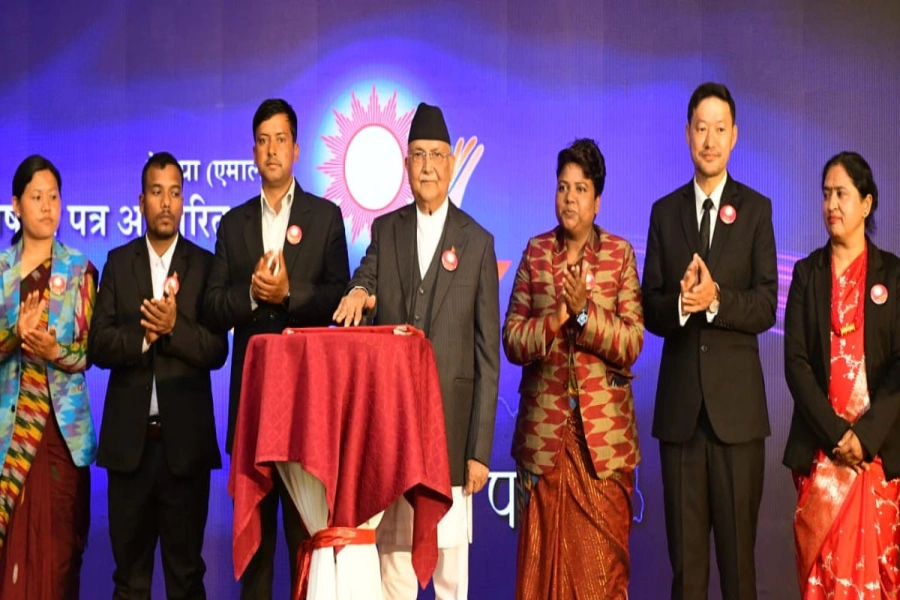
KATHMANDU, Feb 20: The Communist Party of Nepal (CPN-UML) has released its manifesto for the upcoming House of Representatives elections on March 5, setting ambitious targets to transform Nepal’s economy and improve citizens’ livelihoods over the next five years.
The party has pledged to end extreme poverty and raise per capita income to approximately USD 3,000 through inclusive and rapid economic growth. UML plans to achieve an annual economic growth rate of 7–9% by boosting agricultural production, electricity generation, mineral and industrial output, information technology, and physical infrastructure. The party aims to expand the economy to Rs 100 trillion within five years and Rs 200 trillion within ten. To realise these goals, UML intends to modernise agriculture, implement investment- and production-friendly policies, mobilise financial capital into productive sectors, strengthen capital markets, and attract both domestic and foreign investment.
Focusing on employment, UML has announced its aim to create 500,000 new jobs annually, while simultaneously doubling employment opportunities to reduce the compulsion for foreign employment. Job creation will concentrate on modernised agriculture, commercial farming, food processing industries, infrastructure development, green industries, and the service sector. In addition, the party plans to expand skill-based education, IT, digital and remote work opportunities, and establish labour desks in every municipality to register workers, provide skill development, and ensure social security. UML also promises to double labour income within five years, while guaranteeing dignified work and fair wages.
Department Mines and Geology grants exploration permits for 80...

In terms of housing, UML has announced its “Safe and Dignified Homes: Modern and Citizen-Friendly Housing” initiative. The manifesto highlights plans to provide secure, affordable housing with basic services for landless, squatter, vulnerable, and low-income citizens. A “Citizen Housing Fund” will support public–private housing development, ensuring that no citizen remains without a home. The party further proposes integrated settlement development, relocation from risk-prone areas, and infrastructure-equipped housing, alongside the development of villages as production and labour centres and cities as hubs of capital, technology, services, and markets. Sub-metropolitan and metropolitan areas are set to evolve into “mega cities,” functioning as financial, industrial, commercial, educational, health, and innovation centres.
Infrastructure development is another key focus. UML plans to upgrade the Mid-Hill Highway, Koshi–Gandaki–Karnali corridors, and Postal Highway as economic corridors. Rural areas will benefit from expanded health, education, skill development, digital access, and employment opportunities, while cities will see improved waste management, open and green spaces, and modern utilities, including water supply, sewage, electricity, and fibre-optic infrastructure. The party aims to implement “utility tunnels” in sub-metropolitan cities and “underground utility corridors” in major urban areas. Additionally, villages, towns, and cities are to be declared “zero-waste zones,” with green spaces, parks, flower gardens, riverbank protection, tree plantation campaigns, and satellite cities for each sub-metropolitan area.
UML has also promised universal access to basic drinking water and sanitation within the next two years, and safe, clean, and high-quality water for all within five years. The manifesto emphasises modern water management, using GIS mapping to improve service delivery from source to tap.
On the industrial and mining front, UML has included commercial production of gas and iron mines in Dailekh in its plans. By expanding production-oriented industries, mining, electricity, water supply, and construction, the party aims to double industrial contributions to GDP. UML also intends to maintain policy stability in industrial operation, taxation, customs, and finance, provide online services via a “single-window service centre,” and operate at least one special economic zone per province. Public procurement will prioritise domestic production, while exports are expected to double within three years and triple within five, supported by modernised ports and customs systems with China and India.
Other key priorities include transparent regulation of cooperatives, expanding financial access for small enterprises and farmers, promoting Nepal as a safe and diverse tourist destination, practical and employment-oriented education, universal primary healthcare, digital infrastructure expansion, strengthened e-governance, increased hydropower and alternative energy investment, and improved transport networks, including roads, railways, air services, and expressways. The manifesto also emphasises support for youth entrepreneurship and startups, enhanced sports infrastructure, and greater participation in international competitions.
UML has also committed to strong anti-corruption measures, transparent public service delivery, and governance reforms through judicial, administrative, and financial improvements. The manifesto highlights 25 pillars of national prosperity and five fundamental declarations: Country First, Full Democracy, Constitution, Rule of Law, and Good Governance. It also draws attention to the party’s past achievements and calls for citizens to evaluate policies based on facts rather than misconceptions.