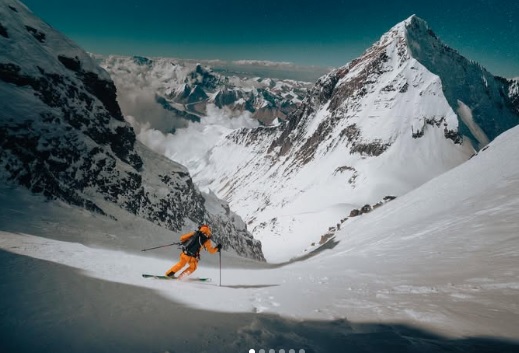
KATHMANDU, Oct 16: American mountaineer and skier Jim Morrison has become the first person to ski down Mount Everest via the Hornbein Couloir—considered the mountain’s most difficult and direct descent route, according to the US-based media outlet National Geographic.
The Hornbein Couloir is a narrow and steep couloir high to the west on the north face of Mount Everest in Tibet, that extends from about 8,000 to 8,500 m elevation, and is 350 metres below the summit. The achievement, completed on October 15, marks a historic moment in the world of high-altitude skiing.
According to National Geographic, Morrison, 50, reached the 8,848-meter (29,032-foot) summit of Everest at 12:45 PM local time after a six-and-a-half-week expedition. He descended via a linkup of the Hornbein and Japanese Couloirs—routes that have captivated elite climbers for decades due to their extreme technical difficulty and exposure.
“A descent of the Hornbein Couloir has eluded the ski world for decades,” National Geographic reported. Morrison’s solo ski descent from the summit to the Rongbuk Glacier covered more than 9,000 vertical feet, taking four hours and five minutes on a 50-degree slope.
Japanese embassy hands over ski equipment to Nepal

Morrison was accompanied by 11 others including Sherpas, mountain fixers and a film crew led by National Geographic Explorer and photographer Jimmy Chin. Chin and Chai Vasarhelyi, the Oscar-winning directors of Free Solo, are currently filming a National Geographic documentary about the expedition.
After reaching the summit, Morrison scattered the ashes of his late partner, Hilaree Nelson, who died in 2022 during a ski descent from Manaslu, the world’s eighth-highest peak. “I had a little conversation with her and felt like I could dedicate the whole day to her,” Morrison told National Geographic.
This was Morrison’s third attempt to ski the Hornbein Couloir. Previous efforts in 2023 and earlier in 2024 were hampered by permitting issues and an avalanche accident involving his rope-fixing team. Morrison said the terrain is "super steep and unrelenting from top to bottom... more than a mile long and just massive, dark, and beautiful in scale."
The Hornbein Couloir was first climbed in 1963 by Americans Tom Hornbein and Willi Unsoeld during a groundbreaking ascent of Everest's West Ridge. That expedition remains one of the most daring in Himalayan climbing history. According to National Geographic, only six expeditions have ever climbed the Hornbein Couloir, with Morrison’s being the first successful ascent in over 30 years.
The descent also carries symbolic weight. Morrison and Nelson had been planning a 2023 attempt to ski the route before her death. Morrison, who has completed multiple high-altitude ski descents around the world, described this mission as a personal and professional milestone.
Everest’s more common Southeast Ridge route, first climbed by Edmund Hillary and Tenzing Norgay in 1953, now sees up to 500 commercial climbers each spring. But the Hornbein Couloir, located on the North Face of Everest, remains remote and rarely visited—especially in October, when fewer teams attempt the mountain.
Ski descents of Everest are rare. The first successful ski descent from the summit was made in 2000 by Slovenian climber Davo Karničar, who descended via the Southeast Ridge route, including the Hillary Step.
Morrison’s ski line down the Hornbein Couloir is being hailed as one of the boldest descents in mountaineering history.