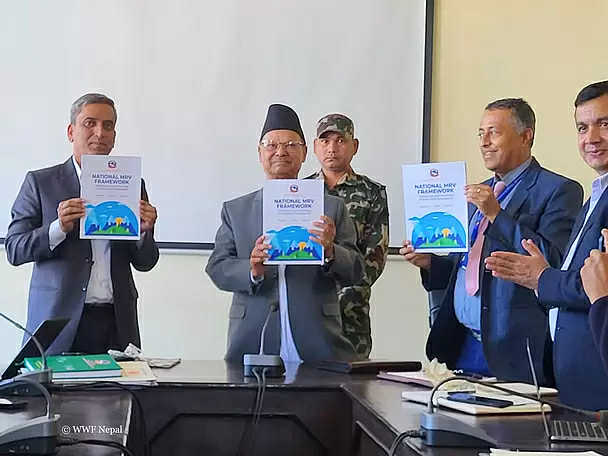
KATHMANDU, Oct 16: The Ministry of Forests and Environment (MoFE) officially launched the National Measurement, Reporting and Verification (MRV) Framework today in Kathmandu, marking a major milestone in Nepal’s journey toward transparent and accountable climate action.
Developed under the Capacity Building Initiative for Transparency (CBIT) Project executed by MoFE at WWF Nepal, the National MRV Framework provides a strategic blueprint for institutionalizing a comprehensive climate transparency system aligned with the Enhanced Transparency Framework (ETF) of the Paris Agreement. It establishes a structured mechanism to track greenhouse gas (GHG) emissions, monitor progress on adaptation, and assess climate finance flows across key sectors, including energy, industry, agriculture, forestry and waste.
Speaking at the launch, Minister Pariyar emphasized that strong reporting strengthens Nepal’s capacity to meet international reporting obligations and to access global climate finance by demonstrating transparency, accountability, and evidence-based policymaking.
SHIFT for Our Planet: Youths urge authorities to make climate j...

The event held on October 14 was graced by Madan Prasad Pariyar, Minister for Agriculture and Livestock Development (MoALD), as the Chief Guest, alongside the Secretary of MoFE, the Secretary of MoALD, the Chief of the Climate Change Management Division (CCMD), and representatives from various government and non-governmental institutions.
The Framework designates the MoFE as the National Entity (NE) for MRV, with the Climate Change Management Division serving as the national coordinating body. A dedicated MRV Unit will facilitate data collection, verification, and reporting in collaboration with sectoral ministries, provincial and local governments, and other stakeholders.
The National MRV Framework also highlights the use of international tools such as the IPCC Inventory Software and NDC Tracking Tool, ensuring compatibility with global standards. It introduces quality assurance and quality control (QA/QC) mechanisms to maintain data integrity and credibility.
Officials at the launch emphasized that the MRV Framework will support Nepal’s commitments under its Nationally Determined Contributions (NDCs), National Adaptation Plan (NAP), and Long-Term Strategy (LTS) for Net-Zero Emissions, thereby contributing to Nepal’s goal of achieving low-emission, climate-resilient development.
The launch marks the beginning of Nepal’s formal journey toward an operational National MRV System, setting the foundation for enhanced coordination, better data management, and more transparent climate governance at all levels.





_20240309161133.jpg)