KATHMANDU, March 7: As the Rastriya Swatantra Party (RSP) moves closer to securing an overwhelming majority in the House of Representatives (HoR), attention is increasingly turning to the ambitious set of reforms the party has promised to pursue in its election manifesto.
Riding a wave of voter dissatisfaction with Nepal’s traditional political establishment, the relatively new political force campaigned on a platform centred on good governance, institutional reform, economic revival and transparency. Its manifesto outlines a wide-ranging overhaul of the country’s political and administrative systems, aimed at dismantling what party leaders describe as a deeply entrenched culture of corruption, patronage and bureaucratic inefficiency.
Here are some of the key reforms the RSP has promised to pursue after the formation of its government:
Constitutional and political system reforms
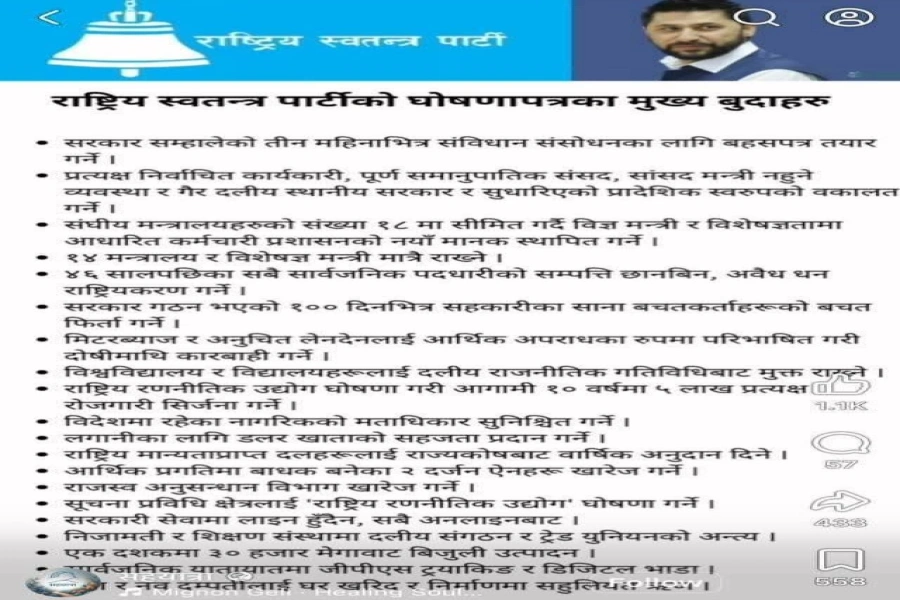
One of the party’s most significant pledges is to initiate debate on constitutional amendments within three months of assuming office. The party has advocated sweeping political reforms, including the introduction of a directly elected executive and a fully proportional parliamentary system.
The RSP has also proposed a structural change to governance by ensuring that Members of Parliament do not simultaneously serve as ministers, a move it says would strengthen parliamentary oversight of the executive.
In addition, the party has called for non-partisan local governments and a reformed provincial structure, arguing that the current federal system requires refinement to improve efficiency and accountability.
Downsizing government, professionalising bureaucracy
A major plank of the party’s reform agenda involves restructuring the federal government. The RSP has pledged to limit the number of federal ministries to 18, while operating with 14 ministries led by specialist ministers.
Govt claims 87.2 percent progress on 100-point governance refor...

Party leaders say the goal is to establish a new governance model based on expert-led ministries and a merit-based professional bureaucracy, reducing political interference in administrative decision-making.
Anti-corruption drive
The manifesto also proposes a sweeping investigation into the assets of all public office holders since the restoration of democracy in 1990. Any wealth found to have been illegally acquired would be nationalised, according to the party’s pledge.
The party has also vowed to tackle long-standing financial irregularities, including loan sharking and unfair financial transactions, which it plans to classify as economic crimes subject to strict legal action.
Economic revival and job creation
On the economic front, the RSP has outlined plans to declare national strategic industries and generate 500,000 direct jobs within the next decade.
The party has also pledged to repeal around two dozen laws that it believes hinder economic growth and investment, while facilitating access to dollar-denominated accounts to encourage foreign and domestic investment.
In addition, the RSP plans to declare the information technology sector a national strategic industry, aiming to position Nepal as a regional hub for digital services.
Education and institutional reforms
The party has emphasised the need to keep universities and schools free from partisan political activities, a longstanding issue in Nepal’s education sector.
It has also pledged to end partisan organisations and trade unions within the civil service and educational institutions, arguing that political interference has weakened institutional performance.
Governance and public service delivery
In a bid to modernise public administration, the party has promised to fully digitise government services, allowing citizens to access services online and eliminating long queues at government offices.
The manifesto also proposes abolishing the Revenue Investigation Department, while introducing broader reforms aimed at improving transparency and accountability in public institutions.
Infrastructure and energy ambitions
The party has set an ambitious energy target, pledging to generate 30,000 megawatts of electricity within the next decade.
In the transport sector, it plans to introduce GPS tracking and digital fare systems in public transportation to enhance efficiency, transparency and passenger safety.
Overseas voting and political funding reforms
Among its democratic reforms, the RSP has pledged to guarantee voting rights for Nepali citizens living abroad, a demand long raised by the country’s large diaspora community.
The party has also proposed a system of annual state funding for nationally recognised political parties, which it argues would help curb the influence of illicit money in politics.
With vote counting still underway but early trends indicating a decisive shift in Nepal’s political landscape, analysts say the coming months will reveal whether the RSP can translate its sweeping reform agenda into concrete policy and governance outcomes.
The full text of the election manifesto is available for download here:
https://rspnepal.org/manifesto