



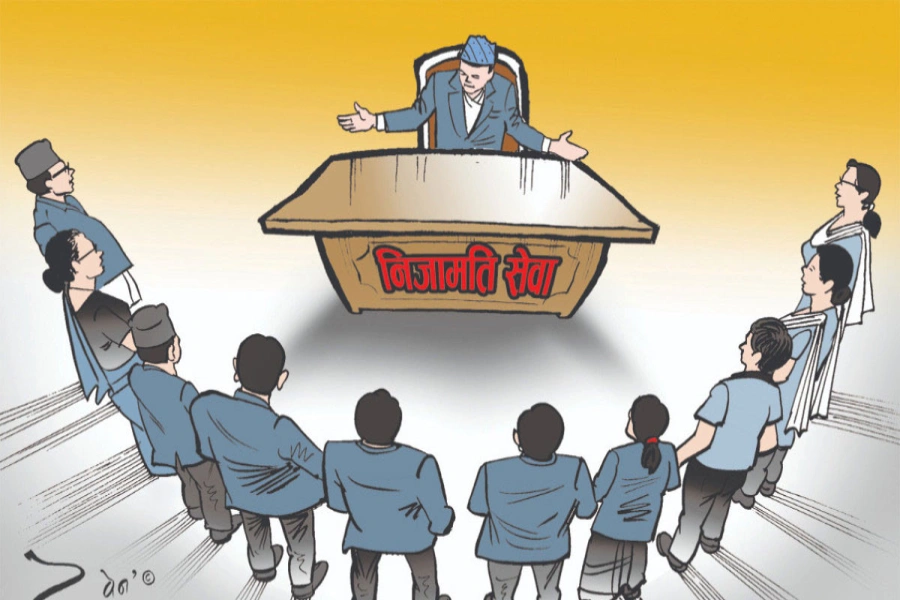
Civil service reform is necessary in Nepal. However, staff downsizing and lateral entry into the bureaucracy without transparent study, evidence-based analysis, and broad consultation risk creating an administration that is more dependent on political leadership than responsive to citizens. Reform should strengthen professionalism, accountability, and service delivery—not political influence over state institutions. One of the most important laws that should have followed the implementation of federalism is the Federal Civil Service Act. Yet, even after a decade of federal governance, the legislation remains pending. The failure to enact the law despite the then Nepal Communist Party (NCP) enjoying a comfortable parliamentary majority reflects both the reluctance and inability of political leaders to pursue meaningful administrative reform. The prolonged delay has been driven by competing interests. Employee unions, senior bureaucrats, and factions within political parties have all sought provisions that protect their own positions, repeatedly obstructing the legislative process. As a result, personal and institutional interests have often taken precedence over the broader goal of building an efficient, accountable, and citizen-oriented administration. The government has now proposed significant changes through a new civil service bill, including open competition for executive and specialist positions, compulsory retirement after a certain age or service period, and expanded open competition at some levels. Debate on these proposals is both natural and necessary. Administrative reform cannot be postponed indefinitely.
Bill bars local units from recruiting civil servants

However, major structural changes should be guided by rigorous study, clear justification, and meaningful consultation with stakeholders. Particularly contentious are proposals related to staff reductions and lateral entry. While both may be legitimate policy tools, they must be supported by transparent assessments of institutional needs, workload distribution, service delivery requirements, and long-term administrative objectives. Without such groundwork, these measures could weaken career civil service institutions and increase political influence over appointments and decision-making. The result may be a bureaucracy that appears streamlined on paper but is less independent, less professional, and more vulnerable to political pressure. Nepal's administrative challenges extend beyond organisational structures. Despite improvements in technology and infrastructure, many public institutions continue to struggle with accountability, efficiency, responsiveness, and performance culture. Citizens often judge the state not by organisational charts but by the quality and timeliness of services they receive. Reform should therefore focus not only on restructuring but also on improving service delivery, transparency, performance evaluation, and public trust. Fiscal realities also deserve consideration. With a significant share of public expenditure devoted to salaries and benefits, reviewing staffing structures may be justified. However, staff reductions pursued primarily as a cost-cutting exercise, without assessing actual needs and service demands, could weaken state capacity and undermine public services. Efficiency cannot be measured solely by the number of employees; it must also be measured by the state's ability to meet citizens' needs effectively.
Moreover, if the government intends to review public-sector structures, the exercise should not be confined to the civil service alone. The organisational efficiency, staffing patterns, and resource requirements of the Nepal Police, Armed Police Force, Nepal Army, and other public institutions should also be evaluated. Singling out one sector for downsizing risks creating imbalance rather than delivering comprehensive reform. In a democratic system, successful administrative reform depends on transparency, impartiality, and institutional trust. The government must clearly explain the objectives, rationale, and expected outcomes of proposed changes. The more inclusive and evidence-based the process, the greater its legitimacy and public acceptance. International experience shows that administrative reforms are most effective when they are gradual, carefully planned, and built on consensus. Rapid changes imposed without adequate preparation often create unintended consequences. While reform requires momentum, it also requires prudence, balance, and a clear understanding of long-term institutional impacts. Ultimately, civil service reform should be guided by citizens' interests, good governance, and institutional independence. Nepal needs a professional, capable, impartial, and accountable bureaucracy that serves the public rather than political leaders. Reform is essential, but it must strengthen the administration's commitment to citizens—not make it increasingly dependent on those in power.





-1788334701.webp)


