

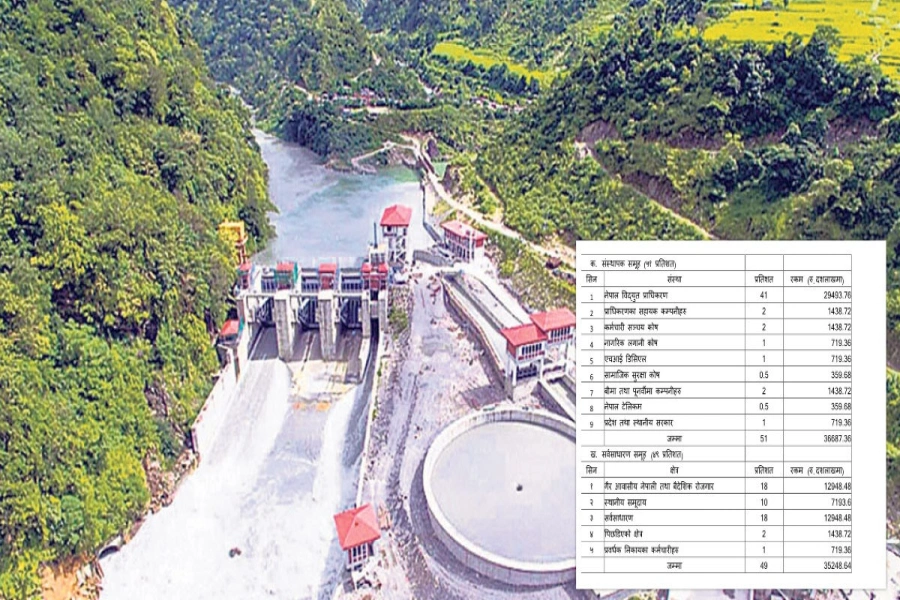
KATHMANDU, Nov 30: Under the leadership of the Nepal Electricity Authority, the 1,063 MW Upper Arun hydropower project with a semi-reservoir is being constructed in Bhote Khola Rural Municipality, Sankhuwasabha. A proposal has been made to allocate shares worth Rs 12.95 billion to non-resident Nepalis (NRNs) and Nepalis working abroad.
The total project cost, excluding construction-period interest, is estimated at USD 151.27 million. Using the current exchange rate of Rs 141 per USD, the total cost without interest amounts to Rs 213.29 billion, while including interest it rises to Rs 239.79 billion. Equity (self-financing) is projected at 30 percent, or Rs 71.94 billion, and the remaining 70 percent, Rs 167.85 billion, would be financed through loans. The construction period is expected to last seven years, with an annual interest rate of 7 percent.
Upper Arun Hydroelectric Project provides over Rs 1 billion for...

The project promoter, Upper Arun Hydro-Electric Limited, submitted the financial management plan to the Nepal Electricity Authority, which the Authority’s board approved for onward submission to the government. Energy, Water Resources and Irrigation Minister and Physical Infrastructure and Urban Development Minister Kulman Ghising said the financial structure is designed to allow NRNs, Nepalis working abroad, affected communities, and the general public to invest in the project. Efforts are underway to complete the financial arrangements quickly and move the project into construction.
Equity investment is proposed to be split 51 percent for the founder and 49 percent through public share issuance. From this, Rs 36.69 billion will come from the founder and Rs 35.25 billion from public shares. Among the 49 percent public shares, 18 percent is reserved for NRNs and overseas workers, 10 percent (Rs 7.19 billion) for affected areas and Sankhuwasabha residents, 18 percent (Rs 12.95 billion) for the general public, 2 percent (Rs 1.44 billion) for disadvantaged regions, and Rs 719.4 million for the promoter’s staff.
The Nepal Electricity Authority will hold 41 percent of the founder shares, equivalent to Rs 29.49 billion. Other founder shareholders include subsidiary companies, employees’ provident fund, insurance and reinsurance companies, citizen investment funds, provincial and local governments, and Nepal Telecom, holding small portions.
The total loan required to complete the project is Rs 167.85 billion, with all financing planned from internal sources without government loans. The mixed investment model is intended to reduce costs, minimize risk, and maximize internal capital usage. Of the total debt, 45 percent is planned through concessional co-financing from institutions like the Employees Provident Fund, Citizen Investment Fund, Social Security Fund, HIDCL, Nepal Telecom, and insurance companies, totaling Rs 7.553 billion.
To meet mandatory liquidity requirements, 30 percent of the project loan (Rs 50.36 billion) will be raised via energy bonds, with an additional Rs 41.96 billion through co-financing from banks and financial institutions.
The first year of commercial production is expected to generate Rs 27.9 billion, and with an annual 3 percent price escalation over eight years, total revenue is projected at Rs 34.59 billion. Annual electricity production will reach 453 million units, with an initial average PPA rate of Rs 6.3 per unit, rising to Rs 7.8 per unit over the project lifetime.
Construction is underway in the geographically challenging area, including a 21-kilometer access road from the proposed powerhouse near Chhongrang, Bhote Khola–4, to the dam site in Chepuwa, Ward No. 2. A 70-meter-long steel arch bridge is being built over the Arun River to connect the site to the Koshi Highway.


