

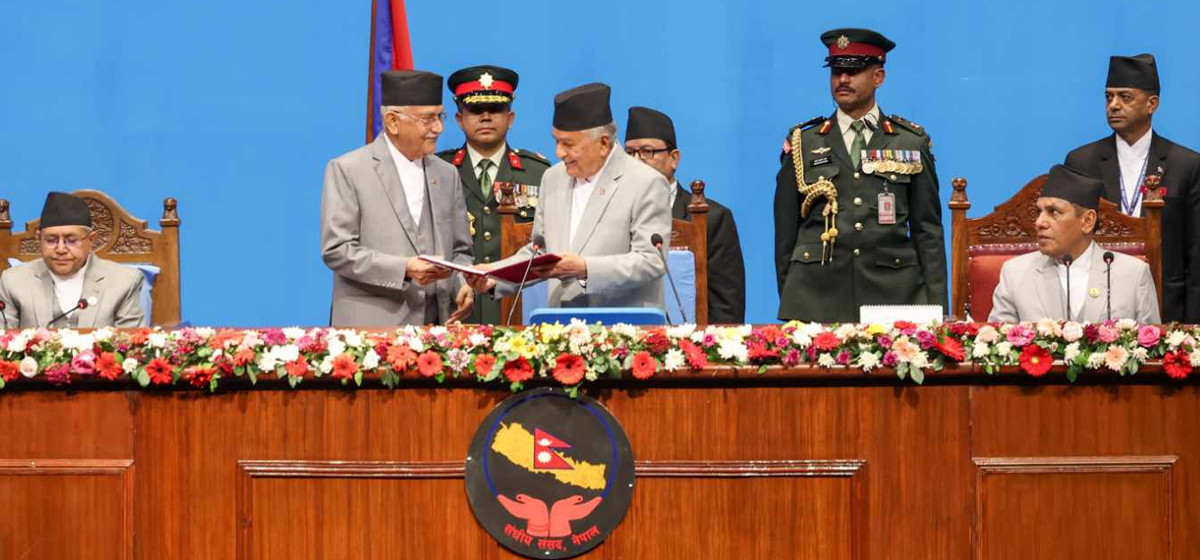
KATHMANDU, May 2: The government of Nepal unveiled its policies and programs for the fiscal year 2025/26 on Friday. President Ramchandra Paudel presented the plan during a joint session of both houses of the Federal Parliament.
The policy emphasizes the government’s commitment to promoting good governance and achieving rapid economic growth, aligning with the minimum common agenda of the ruling coalition.
Reaffirming its support for the federal democratic republican system, the government stated its determination to counter any regressive or anarchic attempts to undermine the Constitution or the current political structure, which it described as the result of the Nepali people's long struggle and sacrifice.
The policy document identifies ten major focus areas:
Local govts intensify preparations for budget, policies and pro...

The government aims to strengthen the federal democratic republican system and actively resist any regressive or revivalist anarchic movements against the constitutional order.
A constitutional review process will be initiated to reinforce effective provisions and amend weaknesses based on broad political consensus.
Political and policy stability will be ensured by promoting healthy competition, dialogue, cooperation, and coexistence among political forces.
All infrastructure projects previously announced will be reassessed and re-prioritized. Projects will be classified, scheduled for completion within this fiscal year or the parliamentary term, and those deemed unfeasible will be suspended or scrapped.
Reforms will be introduced in school education to address existing challenges, while higher education will be steered toward knowledge creation, research, and innovation.
The government will adopt an entrepreneurship-friendly education policy, overhauling curricula and teaching methods to address the gap between skilled labor demand and supply. A startup initiative targeting Gen-Z youth will be launched with defined business plans and supportive ecosystems.
Healthcare access will be improved by addressing imbalances in infrastructure and human resources. All aid and subsidy programs related to health will be incorporated into the national health insurance scheme, which will be restructured for sustainability.
Government programs will focus on promoting entrepreneurship, increasing productivity, and generating employment. Agricultural commercialization and infrastructure development will be carried out through coordination among all three tiers of government.
To curb unnecessary expenditures, redundant public structures will be dissolved or merged. Public service delivery will be digitized through the expansion of "faceless services" and further development of the Nagarik App.
Development programs falling under concurrent jurisdiction will be implemented through coordinated planning among federal, provincial, and local governments. An integrated project bank system will be adopted to avoid duplication. On the foreign policy front, Nepal will pursue strong, balanced international relations centered on national sovereignty and the interests of the Nepali people.





