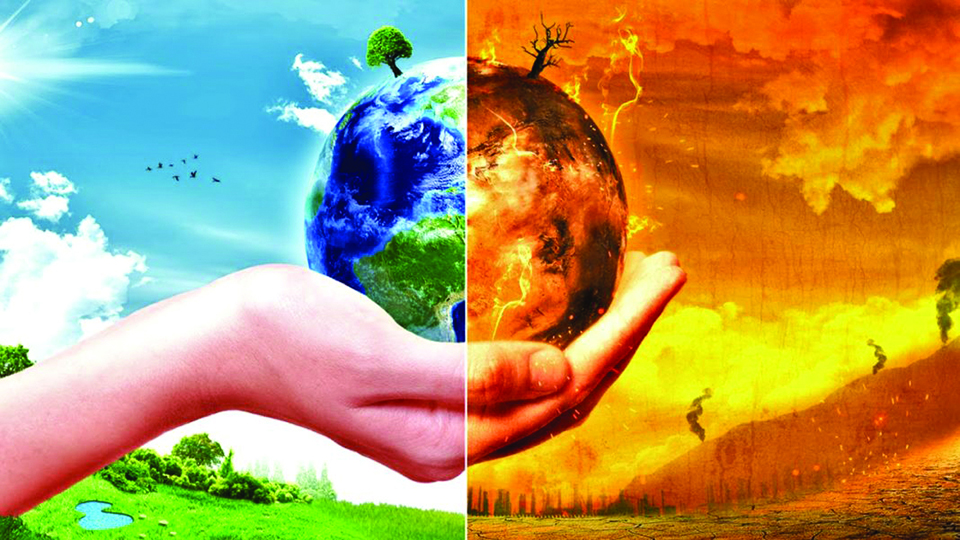
Prime Minister Balen Shah’s upcoming visit to the United Nations General Assembly (UNGA) in New York would provide Nepal with an opportunity to demand immediate international climate action for climate justice and financial compensation following the catastrophic Himalayan glacial flood. The proposed shift from aid to compensation marks an increasingly assertive position by Nepal as it seeks to make the devastation caused by the floods part of the wider global debate over climate responsibility.
Initially, Nepal planned to send its Foreign Minister to the UNGA. However, the sheer scale of this environmental crisis shifted the government’s strategy, making it vital for the Head of Government to personally present Nepal’s case to world leaders.
As a young leader who rose to power on a wave of anti-establishment reform, Shah holds a distinct international profile. Diplomatic officials emphasize that having the Head of State directly voice the pain of a victimized nation generates significantly higher trust and visibility. This trip will mark his first official foreign visit since taking office in March 2026.
The Glacial Lake Outburst Floods (GLOFs), which struck on August 26, 2026, were triggered by a massive glacial collapse and rockslide along the China-Nepal border. They caused the Bhotekoshi River to unleash a devastating deluge downstream, resulting in more than 1,250 confirmed deaths, thousands missing, and displacement affecting 1.6 million people.
The disaster wiped out villages, critical roads, and underground hydropower installations along the Bhotekoshi River. With estimated recovery and reconstruction costs running into billions of dollars, Nepal’s domestic economy cannot absorb the burden alone. Nepalese officials framed the disaster response as a matter of moral and legal liability rather than aid. Nepal pointed to top greenhouse-gas producers—including the United States, China, and India—arguing that heavy polluters must share reconstruction costs. Shah’s presence is critical to unlocking fast-tracked funding from the UN’s specialized climate-disaster recovery and Loss and Damage funds.
SHIFT for Our Planet: Youths urge authorities to make climate j...

The Himalayas are warming at 0.3-0.7°C faster than the global average due to a situation called ‘Elevation Dependent Warming’. Environmental campaigners refer to the Himalayas as the “third pole” and say that melting glaciers are the biggest potential contributors to rising sea levels after the North and South poles.
Melting glaciers, erratic and unpredictable weather conditions, changing rainfall patterns, and rising temperatures are impacting Nepal. The Himalayan country of Nepal has neither a large number of industries nor an excessive number of vehicles. The problem of deforestation is also not significant here. Without any major fault of its own, Nepal is getting punished by global warming; the gift of the industrialized nations to the globe, global warming, has covered the entire atmosphere of Nepal. It has been trapped between India and China, two major polluters of the world.
Each year, the temperature in Nepal is increasing by 0.06 degrees Celsius due to the greenhouse effect. The agriculture sector has become unreliable due to heavy rain, drought and floods. Fires in huge areas of forest are a regular phenomenon for many months of the year. Due to a lack of rain in winter and excessive dryness in the forests, fires are increasing in Nepal.
Climate change is affecting the health of millions of people, especially the poor, the elderly and city dwellers, through increased deaths and disease caused by heat waves, floods, storms, fires and droughts. It also negatively affects development activities, the economy, and the lives and property of the general population.
The Himalayas have steep slopes that are prone to landslides. Large hydropower constructions, excessive hillside cutting for road construction, riverbank erosion, and earthquakes are other factors that are causing natural disasters.
Landslides and flash floods caused by glacial outbursts have been a regular yearly phenomenon. The dangerous effects of global warming and snow melting were observed a couple of years ago during the excessive flooding of the Koshi River in Nepal; the abnormal flood in the Koshi River broke the embankment dam, killed countless people, and inundated vast areas of eastern Nepal and northern Bihar in India.
As a concept, loss and damage under climate finance means that rich countries, having emitted the most planet-warming gases, should pay poorer countries that are now suffering from climate disasters they did not create.
In 2009, at a United Nations climate summit in Copenhagen, rich nations made a significant pledge. They promised to channel US$100 billion a year to less wealthy nations by 2020 to help them adapt to climate change and mitigate further rises in temperature. As of November 2020, development banks and private finance had not reached the US$100 billion per year investment set out in the UN climate negotiations for 2020.
Based on Nepal’s Climate Change Policy 2019, Nepal would need a total of US$47.4 billion until 2050 to implement low-carbon resilient development (LCRD) programs. Of the total need, Nepal can barely manage US$1.5 billion from its internal sources, while a whopping US$45.9 billion must be attracted through external sources. Within this projection, Nepal would need climate finance to the tune of Rs 26.4 billion until 2030, which means US$2.1 billion every year.
Experts speculate that if global temperatures rise by 3.2°C, this could decrease world GDP by up to 18%. This decline could be limited to 4% if the targets set in the Paris Agreement are met, since the rise in global temperatures would be less than 2°C.
Nepal is the only country experiencing the heaviest effects of Himalayan glacial melting and climate change; however, almost all the countries in the region around the Himalayas are also suffering. The glaciers in the Himalayas, a 2,400-km range that sweeps through Pakistan, India, China, Nepal and Bhutan, provide the headwaters for Asia’s largest rivers, a lifeline for people who live downstream. The glaciers of the Himalayas are a renewable storehouse of fresh water that serves as the perennial source of several rivers in the country. With 2 billion people dependent on the water that flows down from the melting Himalayan glaciers, protecting Nepal from natural disasters is essential for the stability, environmental security, and economic resilience of the entire South Asia region, especially for India and Bangladesh. Therefore, it is urgent to activate and restructure joint early warning systems and establish real-time data sharing on rainfall and river levels between Nepal, China and India to give communities hours or days to evacuate.
Nature is man’s best friend, but humans have failed to replicate this friendly bond. With massive deforestation to modernize societies and high industrialization to become rich, humans have failed to reconcile with nature.
United Nations Secretary-General Antonio Guterres’ message in this regard seems to be an alarming signal on climate change, which he issued from Mount Everest during his visit to Nepal. His message says, “The world cannot wait!” on the terrible impact of the climate crisis in the Himalayas.
(The author is a former Government of Nepal and UNDP official, author of three books, and a freelance writer who regularly contributes to Republica.)